Of Pride and Power: 1st Percussion Sheet Music Preview

Of Pride and Power: 1st Percussion

By Paul J. Caliendo

Grade: 1

Item: 00-PC-0017881_PC1

Digital Download
$3.00
Description
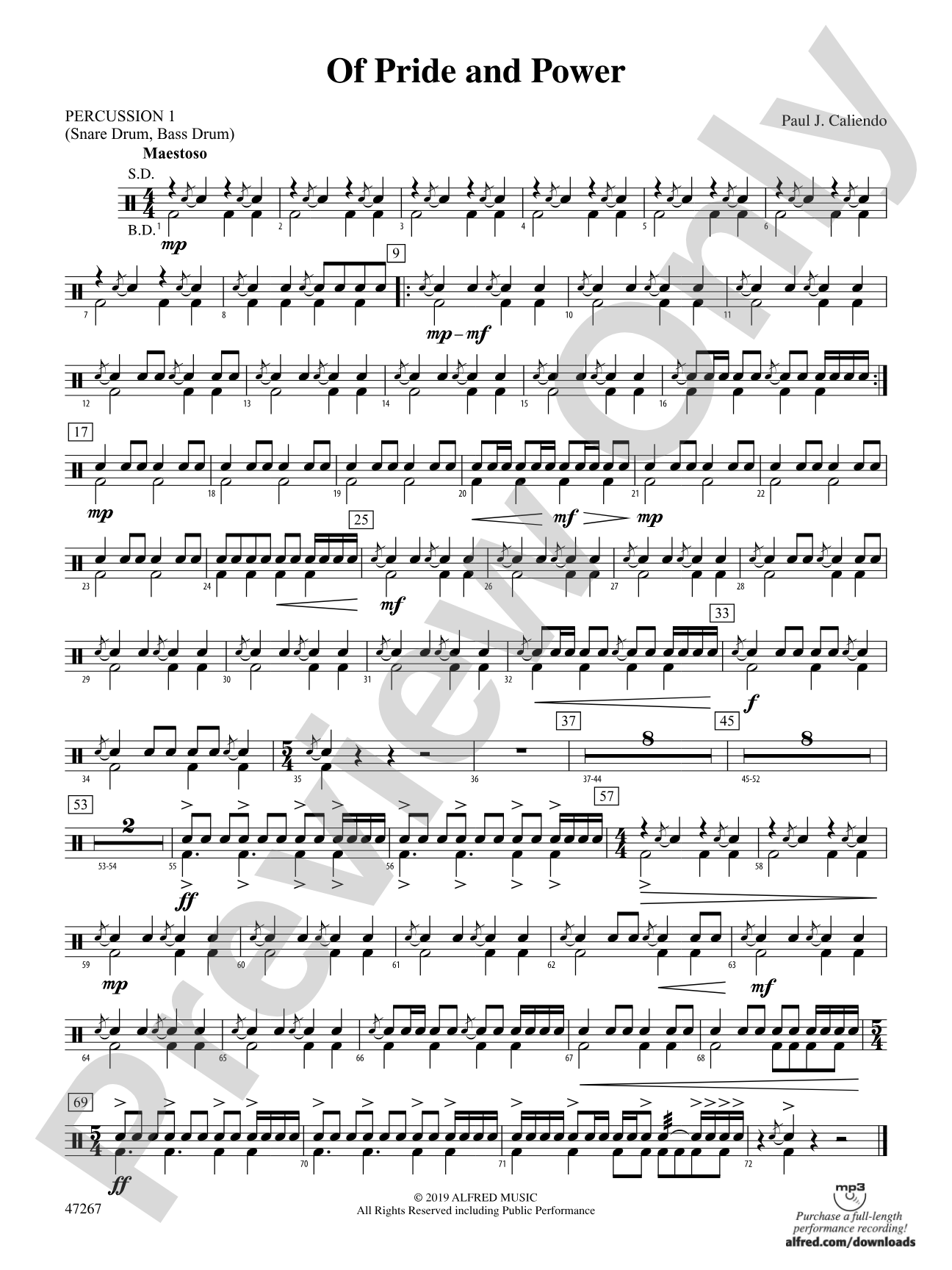
Exploring both 4/4 and 5/4 time signatures in a manner that is attainable for less experienced musicians, this piece is perfect for festivals as well as concerts and will showcase every section of the band.

Don't just read it, hear it, play along with it, and watch your students grow with it. In MakeMusic Cloud, Of Pride and Power: 1st Percussion comes alive with professional accompaniment, adjustable tempo, and built-in practice tools that turn solo practice into real progress.

Sample Audio
0:00
0:00
Sample Video
Additional Details
Series: Alfred Debut Series
Publisher: Alfred Music
Page Count: 122
SKU: 00-PC-0017881_PC1

More about this title

About the Composer: Paul J. Caliendo

Paul J. Caliendo has built a reputation as a composer deeply committed to the educational band repertoire, understanding both the technical demands and creative possibilities at each grade level. His work consistently balances musical substance with pedagogical clarity, making him a trusted voice in the Debut Series.

Why we love this

Caliendo writes with respect for where Grade 1 musicians actually are, introducing metric complexity through musical context rather than technical isolation. The orchestration ensures every section has moments to shine, so your ensemble leaves the stage feeling heard, not overwhelmed. It's the rare festival opener that teaches something real without sacrificing momentum.

What to expect

The piece radiates confidence and forward motion, moving between the grounded stability of 4/4 and the slightly asymmetrical energy of 5/4 with a sense of purpose. There's genuine virtuosity in the orchestration and phrasing, even at this entry level; the band sounds accomplished without needing to play beyond Grade 1 technique.

Who it's for

Grade 1 concert bands preparing for festival or concert programming where students are comfortable reading standard notation but need scaffolded exposure to less familiar meters. It works well for ensembles with solid fundamentals in rhythm and section balance who are ready to expand their metric vocabulary without derailing the musical narrative.

How to get the most out of it

  • Establish the pulse in 4/4 before the transition to 5/4 occurs; rehearse the modulation separately until it feels inevitable rather than jarring to the ensemble.
  • Balance the thematic material across sections during rehearsal rather than assuming the strongest players will carry the piece; mark section entrances clearly in parts so younger players aren't searching for their cues.
  • Record a full run-through at a slow tempo to let students hear the shape and harmonic movement, especially through the metric shifts, before drilling transitions.
  • Give explicit attention to the changes in note values that accompany the meter shift; what feels natural in 4/4 may feel awkward when the pulse reorganizes.

How to use it

Use this as a festival selection or early-season concert piece that demonstrates your ensemble's growth in rhythmic flexibility. It pairs well alongside more traditional Grade 1 marches or fanfares because it expands what audiences expect from newer musicians without feeling like a technical exercise.

Skills your students will build

  • Reading and performing in 5/4 time signature alongside 4/4
  • Managing meter changes and metric modulation in ensemble context
  • Following sectional balance and orchestration across full concert band instrumentation
  • Maintaining tempo and ensemble cohesion through transitions between different metric frameworks
  • Interpreting phrasing and articulation changes that accompany shifts in time signature

You May Also Like