
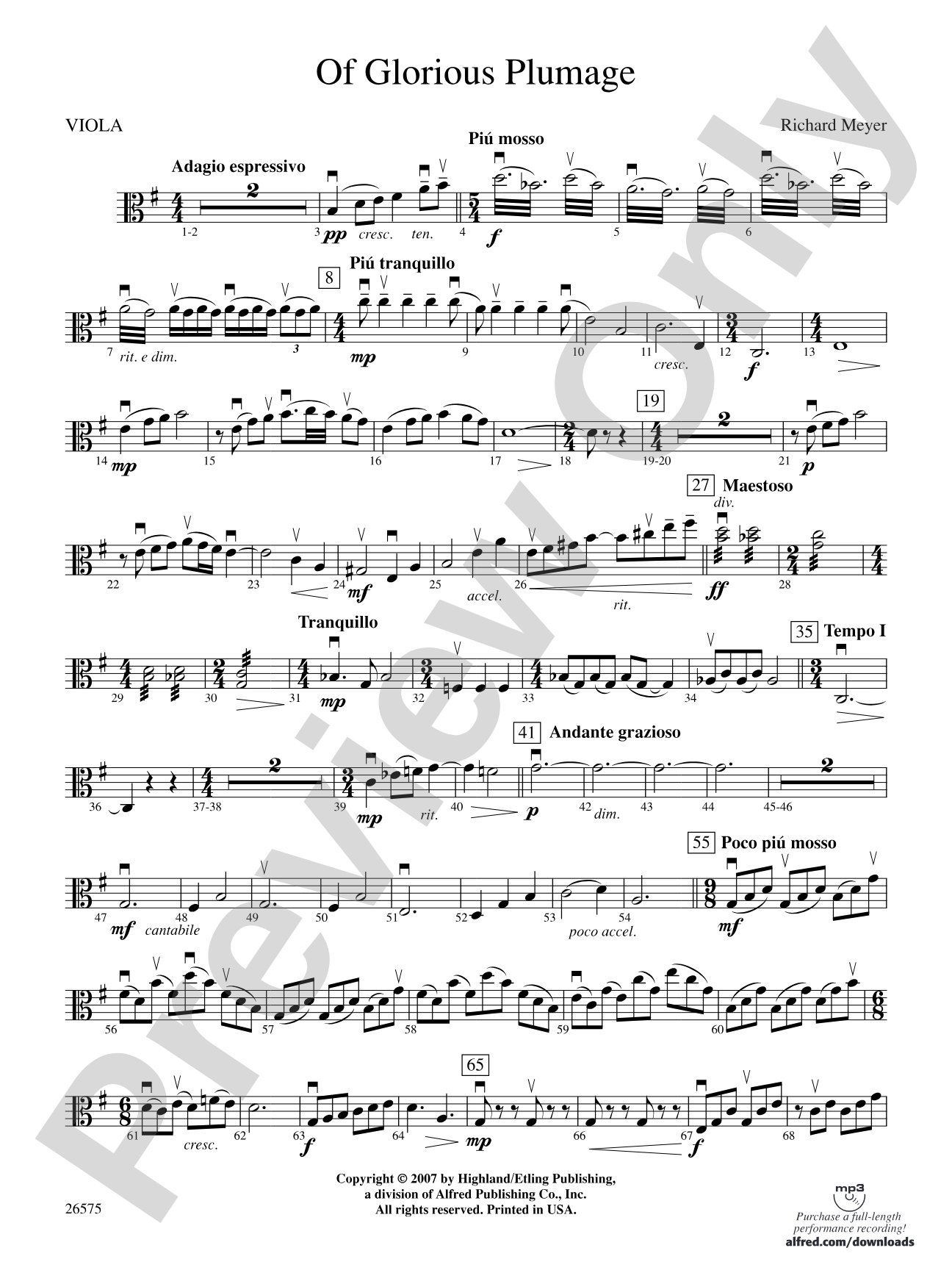

Of Glorious Plumage: Viola
By Richard Meyer
Grade: 4.5
Item: 00-PC-0001091_VA1
$5.99
Pickup currently not available
Description
A wonderful exploration of the sonorities and orchestration techniques of the French Impressionists, this mature and fascinating work is sure to be a favorite with your advanced high school string orchestra. This title is available in MakeMusic Cloud.


Don't just read it, hear it, play along with it, and watch your students grow with it. In MakeMusic Cloud, Of Glorious Plumage: Viola comes alive with professional accompaniment, adjustable tempo, and built-in practice tools that turn solo practice into real progress.
Open in the Player
Jump straight in and assign it today.
Start Your Free Trial
Open this title and explore the full library in minutes.
Sample Audio
1
Audio File
--:--
0:00
0:00
Sample Video
No sample videos found.
Additional Details
Series:
Highland/Etling String Orchestra
Publisher:
Alfred Music
Page Count:
94
SKU:
00-PC-0001091_VA1
More about this title
About the Composer: Richard Meyer

Richard Meyer spent 35 years in public school string education, teaching at elementary, middle, and high school levels. He directed orchestras at Oak Avenue Intermediate School in Temple City, California for 22 years, expanding the program from 29 students to 200, and oversaw the district's elementary string curriculum. He led the Pasadena Youth Symphony Orchestra for 16 years, taking them on concert tours across North America, Europe, and Australia.
Beyond the classroom, Meyer has become a nationally recognized composer with over 190 published works and arrangements. He served as string editor for Alfred Publishing Company for 16 years and co-authored the String Explorer Series and Sight-read It for Strings. His "Giving Bach" program, launched in 2009, uses interactive concerts to serve special needs and underserved student populations throughout Southern California. He has clinicked at the A.S.T.A. National Conference, the Texas Orchestra Directors' Association Conference, and string workshops at major universities.
Why we love this
Meyer captures the shimmering textures of French Impressionism without sacrificing the structural clarity advanced students need to feel musical progress. The orchestration choices throughout model sophisticated use of divisi, doublings, and dynamic color in ways that directly teach students what they're hearing in the concert hall. This is a work that sounds mature and refined while remaining fully accessible to a well-trained high school orchestra.
What to expect
Shimmering and luminous, with the floating quality of water catching light. The piece unfolds through layers of color and texture rather than traditional melody and accompaniment, inviting students into a more impressionistic soundworld where the journey of timbral transformation becomes the musical narrative itself.
Who it's for
Advanced high school string orchestras ready to engage with 20th century orchestration techniques and impressionistic harmonic language. Directors preparing ensembles for festival or contest performance will find a work that challenges musicianship without overwhelming technical demands.
How to get the most out of it
- Balance the divided string sections carefully during impressionistic passages; use rehearsal markings as landmarks to ensure each section's melodic line registers clearly without overpowering the whole.
- Pay attention to Meyer's dynamic markings as primary textural tools rather than volume adjustments alone. Subtle shifts between pp and mp often indicate a change in orchestration color rather than dramatic intensity.
- Record a rehearsal run-through early in your preparation and listen for transparency in the middle registers, where many of the harmonic colors sit. Adjust bow pressure and vibrato intensity across sections to enhance blend rather than blend out detail.
How to use it
This piece works beautifully in a second-half concert slot where the audience has settled in and can appreciate its subtle transformations. Pair it with earlier string repertoire (Baroque or Classical) to highlight how orchestration language evolved, or follow it with contemporary works to establish the impressionistic period as a bridge between Romantic and modern string writing.
Skills your students will build
- Recognizing and executing orchestration techniques typical of French Impressionism (parallel motion, unresolved dissonance, timbral color as structural element)
- Balancing divided string sections and managing transparency in complex textures
- Reading and responding to nuanced dynamic and articulation markings as textural instructions rather than merely expressive choices
- Sustaining ensemble focus through phrase structures that prioritize color and harmony over traditional melodic direction