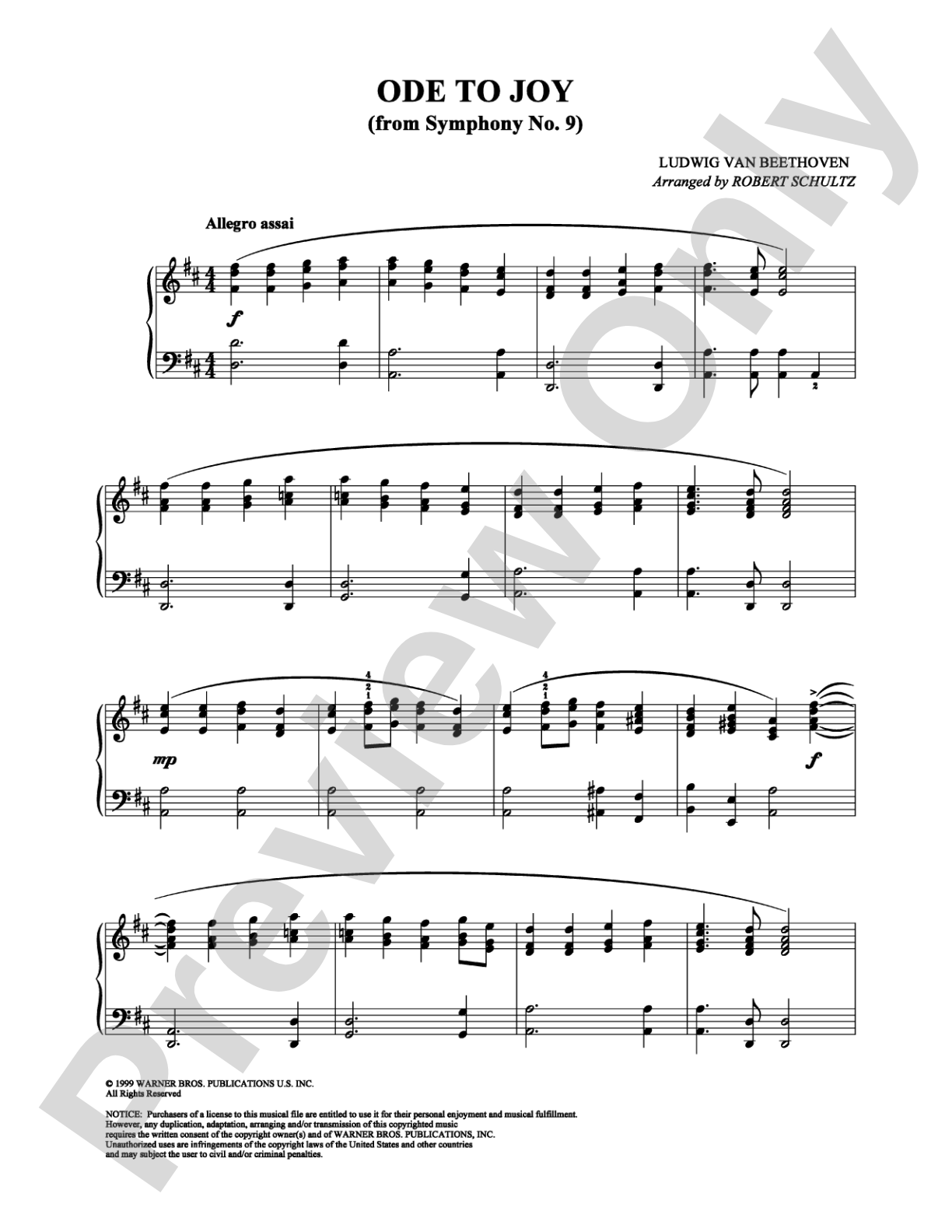
Ode to Joy (from Symphony No. 9): Easy Piano Digital Sheet Music

Ode to Joy (from Symphony No. 9): Easy Piano Digital Sheet Music

Ludwig van Beethoven

Item: 00-PS-0001544

Digital Download
$3.99
Description

Ode to Joy (from Symphony No. 9): Easy Piano Digital Sheet Music isn't in MakeMusic Cloud just yet...but it could be. Let us know you'd like to see it, and you'll help shape what comes next. In the meantime, start a free trial and dive into thousands of interactive titles your students can play along with today.

Sample Audio
No sample audio found.
Sample Video
Additional Details
SKU: 00-PS-0001544

More about this title

About the Composer: Ludwig van Beethoven

Ludwig van Beethoven (1770, 1827) stands as one of history's most influential composers, yet his later works emerged from profound deafness. His Ninth Symphony, completed in 1824, represents a watershed moment in Western music: the first time a major symphony incorporated the human voice, setting Friedrich Schiller's "Ode to Joy" to music that would become a universal anthem for human dignity and brotherhood.

Beethoven's late style broke every rule of his time. Where convention demanded predictability, he offered raw emotion and structural innovation. The "Ode to Joy" theme itself is deceptively simple, a melody so direct and memorable that it transcends the concert hall and lives in the collective memory of musicians everywhere.

Why we love this

This is the piece students recognize instantly, which means they bring genuine enthusiasm to learning it. The melody sings naturally under the hands, and the harmonic language, while grounded in Classical practice, opens doors to understanding how Beethoven moved music forward.

What to expect

Warmth, nobility, and quiet triumph. The melody has an almost hymn-like quality, moving with quiet conviction rather than flashy virtuosity. There's a sense of sharing something universal, a melody that belongs to everyone and carries the weight of that recognition.

Who it's for

Early-intermediate pianists ready to tackle a well-known classical melody with modest technical demands. Students who respond well to playing pieces they already know, and teachers looking for repertoire that builds confidence while introducing students to Beethoven's musical world.

How to get the most out of it

  • Let the melody line breathe; resist the urge to rush through this familiar tune. The beauty lies in how Beethoven's harmony supports each note, so take time to shape the phrase arc.
  • Balance the accompaniment carefully so it stays subordinate to the melody. The left hand should provide harmonic foundation without overpowering the right hand line.
  • Find a tempo that feels comfortable for your hands but maintains the celebratory character. Too slow becomes heavy; too fast loses the grandeur of the piece.
  • Practice hands separately until the fingering patterns feel automatic, then focus on unified phrasing and pedal control to blend the harmonies.

How to use it

Program this as a standalone recital piece for a student seeking meaningful repertoire, or include it in a thematic concert exploring how classical melodies continue to resonate in modern culture. It works beautifully as an encore or as part of a program celebrating classical composers alongside contemporary works.

Skills your students will build

  • Phrasing and voice leading in a melody-with-accompaniment texture
  • Balancing melodic line against supporting harmonies
  • Pedal control to blend extended harmonic progressions
  • Stylistic interpretation of Classical-era keyboard music
  • Sight-reading at the early-intermediate level

You May Also Like