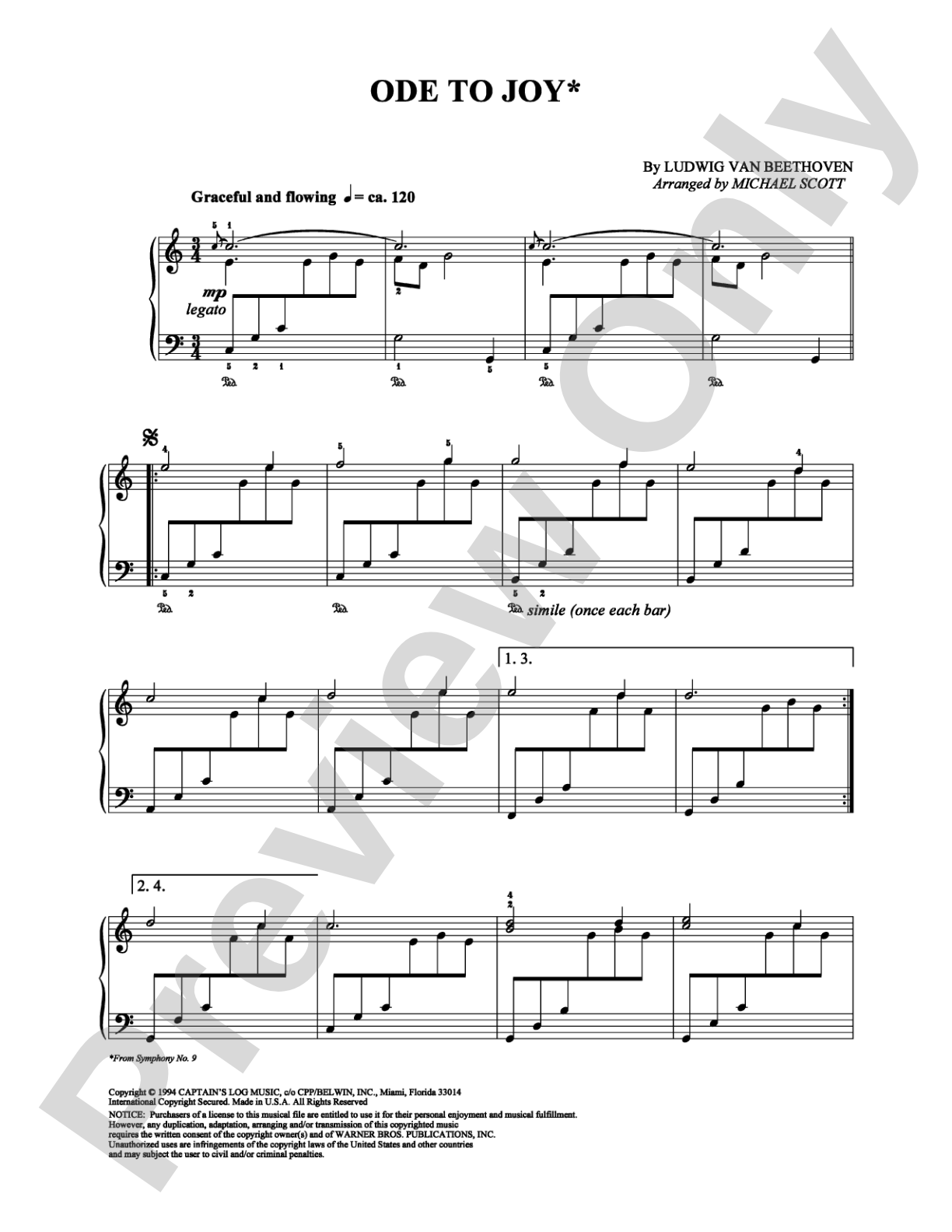
Ode to Joy (from Symphony No. 9): Piano Digital Sheet Music

Ode to Joy (from Symphony No. 9): Piano Digital Sheet Music

Ludwig van Beethoven

Item: 00-PS-0000377

Digital Download
$3.99
Description

Ode to Joy (from Symphony No. 9): Piano Digital Sheet Music isn't in MakeMusic Cloud just yet...but it could be. Let us know you'd like to see it, and you'll help shape what comes next. In the meantime, start a free trial and dive into thousands of interactive titles your students can play along with today.

Sample Audio
No sample audio found.
Sample Video
Additional Details
SKU: 00-PS-0000377

More about this title

About the Creator: Ludwig van Beethoven

Ludwig van Beethoven (1770, 1827) transformed the symphony from a courtly form into a vehicle for profound philosophical and emotional statements. His Ninth Symphony, completed near the end of his life and while profoundly deaf, stands as one of music's most ambitious works, the first symphony to incorporate a full choir and soloists into its finale.

The fourth movement's "Ode to Joy" setting of Friedrich Schiller's poem became a global anthem for unity and human dignity. Beethoven's genius lies not just in the melody itself, but in how he builds it from simple phrase to overwhelming collective affirmation, making it one of the most recognizable and emotionally resonant moments in all of classical music.

Why we love this

This excerpt gives students direct access to one of humanity's most celebrated melodies without requiring them to navigate the full symphony's complexity. The piano arrangement preserves the harmonic richness that makes Beethoven's orchestration so powerful, and the piece works equally well as a concert closer, a teaching tool for discussing classical form, or a gateway into larger repertoire.

What to expect

Luminous and hopeful. The melody unfolds with the simplicity of a folk tune, yet each iteration grows in complexity and warmth, building toward something transcendent. There's an unmistakable sense of collective joy emerging from humble beginnings.

Who it's for

Piano students working at early-intermediate to intermediate levels will find an accessible yet musically substantive arrangement. This is equally useful for adult learners exploring classical masterworks and for young pianists building familiarity with the core concert repertoire.

How to get the most out of it

  • Shape the melody with gentle dynamic swells rather than playing it flat; even at a moderate volume, the line should breathe like a singer.
  • Allow the accompaniment to sit slightly beneath the melodic voice so the "Ode to Joy" tune remains the clear focal point.
  • Resist the urge to rush the tempo as excitement builds; Beethoven's power comes from structural inevitability, not speed.

How to use it

Position this as an encore or closing piece on a recital to leave audiences with a familiar, uplifting final image. It also works beautifully on a program exploring "Themes in History" or "Music and Words," where you can pair it with discussion of Schiller's text and Beethoven's vision of universal brotherhood.

Skills your students will build

  • Balancing melody and accompaniment texture
  • Shaping long musical lines with appropriate phrasing and dynamics
  • Recognizing harmonic movement and functional harmony in Classical style
  • Playing with independence between hands in varied rhythmic contexts

You May Also Like