
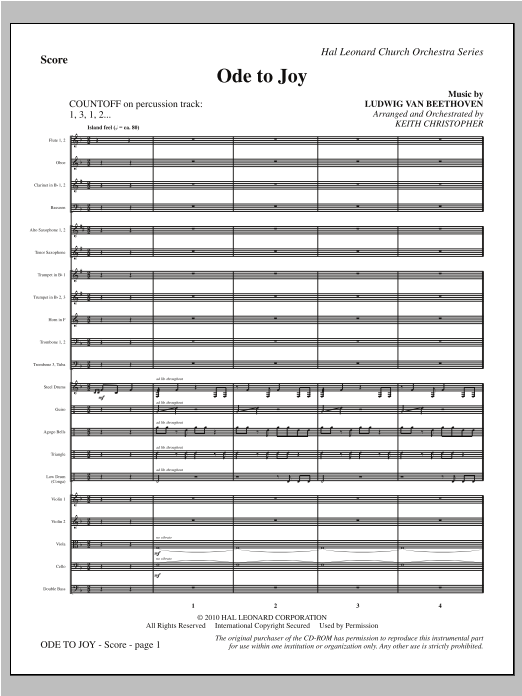

Ode To Joy (Does Not Match SATB 08752035): Choral Instrumental Pak
As performed by Ludwig Van Beethoven / Arranged by Keith Christopher
Item: 35-PK00254853
$65.00
Pickup currently not available
Buy Extra Parts (Digital PDF Download)
Parts Added to Cart!
Description
Here is an exciting instrumental arrangement based on the popular anthem of the same title. Rhythmic figures and harmonic turns will make this fun for players in every section of the orchestra. Duration: ca. 2:30.
NOTE: This work is a stand-alone orchestra arrangement, and is not compatible with the choral arrangement.


Ode To Joy (Does Not Match SATB 08752035): Choral Instrumental Pak isn't in MakeMusic Cloud just yet...but it could be. Let us know you'd like to see it, and you'll help shape what comes next. In the meantime, start a free trial and dive into thousands of interactive titles your students can play along with today.
Request This Title
Tell us you want it.
Start Your Free Trial
Explore everything that's ready to play right now.
Sample Audio
No sample audio found.
Sample Video
No sample videos found.
Additional Details
Publisher:
Hal Leonard
SKU:
35-PK00254853
More about this title
About the Artist: Ludwig Van Beethoven
Ludwig van Beethoven (1770–1827) fundamentally redefined what composers could accomplish with instrumental forces. His nine symphonies alone represent a seismic shift in orchestral thinking, moving from the classical balance of Mozart toward something more expansive, more emotionally direct, and more demanding of every player. The final movement of his Ninth Symphony (1824), which contains this "Ode to Joy" melody, stands as one of the most ambitious choral-orchestral statements in Western music.
For music educators, Beethoven matters because his works insist that players and singers take themselves seriously. He writes for orchestras not as accompanists to singers but as equal partners in meaning-making. Even in a simplified or arranged version, his harmonic logic and rhythmic drive challenge musicians to think beyond the notes and engage with architecture.
Why we love this
This arrangement captures the architectural strength of Beethoven's melody without requiring a massive ensemble or professional soloists. Keith Christopher has crafted writing that gives meaningful material to every section of the orchestra, so no one is marking time while others carry the load. The result is a piece that sounds substantial and celebratory, yet remains accessible enough for young to intermediate players.
What to expect
Dignified and radiant. There's a formal elegance in the harmonic movement, yet the writing generates genuine warmth and forward motion. Players in every section will feel the piece propel them; no one is stuck in a purely accompanimental role, and the orchestration sparkles with color.
Who it's for
Orchestra programs at the middle through early high school level, or any mixed ensemble that wants to program a recognizable, uplifting work without the complexity of a full-length symphony. It works equally well as a concert opener or closing piece, and fits naturally into programs pairing classical masterworks with contemporary compositions.
How to get the most out of it
- Balance the melody carefully when it shifts between sections. The harmonic turns can easily obscure the tune if inner voices aren't controlled for transparency.
- Establish a steady tempo early in sectional rehearsals. The rhythmic figures will feel looser and less driving if you let the tempo breathe too much, especially in accompaniment parts.
- Shape the overall arc across the full 2:30 duration. This melody famously builds momentum; resist the urge to treat it as static and allow the arrangement to gain energy toward its conclusion.
How to use it
Use this as a standalone concert feature that gives your orchestra a moment of triumph without derailing your pacing. It works especially well sandwiched between more contemporary or experimental pieces, or as the final number before intermission to send the audience out energized. The 2:30 duration makes it a lean, effective programming choice for a mixed concert.
Skills your students will build
- Maintaining clarity within dense harmonic textures
- Phrase shaping across an unfamiliar harmonic language
- Rhythmic coordination within a traditional tonal framework
- Balancing melody against supporting figures
- Sustaining ensemble cohesion through key areas and harmonic turns