Ode To Joy (arr. Paul Mealor) Sheet Music Preview

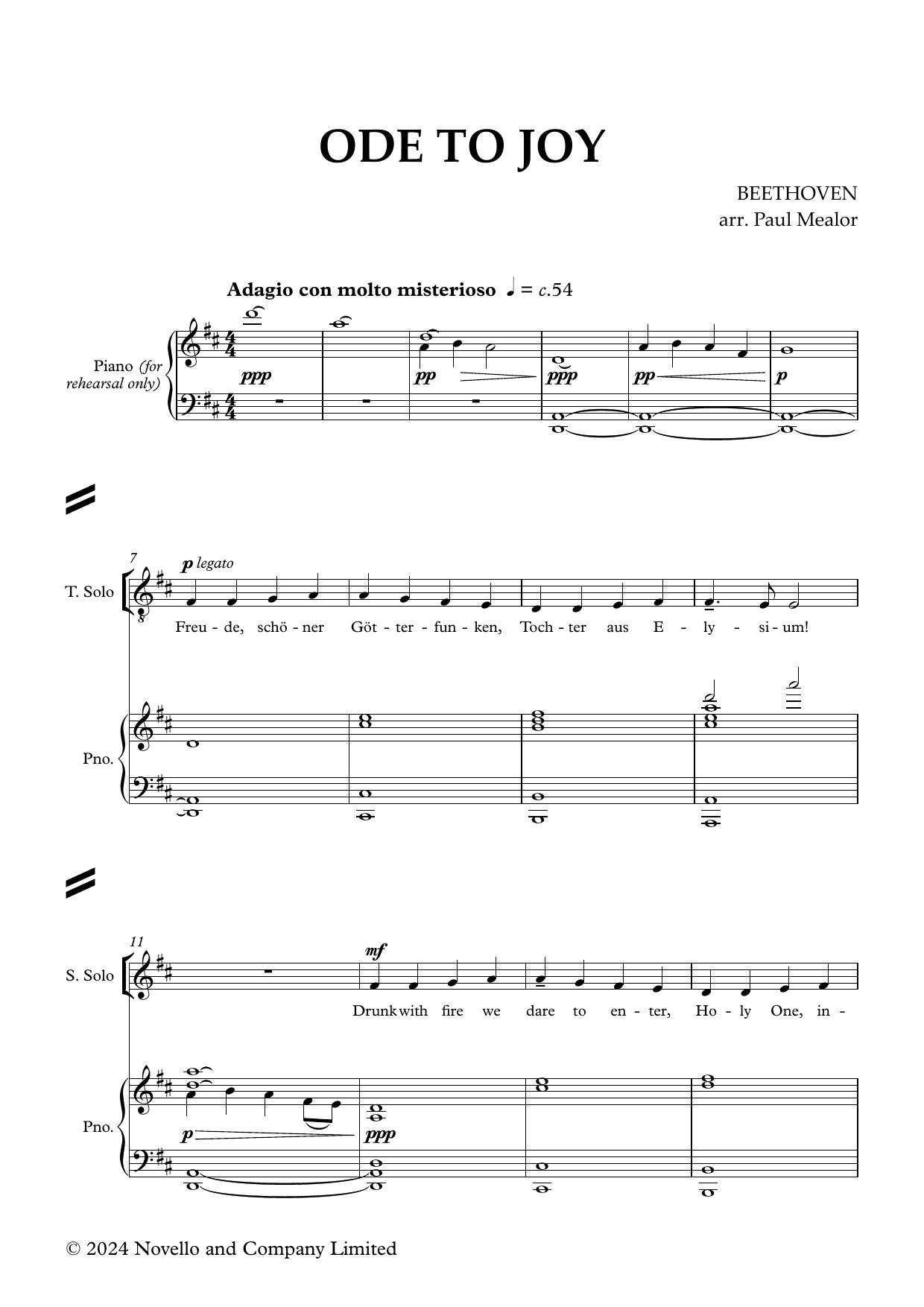
Ode To Joy (arr. Paul Mealor): SATB Choral Octavo

By Ludwig Van Beethoven / Arranged by Paul Mealor

Item: 35-DS01487944

Digital Download
$7.95
Description

Ode To Joy (arr. Paul Mealor): SATB Choral Octavo isn't in MakeMusic Cloud just yet...but it could be. Let us know you'd like to see it, and you'll help shape what comes next. In the meantime, start a free trial and dive into thousands of interactive titles your students can play along with today.

Sample Audio
No sample audio found.
Sample Video
Additional Details
Publisher: Hal Leonard
Page Count: 34
SKU: 35-DS01487944

More about this title

About the Composer: Ludwig Van Beethoven

Ludwig van Beethoven (1770–1827) stands as the bridge between Classical and Romantic musical traditions, and his work fundamentally shaped how composers approached both form and emotional expression. His late symphonies and choral works remain central to music education because they demand serious musicianship while rewarding singers with some of the most affirming melodies ever written.

Why we love this

Paul Mealor's arrangement respects the iconic melody while crafting a setting that sits comfortably for community and school choirs. This version gives you a piece that carries genuine weight and recognition without requiring the operatic demands of the original symphony, making it an ideal anchor for concerts where you want both accessibility and substance.

What to expect

There's an undeniable warmth and humanity in this melody; singers feel the joy they're communicating rather than merely executing notes. Mealor's arrangement preserves that directness while adding harmonic color that lets the singers experience themselves as part of something larger and more textured than the melody alone.

Who it's for

This setting works for intermediate to advanced choirs seeking a crowd-pleasing centerpiece that doesn't condescend to the singers' abilities. It suits school choirs, community ensembles, and church programs where you need a piece that's instantly recognizable yet requires genuine musicianship to perform well.

How to get the most out of it

  • Shape the opening phrases with a slight lift at bar endings to avoid the melody feeling static; the simplicity of the tune rewards subtle phrasing work.
  • Balance the lower voices carefully during harmonic passages so sopranos and altos aren't forced into an uncomfortable register to be heard.
  • Invest rehearsal time in ensemble precision during unison or octave doublings; even small rhythmic lag will undermine the clarity of this transparent texture.
  • Treat the dynamic arc as a journey rather than peaks and valleys; build gradually and allow the piece to breathe at its natural resting points.

How to use it

Reserve this for closing moments where you want an emotional resolution and audience connection. It pairs naturally with other 19th century choral literature or stands alone as a concert finale; the piece's inherent optimism makes it an excellent bookend after more introspective repertoire.

Skills your students will build

  • Sustaining legit tone across longer phrases without breathiness or tension
  • Balancing four-part harmony while maintaining line independence
  • Responding to subtle dynamic shaping in predominantly forte or mezzo-forte ranges
  • Coordinating ensemble entrances and releases with precision in SATB texture

You May Also Like