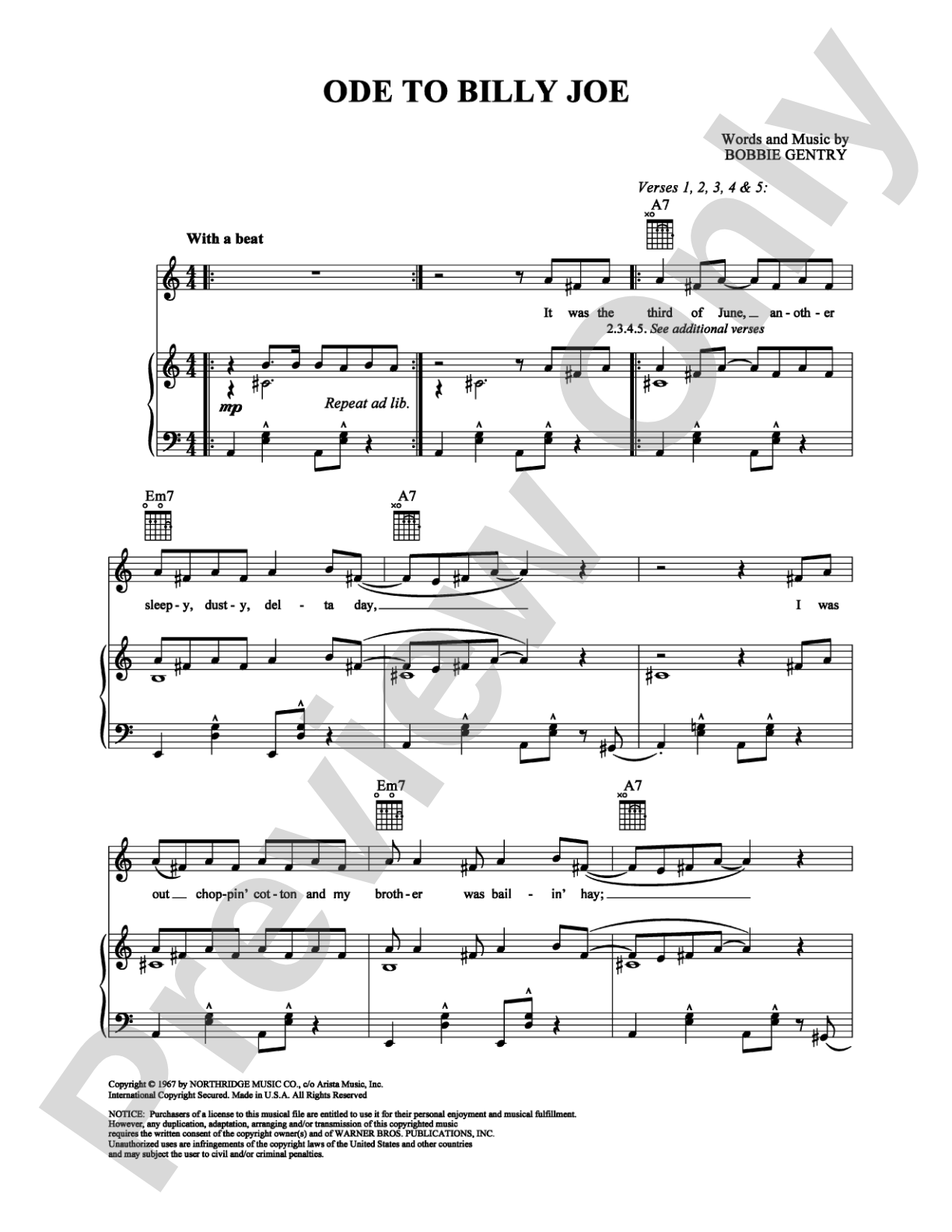
Ode To Billy Joe: Piano/Vocal/Chords Digital Sheet Music

Ode To Billy Joe: Piano/Vocal/Chords Digital Sheet Music

Bobbie Gentry

Item: 00-PS-0007455

Digital Download
$2.95
Description

Ode To Billy Joe: Piano/Vocal/Chords Digital Sheet Music isn't in MakeMusic Cloud just yet...but it could be. Let us know you'd like to see it, and you'll help shape what comes next. In the meantime, start a free trial and dive into thousands of interactive titles your students can play along with today.

Sample Audio
No sample audio found.
Sample Video
Additional Details
SKU: 00-PS-0007455

More about this title

About the Artist: Bobbie Gentry

Bobbie Gentry's 1967 debut single "Ode to Billie Joe" became a cultural phenomenon, reaching number one on the Billboard Hot 100 and winning a Grammy Award. The song's mysterious narrative and Southern Gothic storytelling set it apart from typical pop radio fare of the era, establishing Gentry as both a songwriter and performer of uncommon depth.

Gentry released five albums throughout the late 1960s and early 1970s before stepping back from the music industry at the height of her commercial success. Her influence on narrative songwriting in country and pop music remains significant, and her work continues to inspire musicians interested in storytelling beyond the conventional love song.

Why we love this

This piano/vocal arrangement captures the haunting, conversational quality that made the original recording unforgettable. The song's ability to sustain listener attention through lyrical mystery rather than melodic hooks makes it an excellent teaching tool for students learning how to serve the story in a song, and programming it alongside more conventional pop standards creates compelling contrast in a recital or showcase.

What to expect

The piece settles into a minor-key melancholy that unfolds gradually, drawing the listener into a private, almost whispered conversation. There's an undercurrent of unease beneath the surface calm, building tension through seemingly simple lyrics until the final lines reveal their emotional weight.

Who it's for

This arrangement works for pianists and singers at the upper intermediate level who can handle nuanced interpretation and aren't intimidated by a lyric that asks for storytelling rather than technical display. It's ideal for students exploring how to perform songs that prioritize emotional authenticity over flashy technique.

How to get the most out of it

  • Treat the vocal line as narrative speech that happens to be sung; avoid over-embellishing or forcing the melody into a rhythmic grid that doesn't match natural speech phrasing.
  • The piano accompaniment should sit quietly beneath the voice rather than compete for attention; let the chord progression support the mood without drawing focus away from the lyric.
  • Pay attention to the dynamic arc of the story itself: the opening verse should feel conversational and almost casual before the emotional weight builds toward the chorus and final revelation.
  • Experiment with rubato in the vocal line to emphasize moments of tension or uncertainty in the narrative, but keep the piano part steady enough that the underlying harmonic movement stays clear.

How to use it

This works beautifully in a recital that pairs 1960s-70s singer-songwriter material with other narrative-driven songs, or as a standalone solo that demonstrates a student's ability to convey mood and story through restrained performance. It also pairs well with other Bobbie Gentry compositions or similar era country-pop crossover material for a thematic program exploring Southern voices in popular music.

Skills your students will build

  • Narrative interpretation and emotional storytelling in song
  • Handling rubato and flexible phrasing while maintaining harmonic clarity
  • Balance between voice and piano accompaniment
  • Sustaining listener engagement through lyrical content rather than melody alone

You May Also Like