
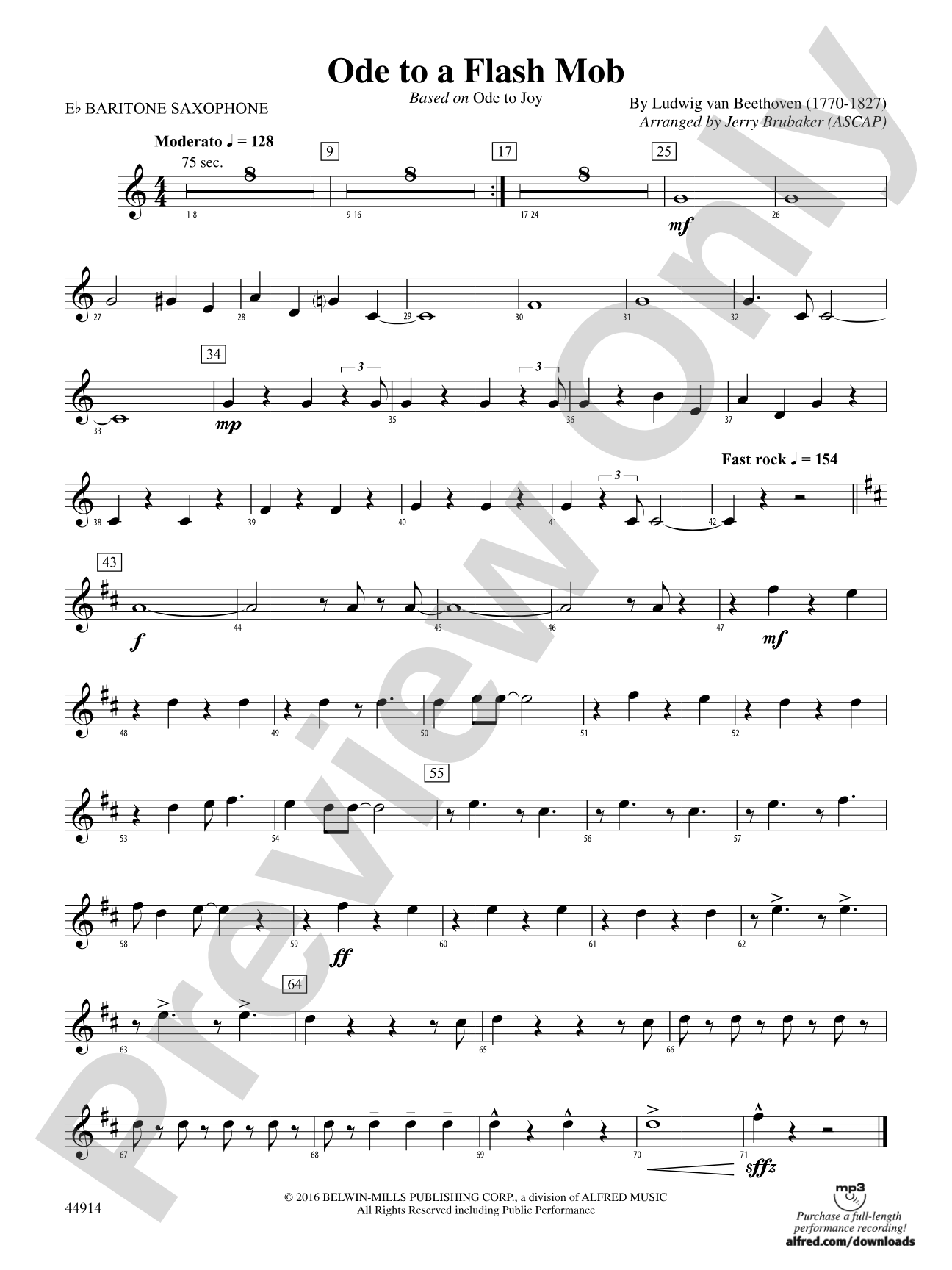

Ode to a Flash Mob: E-flat Baritone Saxophone
Based on "Ode to Joy"
By Ludwig van Beethoven / arr. Jerry Brubaker
Grade: 2.5 (Easy to Medium Easy)
Item: 00-PC-0017405_BTX
$3.00
Pickup currently not available
Description
We've all seen the YouTube videos---now your band can experience the excitement of a flash mob, either as part of one of your regular concerts or by actually creating a flash mob in your local park on a spring day! Capturing the power and beauty of Beethoven's familiar "Ode to Joy," this outstanding arrangement will have your audiences dancing in the street! (2:30)


Don't just read it, hear it, play along with it, and watch your students grow with it. In MakeMusic Cloud, Ode to a Flash Mob: E-flat Baritone Saxophone comes alive with professional accompaniment, adjustable tempo, and built-in practice tools that turn solo practice into real progress.
Open in the Player
Jump straight in and assign it today.
Start Your Free Trial
Open this title and explore the full library in minutes.
Sample Audio
1
Audio File
--:--
0:00
0:00
Sample Video
Additional Details
Series:
Belwin Young Band
Publisher:
Alfred Music
Page Count:
144
SKU:
00-PC-0017405_BTX
More about this title
About the Composer: Ludwig van Beethoven
Ludwig van Beethoven (1770-1827) stands as one of the pivotal figures in Western classical music, bridging the Classical and Romantic periods through works of unprecedented emotional depth and structural innovation. A deaf composer who communicated through conversation books in his final decades, Beethoven fundamentally transformed what symphonic and instrumental music could express, moving beyond the refined courtly styles of his predecessors to embrace heroic struggle, universal human themes, and unbridled joy.
His Ninth Symphony, which concludes with "Ode to Joy," remains one of the most recognizable and performed pieces in classical music. The text from Schiller's "Ode to Joy" celebrates brotherhood and unity across humanity, making this melody a natural choice for celebrations, commemorations, and moments of collective triumph. For music educators, Beethoven's work offers repertoire that connects students to profound musical and philosophical traditions while remaining accessible across skill levels.
Why we love this
Jerry Brubaker captures everything that makes "Ode to Joy" resonate with audiences while crafting an arrangement that works brilliantly at Grade 2.5: the melody remains clear and singable, the harmonic support is straightforward without feeling thin, and the instrumentation invites every section to contribute meaningfully. The flash mob concept transforms this from a standard concert arrangement into an experience that can genuinely excite your students and your community, whether performed on stage or staged outdoors.
What to expect
Joyful and energetic, with the infectious pull of a melody everyone knows. The piece builds from intimate passages to a jubilant, full-band celebration of Beethoven's most universally loved theme, capturing the spontaneity and delight that make flash mobs so captivating.
Who it's for
Concert bands at the intermediate level (Grade 2-2.5) who want engaging repertoire that works equally well in a traditional concert or as a community flash mob experience. This arrangement connects strongly with student musicians who respond to contemporary contexts and with audiences who recognize this timeless melody.
How to get the most out of it
- Establish a rock-solid pulse in the opening sections; this arrangement relies on rhythmic precision and forward motion to capture the flash mob energy.
- Balance the melody across your ensemble once multiple sections begin playing "Ode to Joy" together, as thickness can obscure Brubaker's countermelodic ideas.
- Rehearse the final climactic sections with particular attention to rhythmic alignment and dynamic control; the piece builds to an exciting peak that requires ensemble unity.
- If performing as an actual flash mob, drill the opening cue and entry points extensively so musicians can execute cleanly without a visible conductor.
How to use it
Program this as a concert closer on a spring or early summer concert, where the celebratory energy and outdoor-performance concept feel seasonally appropriate. It also works as a standalone community engagement event: rehearse the flash mob scenario with your band, choose a local public space, and execute it as a surprise performance that invites onlookers to witness something unexpected and joyful.
Skills your students will build
- Playing clearly and independently while other sections carry the melody
- Maintaining steady tempo and rhythmic precision in a high-energy ensemble setting
- Balancing dynamics across the ensemble to support (not bury) the main melodic line
- Performing with confidence and musicality in non-concert-hall environments
- Interpreting a familiar melody in a fresh arrangement while respecting its identity