
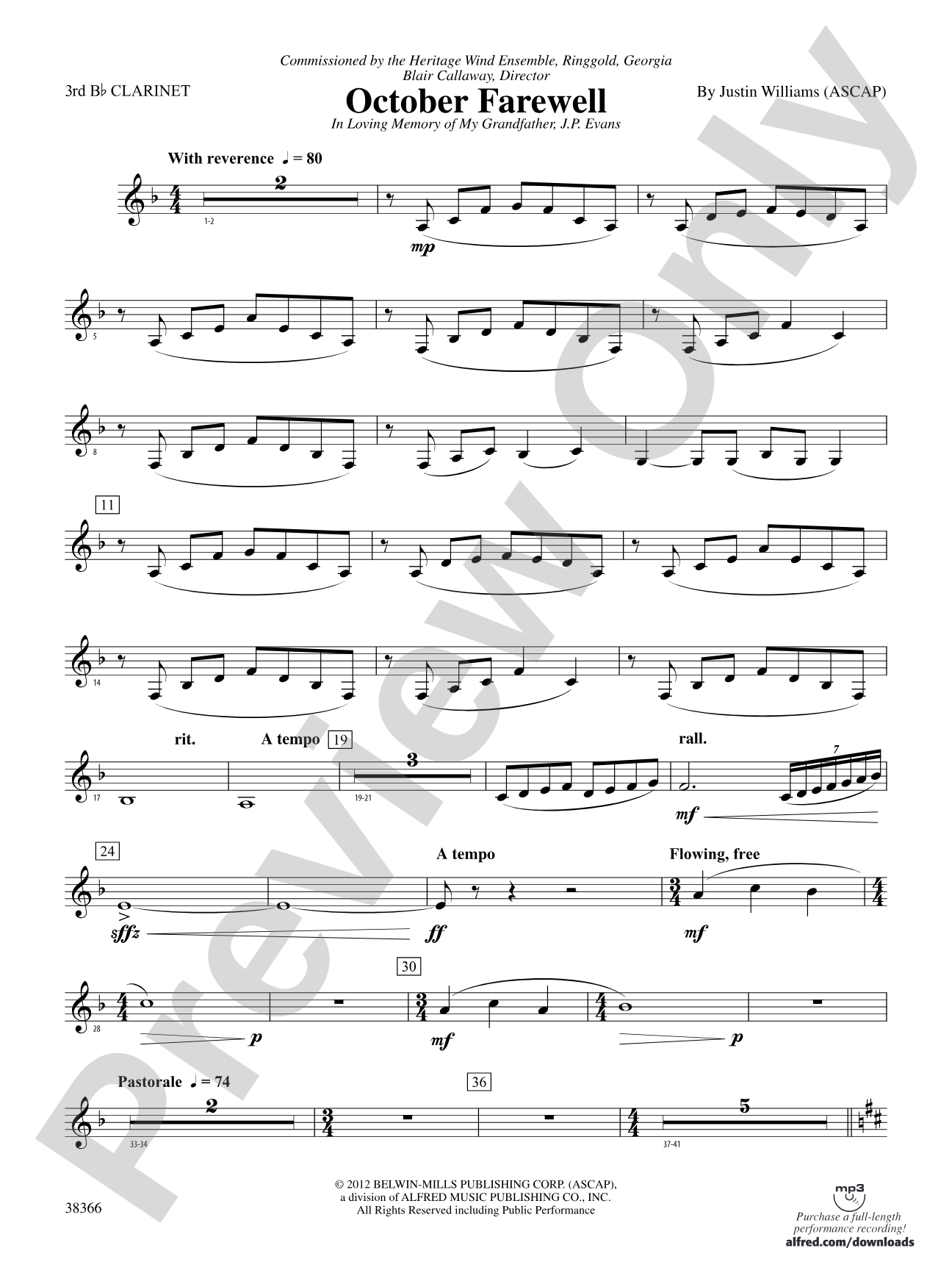

October Farewell: 3rd B-flat Clarinet
By Justin Williams
Grade: 3 (Medium Easy)
Item: 00-PC-0015452_C3
$3.00
Pickup currently not available
Description
A must listen! Written as a memorial piece for the composer's grandfather, this gorgeous and emotional new work features tender melodies that blend with tasteful solos and warm textures in a piece that explores the emotions experienced when a loved one is lost: sadness, grief, acceptance, and hope. Your players and listeners alike will surely be moved by this beautiful new addition to the concert band library. Emotional and moving! (4:00) This title is available in MakeMusic Cloud.


Don't just read it, hear it, play along with it, and watch your students grow with it. In MakeMusic Cloud, October Farewell: 3rd B-flat Clarinet comes alive with professional accompaniment, adjustable tempo, and built-in practice tools that turn solo practice into real progress.
Open in the Player
Jump straight in and assign it today.
Start Your Free Trial
Open this title and explore the full library in minutes.
Sample Audio
1
Audio File
--:--
0:00
0:00
Sample Video
No sample videos found.
Additional Details
Series:
Belwin Concert Band
Publisher:
Alfred Music
Page Count:
180
SKU:
00-PC-0015452_C3
More about this title
About the Composer: Justin Williams

Justin Williams earned a Bachelor of Arts degree with special honors in Political Science and a music minor from Jacksonville State University, then completed a Master of Arts in History at the same institution. His compositional and arranging training came through private study with Dr. William Jerryl Davis, Patrick Roszell, and Robert W. Smith. Williams maintains an active presence in the marching arts as staff arranger for Jacksonville State University's "Marching Southerners" and the University of Louisiana at Lafayette's "Pride of Acadiana" Marching Band, and his work has appeared in bowl game halftime shows, BCS championship productions, the Rose Bowl Parade, Macy's Thanksgiving Day Parade, and the Lord Mayor's New Year's Day Parade in London.
Beyond his arranging work, Williams serves as program consultant for over thirty high school band programs nationwide and holds a position as staff arranger for the Belwin Division of Alfred Music. He teaches history and political science at Central Alabama Community College in Talladega while continuing to compose and arrange. Williams resides in Oxford, Alabama with his wife, Alicia.
Why we love this
October Farewell succeeds because it trusts the maturity of Grade 3 players to hold genuine emotional weight without relying on bombast or complexity. The balance of tender melodies with strategic solos creates opportunities for your musicians to find individual voice within a cohesive whole, and the arc from sorrow to acceptance gives your concert a meaningful thematic arc that audiences remember long after the final chord.
What to expect
October Farewell unfolds like an intimate conversation about loss. Tender, warm melodic ideas arrive unhurried; tasteful solos emerge as if sharing personal memory. The piece doesn't dwell in darkness but rather charts a course from grief toward quiet acceptance and cautious hope, creating a space where both performers and listeners can sit with complicated feelings.
Who it's for
This work speaks to conductors seeking a Grade 3 piece with genuine emotional substance that doesn't require virtuosic playing to move an audience. It works equally well for concert and festival contexts, and pairs beautifully with programs exploring themes of reflection, remembrance, or growth.
How to get the most out of it
- Bring out the solo voices with careful balance; these moments carry the narrative and deserve space to sing over the ensemble texture.
- Shape the longer melodic lines with subtle dynamic peaks rather than sudden swells; the piece's power lies in restraint and legit phrasing.
- Attend closely to the warm harmonic colors Williams uses to support the main ideas; these aren't background but essential to the emotional landscape.
- Allow for slight flexibility in tempo during transitional moments to let the emotional journey breathe naturally.
How to use it
Program this as a centerpiece on a concert devoted to emotional storytelling, or use it as a transitional moment between higher-energy works to deepen the listening experience. Its four-minute length and Grade 3 accessibility make it an excellent festival choice, while its memorial nature also suits spring or fall concerts that mark reflection or seasonal change.
Skills your students will build
- Sustaining warm, legit tone across longer phrases
- Balance and blend within sectional and full ensemble textures
- Responding to subtle dynamic and tempo changes that serve emotional phrasing
- Listening for and supporting solo voices without dominating the ensemble