
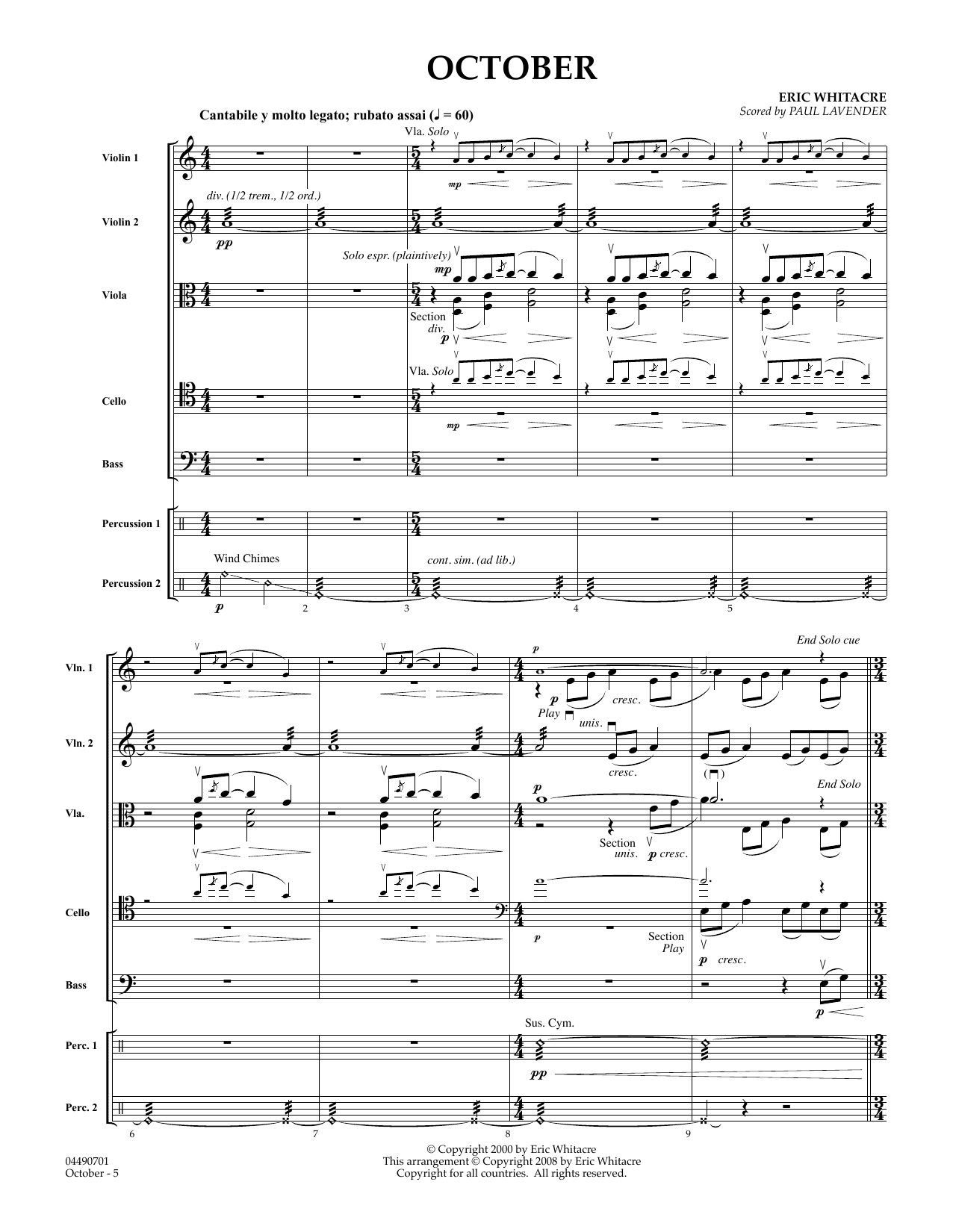

October (arr. Paul Lavender): String Orchestra Conductor Score & Parts
By Eric Whitacre / Arranged by Paul Lavender
Grade: 3-4
Item: 35-PK00402183
$85.00
Pickup currently not available
Buy Extra Parts (Digital PDF Download)
| Product | Price | Quantity |
|---|---|---|
| October - Full Score (arr. Paul Lavender) | $15.00 | |
| October - Violin 1 (arr. Paul Lavender) | $6.99 | |
| October - Violin 2 (arr. Paul Lavender) | $6.99 | |
| October - Viola (arr. Paul Lavender) | $6.99 | |
| October - Cello (arr. Paul Lavender) | $6.99 | |
| October - Bass (arr. Paul Lavender) | $6.99 | |
| October - Percussion 1 (arr. Paul Lavender) | $6.99 | |
| October - Percussion 2 (arr. Paul Lavender) | $6.99 |
Parts Added to Cart!
Description
The continuing popularity of Eric Whitacre's dramatic and evocative music is evident in concert programming everywhere, with his symphonic, choral, and operatic works. "October" is arguably his most notable symphonic work, now adapted in this stunning version for strings.


October (arr. Paul Lavender): String Orchestra Conductor Score & Parts isn't in MakeMusic Cloud just yet...but it could be. Let us know you'd like to see it, and you'll help shape what comes next. In the meantime, start a free trial and dive into thousands of interactive titles your students can play along with today.
Request This Title
Tell us you want it.
Start Your Free Trial
Explore everything that's ready to play right now.
Sample Audio
No sample audio found.
Sample Video
No sample videos found.
Additional Details
Publisher:
Hal Leonard
SKU:
35-PK00402183
More about this title
About the Composer: Eric Whitacre
Eric Whitacre stands among the most frequently performed contemporary composers in concert halls worldwide. His gift for writing lyrical, emotionally direct music has earned him a devoted following among performers and audiences alike, from professional orchestras to school ensembles.
Whitacre's compositional voice emphasizes accessibility without sacrificing depth. His works balance contemporary harmonic language with memorable melodic content, making his scores valuable resources for developing musicians who benefit from engaging with living composers of genuine artistic substance.
Why we love this
October showcases Whitacre's mastery of orchestral color and dramatic arc in a work that translates beautifully to the string orchestra setting. Paul Lavender's arrangement preserves the emotional core of the original while crafting writing that sits comfortably for developing string players, giving your ensemble access to a piece that feels substantial without requiring the resources of a full orchestra.
What to expect
October inhabits a reflective, sometimes turbulent emotional space. The music ebbs and flows with introspective moments alongside passages of genuine intensity, creating a sense of watching weather patterns shift across an autumn landscape. String voices weave together with transparency and warmth, inviting listeners into an intimate but dramatically engaging soundscape.
Who it's for
String orchestras at the intermediate level looking for contemporary repertoire with genuine artistic merit. Ensembles ready to tackle pieces that demand expressive maturity and attention to blend will find October rewarding; it works equally well for high school orchestras seeking concert material or advanced middle school groups aiming to connect with music by living composers.
How to get the most out of it
- Establish the underlying pulse in your early rehearsals before worrying about phrasing details; the piece's emotional power depends on secure ensemble rhythm, particularly in the more static harmonic passages.
- Balance the distribution of primary material among your sections carefully. In a Grade 3 arrangement, one weak voice part can undermine the overall sonority, so ensure every player understands their voice's importance to the texture.
- Give careful attention to the transition points and climactic moments. These sections often require coordinated dynamic shifts across all parts; mark them clearly and rehearse them separately if needed.
- Explore the recording with your students before ensemble rehearsals begin. Hearing Whitacre's original orchestration gives them a clear sense of the music's intention and helps them understand where their individual part fits within the larger emotional narrative.
How to use it
Position October as a centerpiece for a concert focused on contemporary voices, pairing it with other modern works to contextualize Whitacre's compositional language. The piece also works beautifully in a spring concert as a reflective counterpoint to more energetic selections, or as the climax of a concert built around seasonal themes.
Skills your students will build
- Sustaining long lines with consistent tone and dynamic control
- Balancing textural clarity when multiple melodic layers occupy the same register
- Responding to subtle harmonic movement in contemporary tonal contexts
- Coordinating ensemble dynamics and phrasing across four or five-part string texture
- Building expressive interpretation in music with minimal tempo variation