
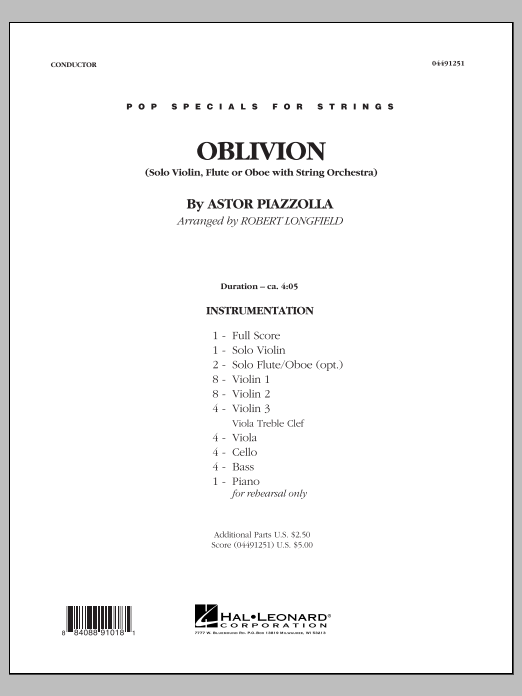

Oblivion: String Orchestra Conductor Score & Parts
Arranged by Robert Longfield
Grade: 3-4
Item: 35-PK00276898
$50.00
Pickup currently not available
Buy Extra Parts (Digital PDF Download)
| Product | Price | Quantity |
|---|---|---|
| Oblivion - Conductor Score (Full Score) | $7.50 | |
| Oblivion - Solo Violin | $7.00 | |
| Oblivion - Solo Flute/Oboe | $7.00 | |
| Oblivion - Violin 1 | $7.00 | |
| Oblivion - Violin 2 | $7.00 | |
| Oblivion - Violin 3 (Viola Treble Clef) | $7.00 | |
| Oblivion - Viola | $7.00 | |
| Oblivion - Cello | $7.00 | |
| Oblivion - Bass | $7.00 | |
| Oblivion - Piano | $7.00 |
Parts Added to Cart!
Description
Arranged here for flexible soloist and strings, this haunting melody from Argentine tango composer Astor Piazzolla provides an impressive showcase for a violin, flute, or oboe soloist. Beautifully scored for string orchestra and carefully paced. Dur: 4:05


Oblivion: String Orchestra Conductor Score & Parts isn't in MakeMusic Cloud just yet...but it could be. Let us know you'd like to see it, and you'll help shape what comes next. In the meantime, start a free trial and dive into thousands of interactive titles your students can play along with today.
Request This Title
Tell us you want it.
Start Your Free Trial
Explore everything that's ready to play right now.
Sample Audio
No sample audio found.
Sample Video
No sample videos found.
Additional Details
Publisher:
Hal Leonard
SKU:
35-PK00276898
More about this title
Why we love this
Longfield captures the hypnotic pull of Piazzolla's tango without drowning the orchestra in period arrangement clichés. The solo part can float over strings on any of three instruments, which solves real scheduling problems while keeping the writing vocally satisfying for each option. Most importantly, it sits at exactly the grade level where students can execute the harmonic sophistication without drowning in technical demands.
What to expect
Austere and introspective, with the melancholy that defines Piazzolla's best writing. The strings create a restless harmonic landscape beneath a melody that feels both familiar and evasive, as if remembering something just out of reach.
Who it's for
String orchestras ready to venture into Latin repertoire with a soloist feature. This works for programs that field violin, flute, or oboe soloists and want to showcase them without the weight of a Baroque concerto.
How to get the most out of it
- Let the soloist breathe through the phrasing. Piazzolla's melodic lines are conversational, not virtuosic, so resist the urge to push tempo between phrases.
- Maintain evenness in the string accompaniment; any rhythmic unevenness in sustained chords will expose the vulnerability of this arrangement.
- Balance the strings so the solo line projects without the orchestra needing to recede dramatically. The interplay between soloist and ensemble is the arrangement's strength.
- Work the tempo carefully in rehearsal. At 4 minutes and 5 seconds, the piece asks for patience, not haste.
How to use it
Pair this with contemporary chamber works or post-Romantic repertoire rather than with core classical period pieces. It reads as a concert closer or a centerpiece that reframes how the audience thinks about tango as serious concert music.
Skills your students will build
- Sustaining long tones with vibrato control in unified chords
- Responding to a soloistic melodic line while maintaining ensemble cohesion
- Navigating Latin rhythmic patterns beneath classical harmonic language
- Shaping rubato and expressive phrasing as an orchestral body
- Reading open score textures with sparse voicing