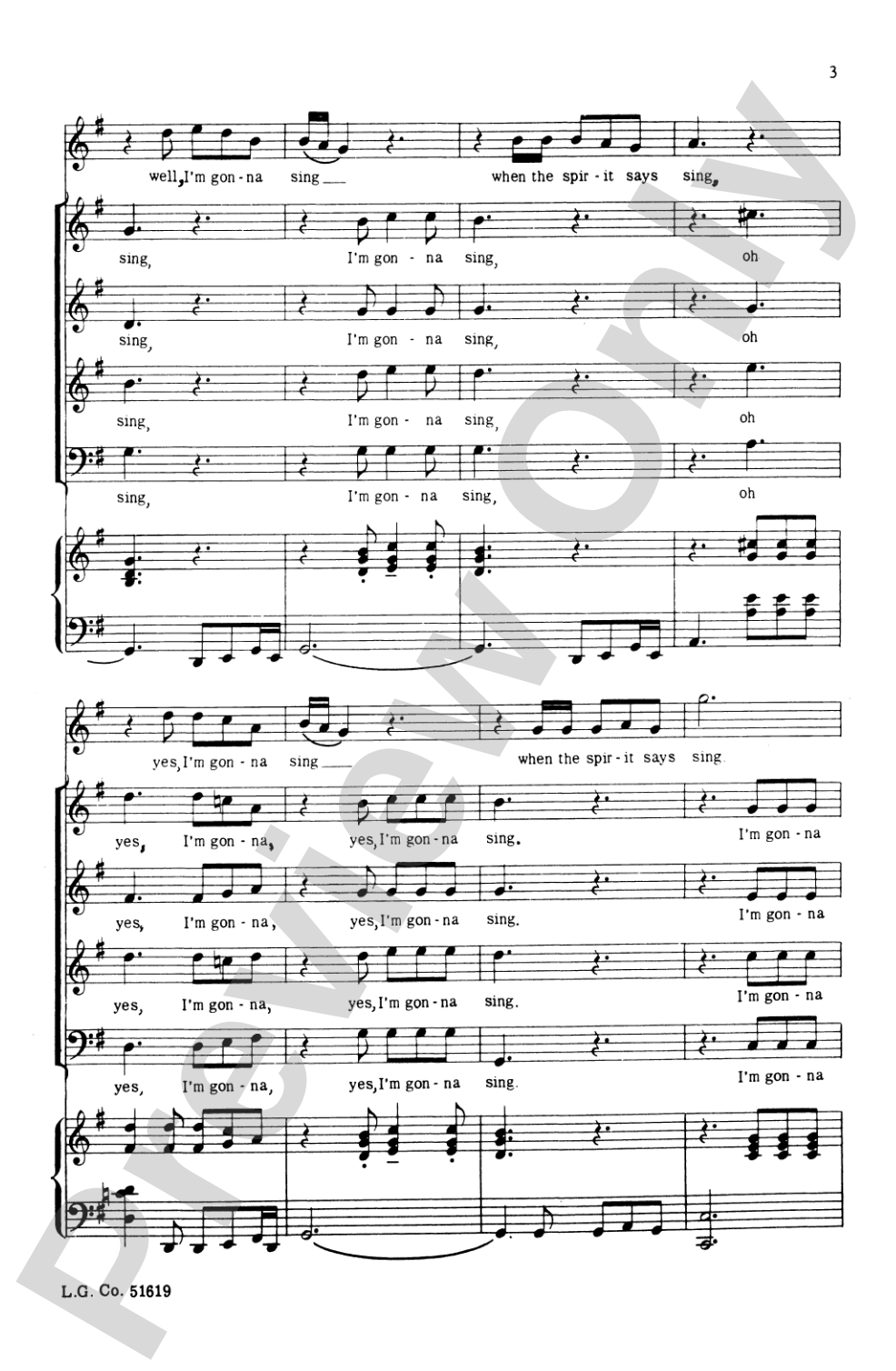
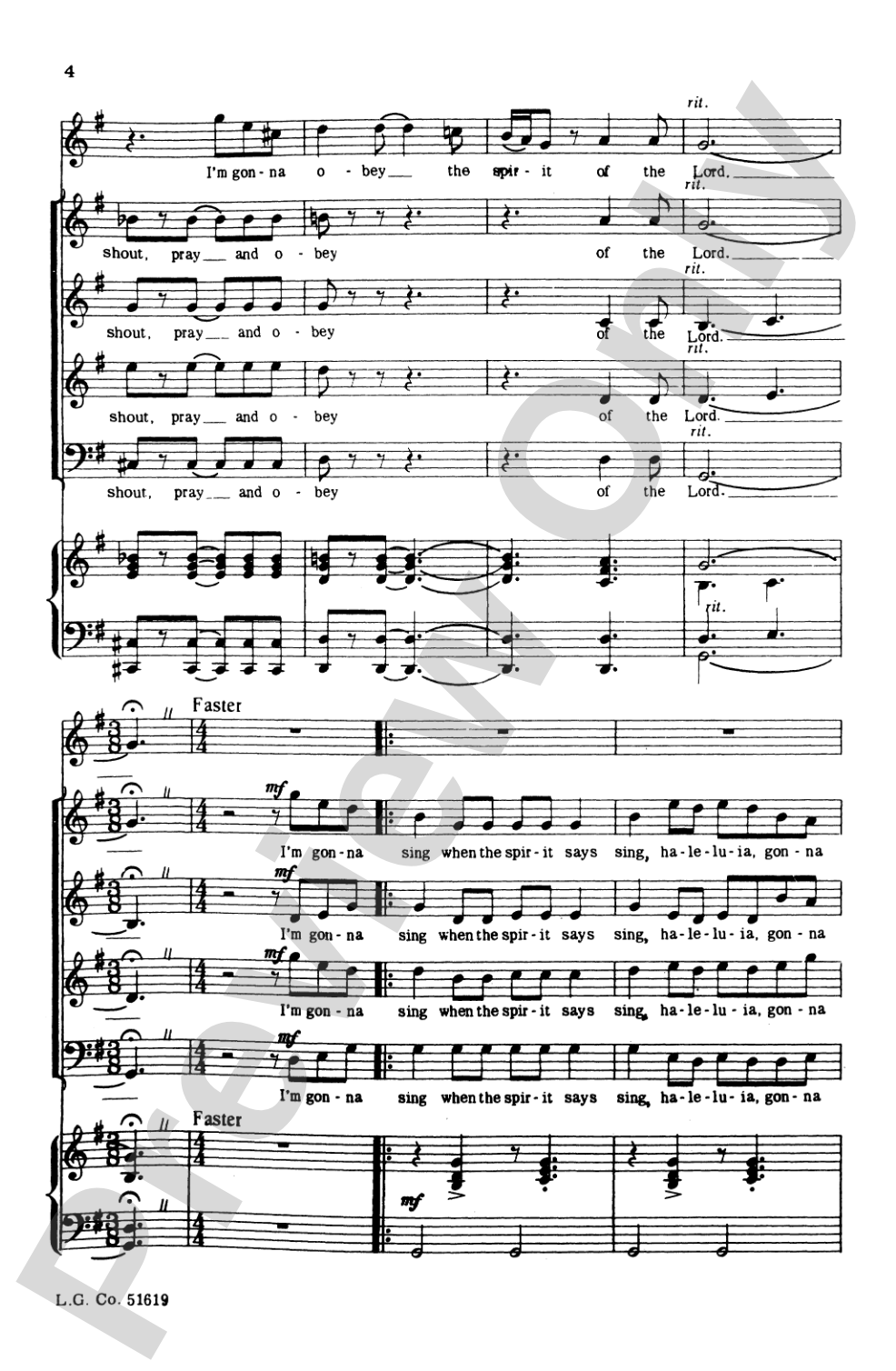
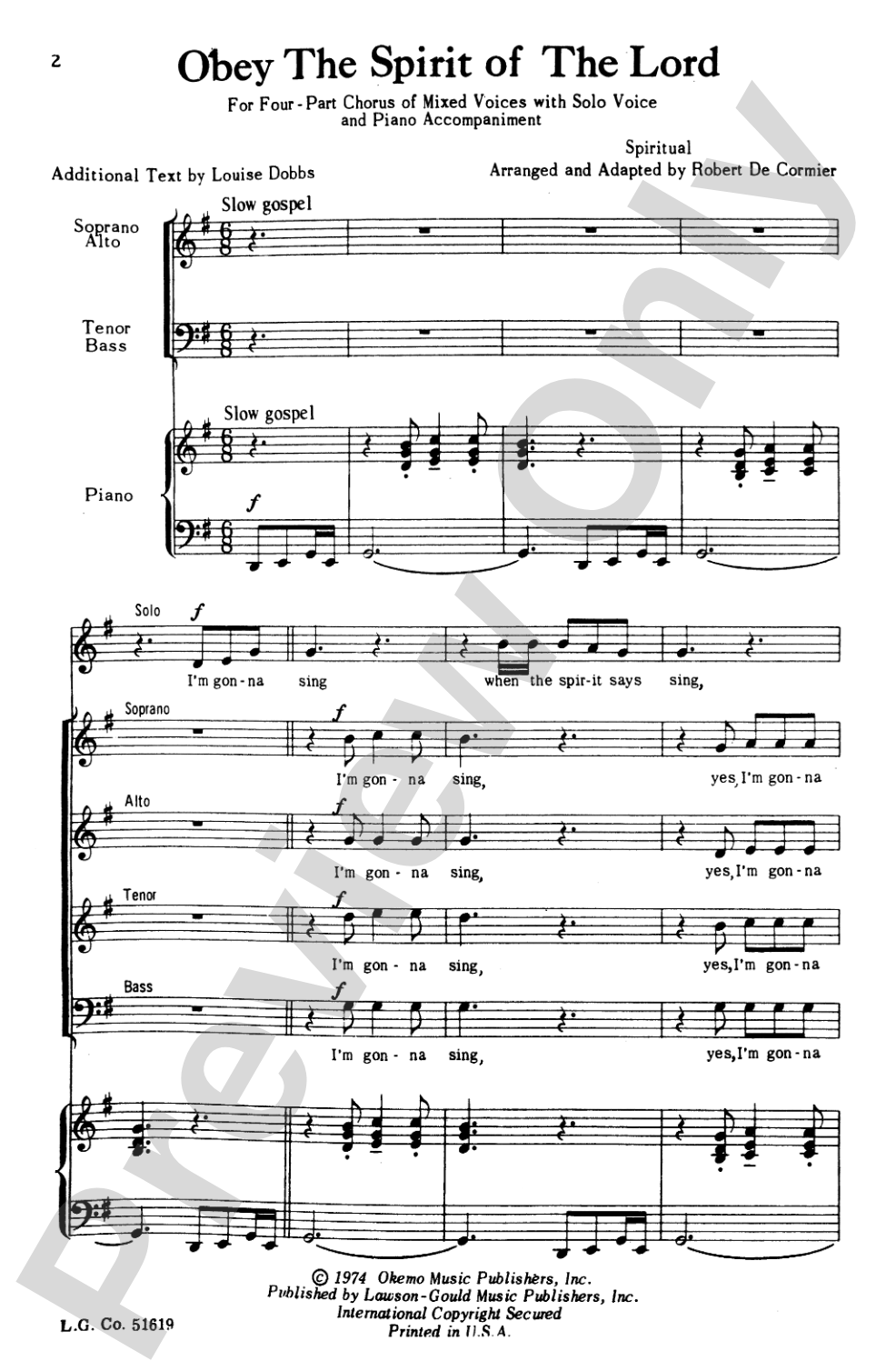
Obey the Spirit of the Lord Sheet Music Preview

Obey the Spirit of the Lord: SATB Choral Octavo

Arr. Robert DeCormier

Item: 00-PO-0005019

Digital Download
$2.95

Minimum order quantity: 20 copies

Description

Obey the Spirit of the Lord: SATB Choral Octavo isn't in MakeMusic Cloud just yet...but it could be. Let us know you'd like to see it, and you'll help shape what comes next. In the meantime, start a free trial and dive into thousands of interactive titles your students can play along with today.

Sample Audio
No sample audio found.
Sample Video
Additional Details
Series: Alfred Archive Edition: Lawson-Gould Music Publishers
Publisher: Alfred Music
Page Count: 16
SKU: 00-PO-0005019

More about this title

About the Arranger: Robert DeCormier

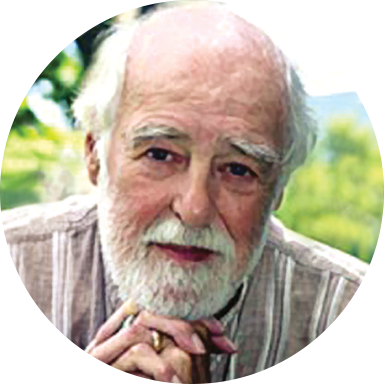
Robert DeCormier

Robert DeCormier studied at Juilliard and built a distinguished career as a conductor, arranger, and composer spanning Broadway, opera, concert music, and folk traditions. He served seventeen years as music director of the New York Choral Society, worked as conductor and arranger for Harry Belafonte, and held the position of music director for Peter, Paul and Mary from 1978 to 2010. He also taught conducting and ensembles at the Eastman School of Music and founded the professional vocal ensemble Counterpoint in 2000, which performed throughout New England and produced six recordings on the Albany label.

DeCormier's arranging work ranged widely across African-American spirituals, American folk songs, and international repertoire. His television credits include choral series for the BBC, PBS specials with Jessye Norman, and a CBS Emmy award-winning special with Harry Belafonte. In 2002, he received the Vermont Governor's Award for Excellence in the Arts, and in 2006, the New England Choral Arts Foundation honored him with a Lifetime Achievement Award.

Why we love this

DeCormier's arrangements of African-American spirituals honor both the cultural roots and emotional power of these songs while making them accessible to mixed choirs at various levels. His writing for SATB voices is always singable and musical; the parts move naturally without sacrificing the spiritual depth that makes this genre so compelling. This arrangement brings genuine artistry to a sacred standard.

What to expect

The piece carries the quiet strength and contemplative dignity characteristic of the spiritual tradition. DeCormier's four-part writing creates warmth and fullness without obscuring the text, allowing the message of obedience and faith to shine through with clarity and sincerity.

Who it's for

This octavo works for community choirs, church choirs, high school and college ensembles, and festival choirs seeking a well-crafted spiritual arrangement. It suits singers with moderate to intermediate reading skills and works in programs that value both accessibility and musical integrity.

How to get the most out of it

  • Balance the four parts carefully so that no single voice overwhelms the texture; the spiritual tradition relies on ensemble cohesion rather than solo prominence.
  • Shape phrases with attention to text stress and theological meaning; let the words guide your dynamic choices and phrasing.
  • Work the rhythmic vitality that DeCormier typically builds into his spirituals, particularly in the accompaniment, so that the piece has forward motion and life.
  • Record a rehearsal run-through early in your preparation and listen for blend across all four parts, especially in moments where voices move independently.

How to use it

Include this in a concert or service program that explores African-American sacred music, pairs it with other spirituals or contemporary sacred works, or programs it as part of a Black History Month observance. The piece also fits well in interfaith services and community choral events where spiritual unity and accessible artistry matter.

Skills your students will build

  • Reading and balancing independent melodic lines in SATB texture
  • Sustaining long phrases while maintaining clear diction and text expression
  • Understanding the cultural and spiritual roots of the African-American spiritual tradition
  • Blending voices to create ensemble cohesion rather than individual prominence

You May Also Like