
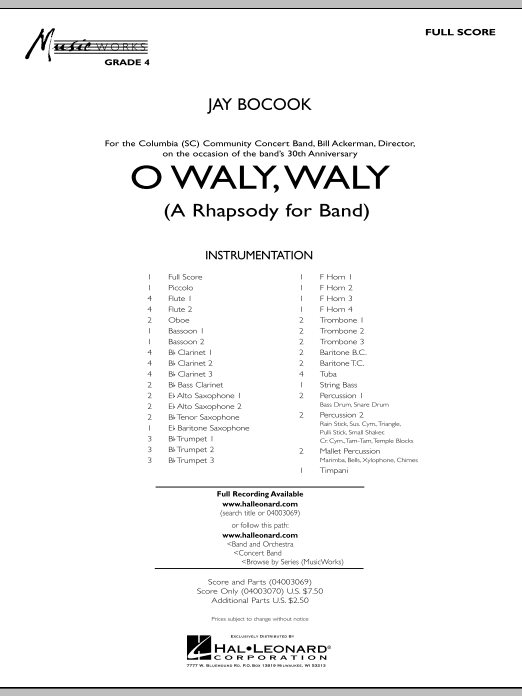

O Waly Waly (A Rhapsody For Band): Concert Band Conductor Score & Parts
By Jay Bocook
Grade: 4
Item: 35-PK00180083
$85.00
Pickup currently not available
Buy Extra Parts (Digital PDF Download)
Parts Added to Cart!
Description
Dating from the 1600s, the folk song "O Waly, Waly" (commonly known as "The Water is Wide") forms the basis for this well-crafted rhapsody for band. The lyrical opening section features solos on flute and euphonium, as a four-note motif common to this song and also "Carolina" (South Caroline's official song) is developed. This motif unifies the entire work. A Celtic flavored Allegro takes over using this fragment, which leads ultimately to a grand Maestoso section for the entire ensemble. A creative and dynamic work for contest or festival! Dur: 5:00


O Waly Waly (A Rhapsody For Band): Concert Band Conductor Score & Parts isn't in MakeMusic Cloud just yet...but it could be. Let us know you'd like to see it, and you'll help shape what comes next. In the meantime, start a free trial and dive into thousands of interactive titles your students can play along with today.
Request This Title
Tell us you want it.
Start Your Free Trial
Explore everything that's ready to play right now.
Sample Audio
No sample audio found.
Sample Video
No sample videos found.
Additional Details
Publisher:
Hal Leonard
SKU:
35-PK00180083
More about this title
About the Composer: Jay Bocook
Jay Bocook is a prolific composer and arranger whose work appears regularly on concert band stages across North America. His arrangements of traditional material demonstrate a gift for preserving the essence of a melody while creating fresh orchestral contexts that engage contemporary ensembles.
Bocook's compositional output spans contest repertoire, educational pieces, and concert works that appeal equally to high school and college programs. His arrangements are known for their balance of accessibility and musical substance, offering students genuine artistic challenges without unnecessary technical barriers.
Why we love this
Bocook's handling of a centuries-old tune avoids the typical trap of folk arrangements: static harmony and predictable orchestration. Instead, he builds genuine drama through deliberate pacing, strategic voicing, and a structural arc that feels earned rather than imposed. The four-note motif threading through the work gives students a compositional principle to listen for and understand.
What to expect
The piece unfolds like a travelogue through the song's own history. It begins in intimate reflection, shifts into energetic celebration, and concludes with the weight of tradition renewed. At five minutes, it sustains interest through clear structural contrasts without overstaying its welcome.
Who it's for
Grade 4 bands seeking substantial contest or festival material with genuine musical substance. This works equally well for ensembles wanting to program an arrangement of a recognized folk melody and those looking for a showpiece with both lyrical and virtuosic moments.
How to get the most out of it
- Shape the opening flute and euphonium solos as intimate conversations. These voices need acoustic space, so balance the harmonic backdrop as accompaniment rather than support.
- The Celtic Allegro section demands rhythmic precision without rigidity; find the swing in the articulation without letting it become sloppy or overly syncopated.
- Approach the final Maestoso as a genuine climax, not just louder. Clarify the inner voices so the harmonic progression builds logically toward the conclusion.
- Listen for the four-note motif across sections. When brass echo what woodwinds introduced, make that connection audible through subtle dynamic shaping.
How to use it
Pair this with other folk-based works or original compositions in a concert exploring musical roots and contemporary voices. The rhapsodic structure makes it particularly effective as a festival or contest selection, where judges appreciate both technical execution and musical storytelling.
Skills your students will build
- Tracking and performing recurring motifs across changing harmonic and rhythmic contexts
- Balancing solo voices against harmonic accompaniment in ensemble settings
- Executing style shifts from lyrical rubato to rhythmic precision
- Understanding structural unity achieved through thematic development rather than repetition
- Responding to dynamic and expressive notation in a through-composed work