O Vos Omnes (from Les Sept Paroles Du Christ ) Sheet Music Preview

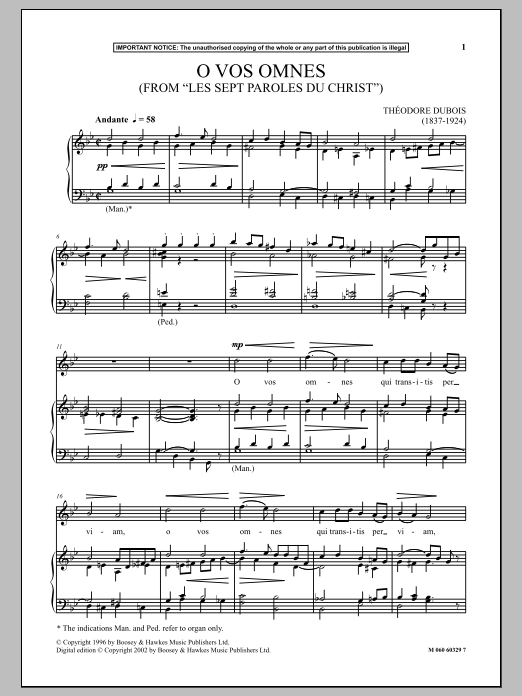
O Vos Omnes (from Les Sept Paroles Du Christ ): Piano Vocal

As performed by Théodore Dubois

Item: 35-DS00238089

Digital Download
$5.99
Description

O Vos Omnes (from Les Sept Paroles Du Christ ): Piano Vocal isn't in MakeMusic Cloud just yet...but it could be. Let us know you'd like to see it, and you'll help shape what comes next. In the meantime, start a free trial and dive into thousands of interactive titles your students can play along with today.

Sample Audio
No sample audio found.
Sample Video
Additional Details
Publisher: Hal Leonard
Page Count: 4
SKU: 35-DS00238089

More about this title

About the Artist: Théodore Dubois

Théodore Dubois (1837–1924) was a French composer and pedagogue whose works dominated French musical institutions during the late 19th century. He spent decades as director of the École Cantorum in Paris, where his influence on sacred music composition and performance shaped an entire generation of musicians. His sacred vocal writing balances accessibility with genuine emotional depth, making his works enduringly popular in church services and concert settings.

Dubois's gift lay in setting religious texts with clarity and sincerity, avoiding unnecessary complexity while maintaining sophisticated harmonic language. His Seven Last Words of Christ remain among his most performed sacred compositions, valued for their reverent tone and straightforward demands on performers.

Why we love this

This movement from Dubois's Seven Last Words offers singers a genuine moment of contemplative beauty without requiring operatic credentials. The piano part stays transparent and supportive, letting the voice breathe through a meditation on compassion rather than overwhelming it with accompaniment texture. It's a natural fit for recitals, services, or concert programs where you need something sacred that connects immediately with listeners.

What to expect

The music unfolds with quiet spiritual gravity. Dubois creates a sense of stillness through simple but elegant harmonic movement, the melodic line rising and falling like a prayer spoken aloud. The overall effect is meditative and honest rather than ornate, inviting the listener into an intimate moment of faith.

Who it's for

This arrangement suits soloists at intermediate to advanced levels who want substantive sacred repertoire for recitals, church services, or auditions. It works equally well for singers developing their art song skills and those exploring classical French vocal writing. Pianists accompanying singers will appreciate the balanced partnership rather than the accompaniment taking secondary status.

How to get the most out of it

  • Find the breath pattern within the text rather than fighting the phrase length. Dubois wrote for singers who understand language, so honor the Latin pronunciation and vowel shapes throughout.
  • Keep the piano articulation light and transparent in accompaniment passages. The voice deserves the full focus, and the keyboard's role is to support harmonic foundation, not compete for attention.
  • Shape the melodic line with gentle dynamic contours. Dubois rarely marks dramatic changes, so create interest through subtle intensity shifts rather than sudden volume jumps.
  • Allow space in the final phrases to breathe into the resolution. The ending needs quiet reflection, not rush.

How to use it

Pair this with other movements from the Seven Last Words to create a complete service or concert segment, or place it alongside other French sacred vocal works from the same period. It also works as a meaningful solo offering on a diverse recital program, providing textural contrast to secular art songs. The concise four-page length makes it practical for singers building a developing repertoire of substantial but manageable sacred pieces.

Skills your students will build

  • Latin text declamation with proper pronunciation and phrasing
  • Balancing vocal line with transparent piano accompaniment
  • Building dynamic shape through subtle intensity rather than dramatic changes
  • Sustaining legit singing posture across longer phrase structures
  • Understanding harmonic function in nineteenth-century French sacred music

You May Also Like