Penny Rodriguez grew up in Peru, where she began piano lessons at age 6 while her parents worked as missionaries. She went on to earn a degree in piano performance from the Moody/American Conservatory of Music and has built a career as a pianist, composer, and recording artist with eleven albums to her name.
Rodriguez has published numerous piano works and choral compositions over the years. More recently, she has devoted her creative energy to art songs for solo voice and piano, carefully selecting classic poetry as text. She lives near Indianapolis with her husband Dave and finds her deepest fulfillment in time spent with their grandchildren.
Why we love this
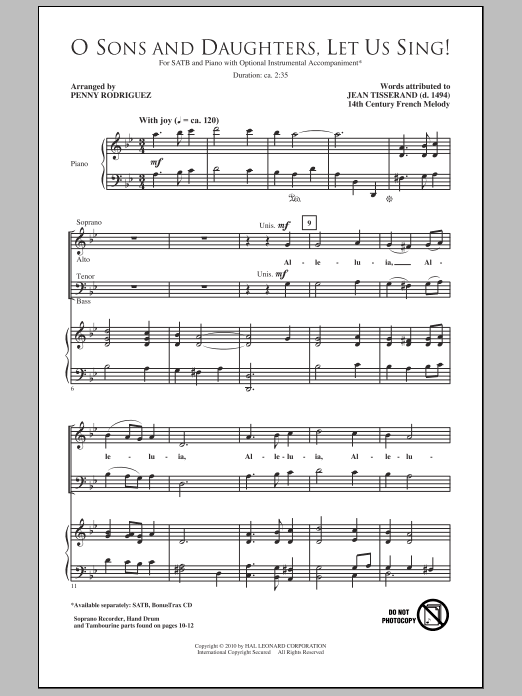
Rodriguez brings both compositional sophistication and practical choral sense to this beloved Easter hymn. The arrangement respects the tune's Renaissance roots while opening up the harmonic palette in ways that keep singers engaged across all four voice parts, making it substantial enough for a concert setting without becoming precious or over-arranged.
What to expect
The piece radiates the quiet confidence of Renaissance harmony meeting contemporary choral writing. Singers will feel the joy inherent in the text lifted by Rodriguez's sympathetic accompaniment and voice leading that gives each part something meaningful to sing.
Who it's for
This arrangement works for choirs at intermediate to advanced levels who want a substantial Easter offering beyond standard hymn settings. It suits both sacred concert programs and liturgical use, and the 11-page length suggests a piece that has real musical substance rather than utility filler.
How to get the most out of it
Balance the soprano line carefully through the higher passages; this tune sits well in the voice but needs restraint to avoid overshadowing the inner harmony work Rodriguez provides.
Shape phrases by thinking in longer musical arcs rather than stopping at every barline. The Renaissance text deserves period-appropriate phrasing that breathes with the poetry.
Let the alto and tenor parts breathe independently. Rodriguez gives them interesting movement that shouldn't get buried by doubling or over-blending.
Establish a warm, resonant tone quality that lets the sacred context shine through without sounding overly reverent or stiff.
How to use it
Position this as your Easter concert's centerpiece or anchor point, particularly if you're building a program around other Renaissance or sacred repertoire. It also functions beautifully within a liturgical Eastertide service where you want something more textured than a simple unison hymn but not so elaborate that it overshadows congregational participation.
Skills your students will build
Singing Renaissance counterpoint in a modern choral context
Voice leading in four-part SATB with independent melodic lines
Interpreting sacred text with stylistic awareness
Managing ensemble balance when inner voices carry harmonic interest
Reading and performing from a full 11-page choral score
You May Also Like
Scan to Complete Your Purchase
Use your phone's camera to scan the code below
You'll log in on your phone and the order will be added to your account