O Savior Of Our Fallen Race (arr. David Angerman) Sheet Music Preview

O Savior Of Our Fallen Race (arr. David Angerman): Choral Instrumental Pak

By Keith Kristyn Getty / By Gilbert E. Doan / Arranged by David Angerman

Item: 35-PK00912033

Digital Download
$75.00

One moment…

Description
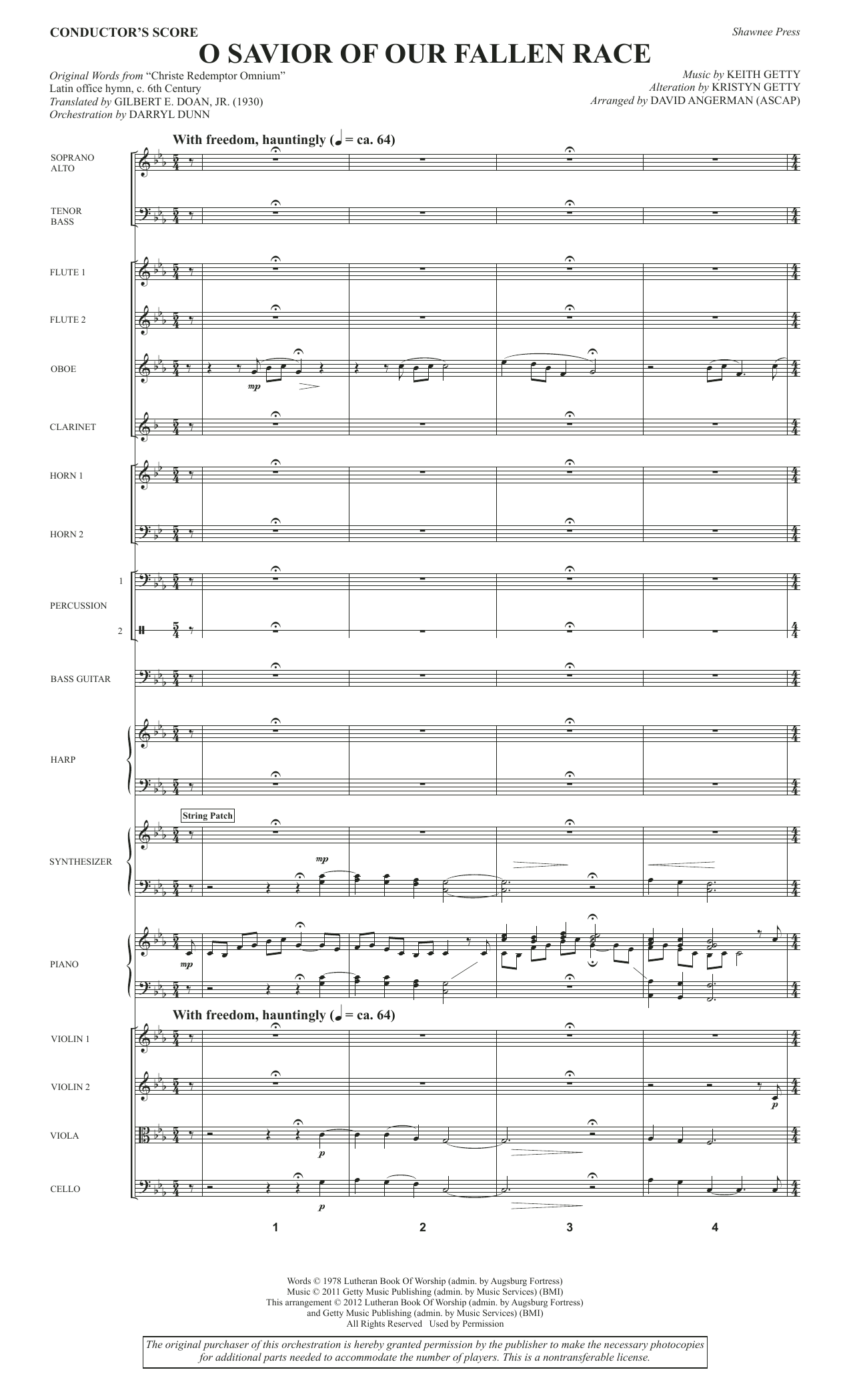
Moving freely like a chant, this ancient text is profound in scope and authenticity as it follows the journey from humanity's sin to God's salvation. Luminous images of God's holiness mingle with the music's cloistered reverence, offering a deep sense of mystery and majesty. Score and Parts (fl 1-2, ob, cl, hn 1-2, perc 1-2, bgtr, hp, syn, pno, vn 1-2, va, vc) available as a digital download.

O Savior Of Our Fallen Race (arr. David Angerman): Choral Instrumental Pak isn't in MakeMusic Cloud just yet...but it could be. Let us know you'd like to see it, and you'll help shape what comes next. In the meantime, start a free trial and dive into thousands of interactive titles your students can play along with today.

Sample Audio
No sample audio found.
Sample Video
Additional Details
Publisher: Hal Leonard
SKU: 35-PK00912033

More about this title

About the Composer: Keith Kristyn Getty

Keith Kristyn Getty is a Northern Irish composer and songwriter whose work spans classical, liturgical, and popular music contexts. His compositions, often written in collaboration with Stuart Townend, have become staples of contemporary Christian worship while maintaining the harmonic sophistication and textural depth of traditional sacred music. Getty's gift for melody and his respect for theological texts make his settings particularly valuable in educational settings where music and meaning intersect.

Why we love this

Angerman's orchestration transforms this ancient text into something that feels both timeless and immediate, giving your singers a full instrumental palette to lean against without overwhelming the vulnerability of the words. The flexible rubato phrasing lets your choir breathe with the text while the parts provide enough support that even singers uncertain of their pitch lines can find security. Programming this creates a compelling theological arc within a service or concert, moving listeners through profound content without artificiality.

What to expect

The music unfolds with the deliberate pace of liturgical chant, grounded by the weight of its theological subject matter. Instrumental colors shift subtly beneath the vocal line, evoking dim candlelit spaces and centuries of devotional practice. There's an underlying dignity and resignation here, a quiet assurance that emerges not from brightness but from deep, patient faith.

Who it's for

This arrangement serves choirs with access to even partial instrumentation, from flute and strings only to the full ensemble. Directors programming advent or Christmas services will find this especially valuable for creating a contemplative moment alongside more festive selections. Both high school and community choirs can execute this effectively with mature musicianship and careful preparation.

How to get the most out of it

  • Balance the choir's reverent dynamic against the instrumental texture; the organ and strings should enhance rather than carry the musical weight
  • Shape the phrasing around the text's meaning rather than metric divisions, allowing natural speech rhythm to guide your tempo fluctuations
  • Let the percussion parts breathe sparingly; restraint in the rhythm section heightens the sense of mystery the orchestration evokes
  • Work your section leaders through the instrumental parts first so they understand where the harmonic anchors sit beneath the vocal line

How to use it

Pair this with other Getty compositions or with more austere works from the Renaissance to deepen an Advent service's reflective quality. It works equally well as the emotional turning point in a Christmas concert, positioned between joyful processionals and triumphant finales. Consider programming it as part of a liturgically sequenced concert where the text's arc from sin to salvation mirrors the service's spiritual progression.

Skills your students will build

  • Singing sustained, unmetrical vocal lines with accurate pitch and breath control
  • Responding to instrumental cues from strings and winds while maintaining ensemble vowel matching
  • Interpreting text with musical and theological sensitivity in a minor-inflected harmonic context
  • Balancing soft dynamic singing with clear articulation and resonance

You May Also Like