O Salutaris (O Blessed Redeemer) Sheet Music Preview

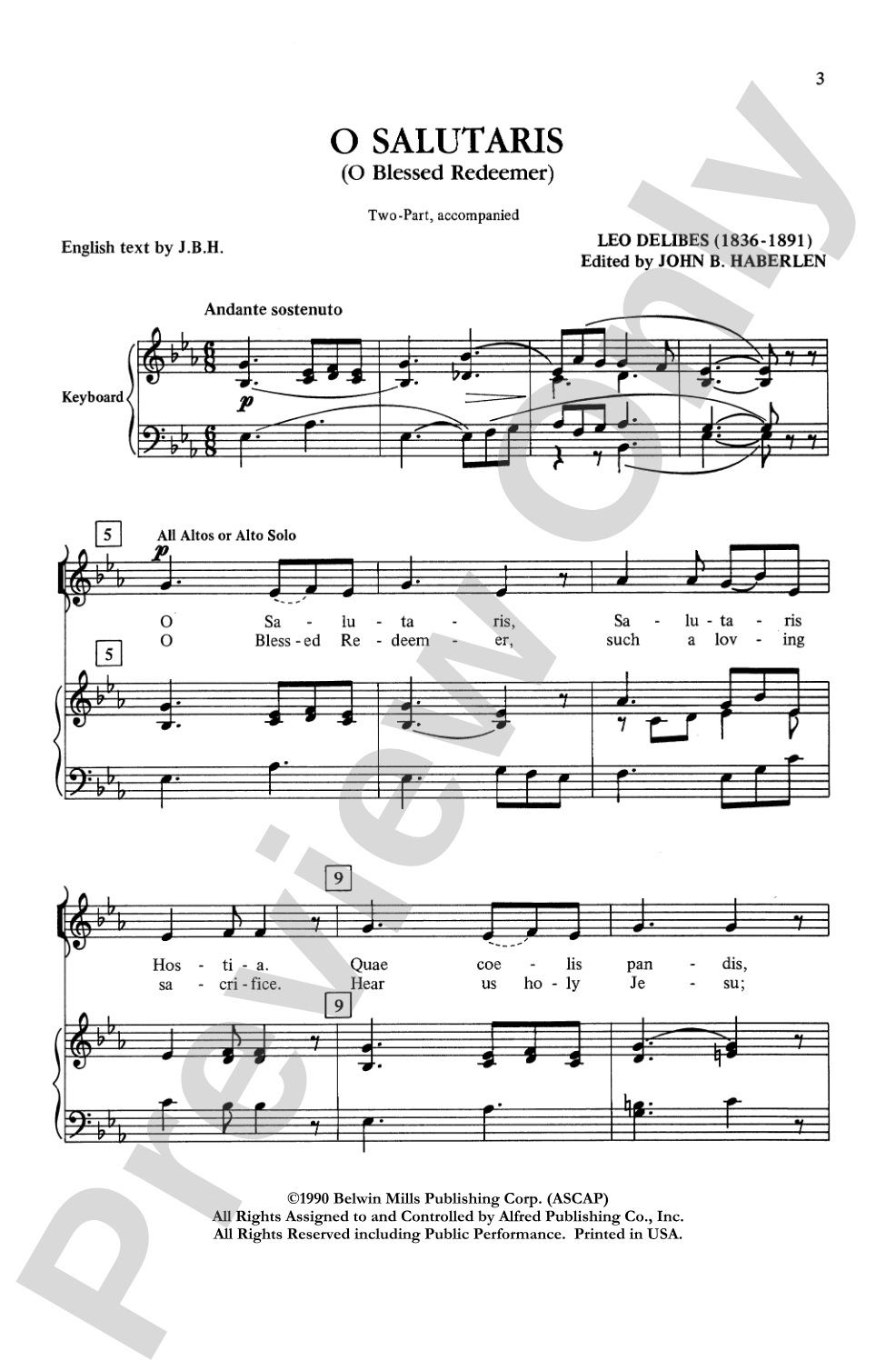
O Salutaris (O Blessed Redeemer): 2-Part Choral Octavo

O Blessed Redeemer

By Léo Delibes / ed. John B. Haberlen

Item: 00-PO-0005137

Digital Download
$2.25

Minimum order quantity: 20 copies

Description

O Salutaris (O Blessed Redeemer): 2-Part Choral Octavo isn't in MakeMusic Cloud just yet...but it could be. Let us know you'd like to see it, and you'll help shape what comes next. In the meantime, start a free trial and dive into thousands of interactive titles your students can play along with today.

Sample Audio
No sample audio found.
Sample Video
Additional Details
Series: Alfred Archive Edition: Belwin Festival Series
Publisher: Alfred Music
Page Count: 8
SKU: 00-PO-0005137

More about this title

About the Composer: Léo Delibes

Léo Delibes (1836–1891) shaped the sound of late 19th-century French music through his gift for melody and orchestration. Best known for his ballets Coppélia and Sylvia, he brought the same lyrical sensibility to sacred vocal works, creating music that feels both spiritually reverent and musically sophisticated. His choral writing balances accessibility with artistry, making his sacred pieces ideal for ambitious festival choirs.

Why we love this

Delibes's sacred writing rarely appears in standard octavo catalogs, which makes this piece a genuine discovery for directors seeking repertoire with genuine emotional depth rather than predictable piety. The two-part texture allows treble and lower voices to shine equally, and the harmonic language carries enough sophistication to hold adult singers' attention while remaining accessible to developing choirs. Its festival designation speaks to quality that stands up to adjudication and audience expectation alike.

What to expect

Reverent without sentimentality, this piece unfolds like a prayer set to elegant French melody. The two-part writing creates an intimate, almost devotional quality that invites singers to connect deeply with both the text and each other. Delibes's harmonic language adds gentle color and complexity without losing the spiritual centeredness the text demands.

Who it's for

Festival choirs, select ensembles, and advanced high school or community choirs seeking sacred repertoire with artistic substance. This works particularly well for groups comfortable with text underlay and harmonic sophistication beyond basic diatonic writing.

How to get the most out of it

  • Shape the phrases through gentle dynamic swells rather than sudden crescendos; Delibes favors lyrical continuity over dramatic punctuation.
  • Attend to the vowel consistency within each phrase to support the sustained, hymn-like quality of the music.
  • Balance the two parts carefully so that neither overshadows the other; treat them as equal conversational lines rather than melody and accompaniment.
  • Let the harmonic movement breathe naturally without dragging; the Romantic era writing benefits from slight rubato but maintains forward momentum.

How to use it

Pair this with other sacred octavos to create a coherent concert section, or position it as a festival entry where its refined craftsmanship will be recognized. It also works well as a concert finale following more dramatic or joyful pieces, offering a moment of reflection and musical elegance that closes a program memorably.

Skills your students will build

  • Singing sustained lines with lyrical phrasing in romantic-era sacred music
  • Balancing two-part voicing with equal musical attention to both lines
  • Interpreting harmonic color and movement in impressionistic/Romantic harmonic language
  • Projecting reverence and emotional authenticity through vocal tone and text awareness

You May Also Like