
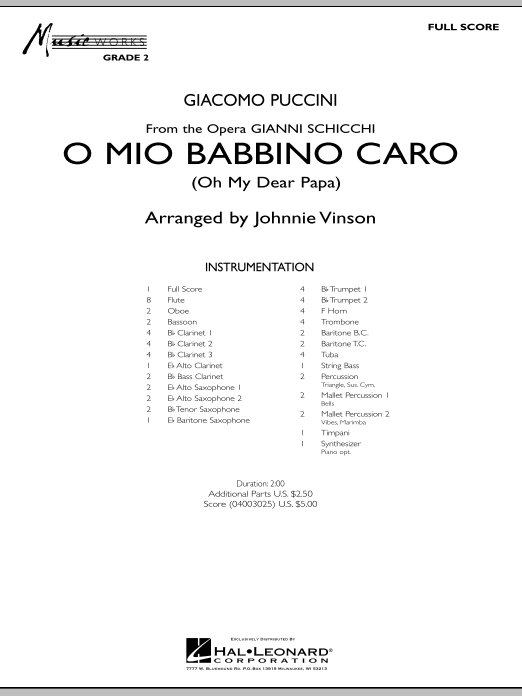

O Mio Babbino Caro: Concert Band Conductor Score & Parts
By Giacomo Puccini / Arranged by Johnnie Vinson
Grade: 2
Item: 35-PK00171877
$65.00
Pickup currently not available
Buy Extra Parts (Digital PDF Download)
Parts Added to Cart!
Description
From the Puccini opera "Gianni Schicchi," this is one of the most beautiful and recognizable melodies in all of classical music. Providing a marvelous opportunity for lyric style playing, Johnnie Vinson's authentic-sounding adaptation for young players will be enjoyed at concerts and festivals alike. Dur: 2:00


O Mio Babbino Caro: Concert Band Conductor Score & Parts isn't in MakeMusic Cloud just yet...but it could be. Let us know you'd like to see it, and you'll help shape what comes next. In the meantime, start a free trial and dive into thousands of interactive titles your students can play along with today.
Request This Title
Tell us you want it.
Start Your Free Trial
Explore everything that's ready to play right now.
Sample Audio
No sample audio found.
Sample Video
No sample videos found.
Additional Details
Publisher:
Hal Leonard
SKU:
35-PK00171877
More about this title
About the Composer: Giacomo Puccini
Giacomo Puccini (1858–1924) shaped modern opera by crafting melodies that embed themselves in the listener's memory. His gift was making ornate vocal lines feel inevitable rather than showy, and his orchestrations balanced intimacy with grandeur. For music educators, Puccini represents a bridge between the Romantic tradition and contemporary sensibility; his works remain central to concert programming because they connect immediately with audiences of all ages.
Puccini's influence on wind band literature is substantial, not because he wrote for bands originally, but because his melodies are so vocally driven and emotionally clear that they translate beautifully across ensembles. Teachers return to his work repeatedly because students grasp the singing quality he demands, and because the harmonic language is accessible without being simplistic.
Why we love this
Vinson's arrangement respects the melody's inherent beauty while making it achievable for young bands. The two-minute duration fits perfectly into concert programs where you need a substantial classical moment without demanding extended rehearsal time, and the Grade 2 level means your players can focus on phrasing rather than technical survival.
What to expect
Tender and yearning. The melody unfolds with a kind of intimate pleading, warm rather than dramatic. It carries the vulnerability of genuine emotion expressed simply and directly.
Who it's for
Young concert bands seeking a showpiece that teaches lyricism without overwhelming the ensemble technically. Directors looking for classical repertoire that engages audiences immediately and gives string-heavy orchestral music a compelling wind band counterpart.
How to get the most out of it
- Shape the melody with consistent vibrato in the principal voice; this aria lives in the legit style, and straight tone will flatten its expression.
- Balance the accompaniment carefully so it never competes with the main line. Young bands tend to play too much; restraint here creates space for the lyric quality Puccini demands.
- Let the rubato breathe naturally at phrase endings. The melody suggests where the conductor should yield slightly and give players room to shape the line together.
How to use it
Slot this into a concert where you're pairing classical standards with contemporary works. The familiarity of the tune makes it an excellent closer for a classical set, or a graceful transition between sections. It also works as a gesture toward operatic tradition without requiring singers.
Skills your students will build
- Sustained melodic phrasing in legit (singing) style
- Balancing principal and accompaniment lines
- Controlling vibrato and tone to support lyric expression
- Understanding rubato and ensemble flexibility within structured harmony