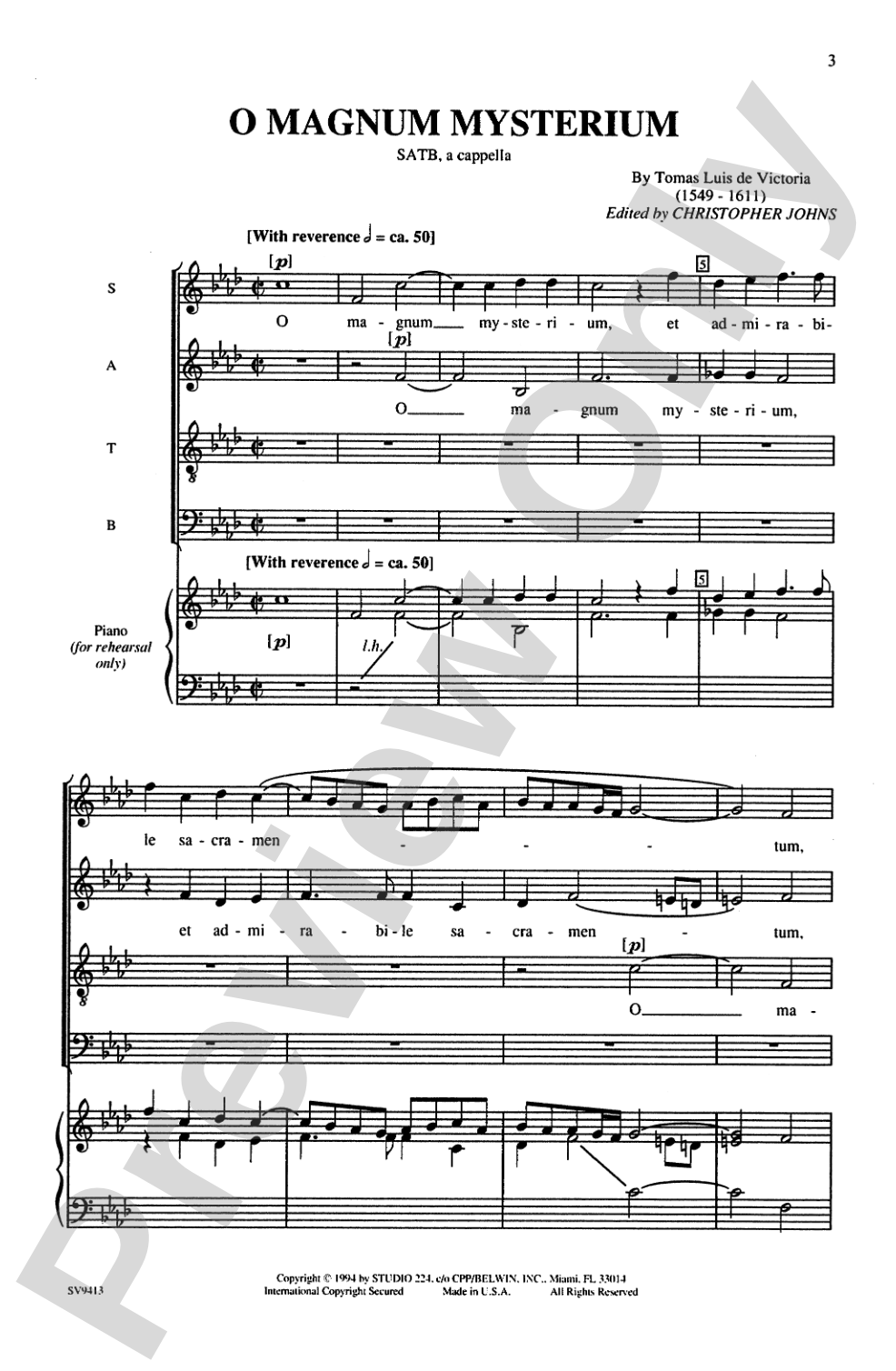
O Magnum Mysterium Sheet Music Preview

O Magnum Mysterium: SATB, a cappella Choral Octavo

By Tomás Luis de Victoria / ed. Christopher Johns

Level: Moderately Difficult

Item: 00-PO-0005231

Digital Download
$2.25

Minimum order quantity: 20 copies

Description
Glorious polyphony soars in this edition of Victoria's O Magnum Mysterium. Long melismas and fugal entrances are part of the beauty of this great Renaissance work. For contest, festival or concert use.

O Magnum Mysterium: SATB, a cappella Choral Octavo isn't in MakeMusic Cloud just yet...but it could be. Let us know you'd like to see it, and you'll help shape what comes next. In the meantime, start a free trial and dive into thousands of interactive titles your students can play along with today.

Sample Audio
No sample audio found.
Sample Video
Additional Details
Series: Alfred Archive Edition: Alfred Choral Designs
Publisher: Alfred Music
Page Count: 12
SKU: 00-PO-0005231

More about this title

About the Composer: Tomás Luis de Victoria

Tomás Luis de Victoria (1548-1611) stands among the most celebrated composers of the Spanish Renaissance, working primarily in Rome before returning to Spain late in life. His sacred music represents the pinnacle of polyphonic achievement, combining the structural rigor of counterpoint with profound spiritual depth and an almost otherworldly sense of luminosity. Victoria's works shaped Catholic liturgical music across Europe and remain central to the choral repertoire today.

Why we love this

Victoria's O Magnum Mysterium sits at that rare intersection where technical mastery and emotional power feel inseparable. The piece demands real polyphonic independence from your singers while rewarding them with some of the most soaring, luminous writing in the Renaissance catalog. Choirs consistently report that this work transforms their sense of ensemble balance and intonation in ways that persist long after the festival ends.

What to expect

O Magnum Mysterium unfolds like stained glass light, with each voice line a separate ray of color that somehow merges into unified brilliance. The long melismas feel contemplative and luminous, inviting your singers into a kind of collective meditation where technical precision and spiritual intention become one.

Who it's for

Advanced high school choirs and collegiate ensembles with secure intonation and polyphonic experience will find this piece both rewarding and achievable at grade 4. Directors preparing for state festival competition, invitational choral festivals, or liturgical performance benefit from a work that impresses adjudicators while serving genuine spiritual purposes.

How to get the most out of it

  • Shape the long melismas as arcs of breath, not elaborate decoration. Let each phrase breathe naturally and arrive at its cadence with purpose.
  • Balance the fugal entrances by bringing out each voice's entry point without sacrificing the harmonic blend. Precision of rhythm matters more than volume.
  • Listen vertically as you rehearse. Victoria's sonorities shift subtly with every voice crossing, and singers who hear these color changes sing with better intonation and ensemble.
  • Maintain even text projection across the a cappella texture. Without instrumental support, clarity depends on consistent vowel formation and articulation from all voices.

How to use it

This work anchors a concert of Renaissance sacred music or stands alone as the centerpiece of a liturgical program. Its moderate difficulty and 12-page length make it manageable for mid-season festival preparation, and its sacred context serves Christmas, Easter, or general concert programming with equal effectiveness.

Skills your students will build

  • Renaissance polyphonic balance and voice independence
  • Melismatic singing with phrase shape and direction
  • Fugal voice entries and staggered entrances
  • A cappella intonation in complex harmonic contexts
  • Text clarity across long, elaborate vocal lines

You May Also Like