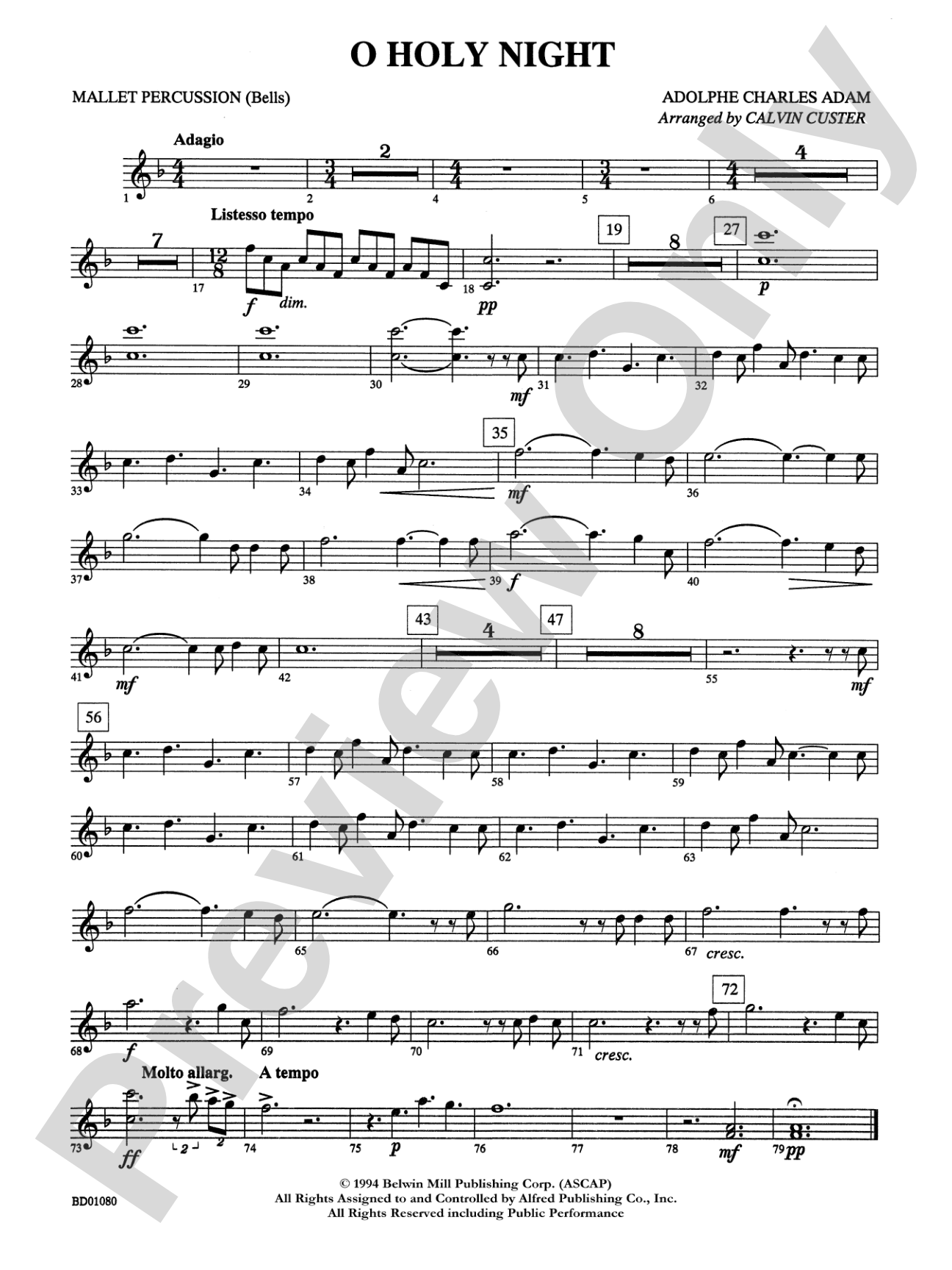
O Holy Night: Mallets Sheet Music Preview

O Holy Night: Mallets

By Adolphe Charles Adam / arr. Calvin Custer

Grade: 4 (Medium)

Item: 00-PC-0002002_M1

Digital Download
$3.00
Description
O Holy Night has been called the most popular Christmas solo song ever written. Calvin Custer artfully examines many of the tonal colors and sonorities available to today's concert band with his treatment of this classic standard. Celebrate the holiday season with this easy rehearsing work for the more advanced ensemble.

Don't just read it, hear it, play along with it, and watch your students grow with it. In MakeMusic Cloud, O Holy Night: Mallets comes alive with professional accompaniment, adjustable tempo, and built-in practice tools that turn solo practice into real progress.

Sample Audio
No sample audio found.
Sample Video
Additional Details
Series: Belwin Symphonic Band
Publisher: Alfred Music
Page Count: 246
SKU: 00-PC-0002002_M1

More about this title

About the Composer: Adolphe Charles Adam

Adolphe Charles Adam (1803-1856) was a French composer whose gift for melody and theatrical instinct made him one of the most performed composers of the Romantic era. Though he composed operas, ballets, and sacred music across a prolific career, his works endure in concert halls and rehearsal rooms because of their direct emotional appeal and orchestral color. Music educators know Adam primarily through "O Holy Night," a song that has transcended its operatic origins to become a cultural touchstone of the holiday season.

Why we love this

Custer's arrangement respects the vocal character of the original while fully exploiting what a concert band can deliver orchestrally. The Grade 4 difficulty sits at that sweet spot where advanced ensembles can achieve genuine refinement without needless technical hurdles, letting musicians focus on phrasing, balance, and the emotional weight of the melody. Programming this in December gives your audience a familiar, beloved work while showcasing your band's tonal sophistication.

What to expect

The arrangement opens with a reverent, almost liturgical character before expanding into full orchestral warmth. There's a sense of timeless devotion here, achieved through careful attention to sonority and phrasing rather than dramatic gestures. Listeners will recognize the melody instantly, but hear it anew through the depth and subtle coloring Custer brings to the concert band medium.

Who it's for

Advanced high school bands and college ensembles comfortable with ensemble balance and voicing concepts will find this arrangement rewarding. Directors seeking a substantial holiday work that feels fresh despite its familiarity will appreciate Custer's orchestral sophistication. Solo singers preparing a band-backed performance of the original song can also use this score as a collaborative foundation.

How to get the most out of it

  • Shape the opening statements in the woodwinds with particular attention to dynamic contours; the sustained hymn-like quality depends on refusing to play mechanically from note to note.
  • Balance the inner voices when the melody passes between sections. The arrangement's richness comes from transparent layering, not homogeneous doubling.
  • Let the bass line breathe during sustained harmonic passages. A common misstep is pushing the foundation too hard when the upper voices are already singing.
  • Approach key modulations as emotional pivots rather than technical events. Custer uses tonal color shifts to deepen the spiritual character of the piece.

How to use it

This works beautifully as the emotional centerpiece of a winter concert, offering an anchor point between lighter seasonal selections and more demanding concert repertoire. It also serves effectively as a finale if you want to leave your audience with a sense of contemplation and beauty rather than spectacle. The accessibility of the melody makes it ideal for community-centered holiday performances where connection with the audience takes priority over showmanship.

Skills your students will build

  • Sustained singing tone and legit phrasing in a concert band context
  • Balancing inner voices while maintaining clear melodic focus
  • Transparent ensemble blending across different instrumental combinations
  • Responding to harmonic color changes and their emotional implications
  • Managing dynamic control within a hymn-like framework

You May Also Like