O Holy Night Sheet Music Preview

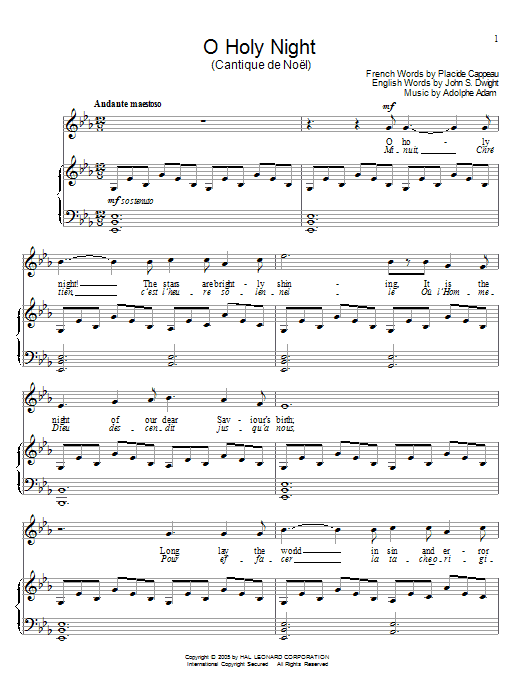
O Holy Night: Piano Vocal

Item: 35-DS00021617

Digital Download
$5.99
Description

O Holy Night: Piano Vocal isn't in MakeMusic Cloud just yet...but it could be. Let us know you'd like to see it, and you'll help shape what comes next. In the meantime, start a free trial and dive into thousands of interactive titles your students can play along with today.

Sample Audio
No sample audio found.
Sample Video
Additional Details
Publisher: Hal Leonard
Page Count: 7
SKU: 35-DS00021617

More about this title

About the Creator

Adolphe Adam (1803–1856) composed the original melody for "O Holy Night" as part of the 1847 French opera "Le Prophète." The piece gained its enduring place in Christmas tradition when French poet Placide Cappeau wrote new French lyrics ("Cantique de Noël") set to Adam's soaring tune. The combination of Adam's gift for memorable melody and the spiritual intensity of the text transformed what began as operatic music into one of the world's most recognized sacred songs.

The vocal line sits at the heart of this arrangement, demanding both technical skill and emotional depth from the singer. Pianists find equally rewarding material in the accompaniment, which must balance support for the voice with its own expressive independence. This pairing has made the piece a standard choice for holiday services, recitals, and special performances across denominations and secular settings.

Why we love this

The seven-page score gives singers room to truly inhabit this spiritual heavyweight rather than rush through a condensed version. The piano writing honors both the vocal line and creates genuine musical conversation, so the accompanist stays engaged throughout rather than serving as mere background. Most importantly, the arrangement respects the piece's inherent power; it doesn't oversell or embellish what's already one of music's most affecting melodies.

What to expect

Reverent without sentimentality. The opening unfolds with quiet intimacy before building toward moments of passionate affirmation, then settling back into contemplative space. There's both vulnerability and certainty woven through the vocal line, supported by piano writing that alternates between delicate and full-voiced.

Who it's for

This arrangement serves singers at intermediate to advanced levels who want to perform a major holiday standard in a thoughtful, substantial setting. Pianists pairing with a vocalist will find the accompaniment challenging and rewarding. It works equally well for a soloist preparing for a holiday concert or a church musician seeking a centerpiece for seasonal programming.

How to get the most out of it

  • Shape the opening phrases with a sense of discovery rather than announcement. The "O holy night" line builds in intensity, so let the voice find its way in gradually rather than entering at full volume.
  • Balance the piano's supporting role carefully in the verses. When the vocal line soars, the accompaniment should recede slightly; when the voice rests, the piano can fill the space without competing.
  • Mark the climactic moments clearly in rehearsal and identify exactly where the singer will need the most support. This piece has natural peaks; plan your dynamics accordingly.
  • Pay attention to the text's pacing. "O holy night" moves between contemplative passages and moments of urgent longing. Your tempo and breath choices should reflect these emotional shifts.

How to use it

This earns a place as a featured solo rather than background music. Position it in a holiday concert as a moment of genuine pause and reflection between lighter fare, or use it as the emotional anchor of a winter recital. The seven-page length and emotional weight suggest centering a portion of a service around this performance rather than tucking it into a medley.

Skills your students will build

  • Sustaining long, controlled vocal lines across multiple phrases without breath support collapse
  • Managing dynamic contrast within a single melodic idea
  • Coordinating voice and piano through extended passages of relative simplicity that demand expressive rather than technical complexity
  • Handling text underlay that requires both clarity and musicality in a language not native to many English-speaking singers
  • Reading and interpreting a piece with deep historical and cultural weight

You May Also Like