
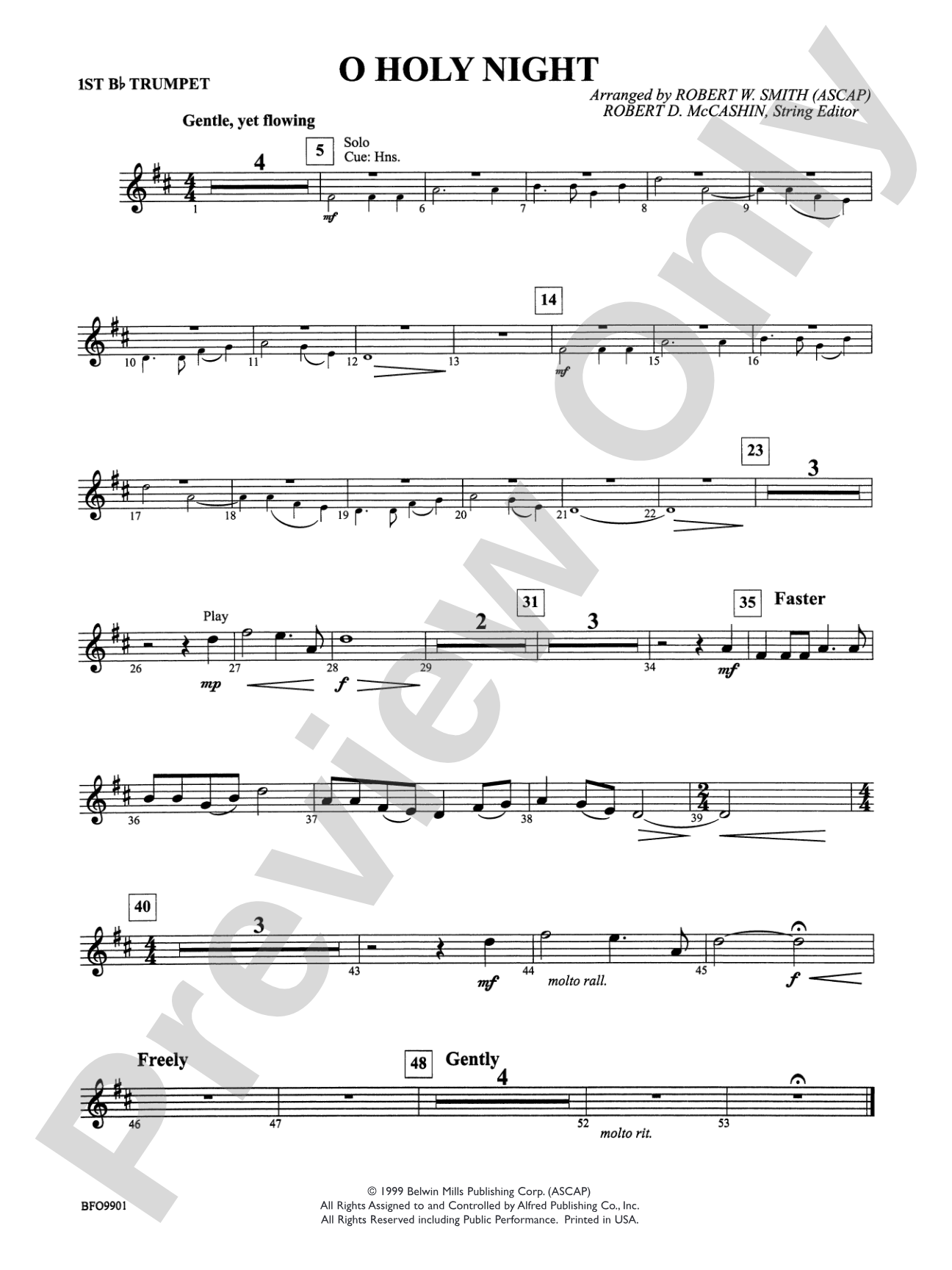

O Holy Night: 1st B-flat Trumpet
Arr. Robert W. Smith
Grade: 2.5
Item: 00-PC-0002215_T1
$3.00
Pickup currently not available
Description
Each year, all of us await the music of the holiday season to give us reason to remember and reflect, as well as to prepare once again for the abundant joys that only this time of year can bring. Robert W. Smith presents this very special setting of one of the most beautiful of holiday melodies. With suave styling, this work can be performed with just strings or by adding any winds and percussion up to full orchestra. Enjoy this mesmerizing scoring for your next holiday concert. (3:37)


Don't just read it, hear it, play along with it, and watch your students grow with it. In MakeMusic Cloud, O Holy Night: 1st B-flat Trumpet comes alive with professional accompaniment, adjustable tempo, and built-in practice tools that turn solo practice into real progress.
Open in the Player
Jump straight in and assign it today.
Start Your Free Trial
Open this title and explore the full library in minutes.
Sample Audio
No sample audio found.
Sample Video
No sample videos found.
Additional Details
Series:
Belwin Intermediate String/Full Orchestra
Publisher:
Alfred Music
Page Count:
128
SKU:
00-PC-0002215_T1
More about this title
About the Arranger: Robert W. Smith

Robert W. Smith stands among the most frequently performed orchestral and band composers working in America. His catalog exceeds 400 published works, the vast majority released through Alfred Music. He holds degrees in music education from Troy State University and a master's degree from the University of Miami.
Smith's original compositions for orchestra and concert band have reached audiences across North America, Europe, Australia, and Asia. His symphonic works (The Divine Comedy and The Odyssey) and pieces for developing ensembles (including The Tempest) have become repertoire standards. Beyond concert halls, his music has appeared on major television broadcasts, from presidential state ceremonies in Japan to Olympic coverage, the Macy's Thanksgiving Day Parade telecast, and Opening Day at Dodger Stadium. He maintains an active schedule as both conductor and clinician, leading workshops throughout the United States, Canada, Japan, Australia, Italy, Austria, and the United Kingdom.
Why we love this
Smith's arrangement respects the emotional core of this timeless melody while offering practical flexibility for real-world scheduling. The optional instrumentation means you can perform it with strings alone if full orchestra participation isn't possible, yet the scoring for full ensemble is sophisticated enough to satisfy serious musicians. The moderate grade level keeps this within reach for most secondary programs while the recording length (3:37) makes it a strong concert closer without overextending limited rehearsal time.
What to expect
Smith's orchestration opens with transparent, reverent textures that gradually expand into rich harmonic fullness. The arrangement preserves the song's meditative quality while adding orchestral color that feels natural rather than overwrought; you hear the timeless melody singing through warmly balanced voicing and careful use of counterpoint.
Who it's for
This arrangement serves orchestras at the intermediate level, including many high school programs and community orchestras seeking substantial holiday repertoire. Directors who want a concert-quality setting of this beloved melody without the technical demands of advanced literature will find Smith's grade 2.5 scoring both accessible and musically rewarding.
How to get the most out of it
- Balance the melodic line across first violins and woodwinds; Smith's voicing distributes the tune intentionally, so resist the urge to spotlight one section at the expense of blend.
- If performing with strings only, ensure your string section is secure in intonation before adding winds and percussion; the arrangement exposes double stops and sustained passages that demand precision.
- Let the tempo breathe during rubato passages rather than pushing forward; the "suave styling" Smith mentions calls for expressive restraint, not rhythmic urgency.
- Coordinate dynamic growth carefully between strings and winds; sudden balance shifts can muddy the arrangement's clean scoring, so mark exact entrance dynamics in all parts.
How to use it
Program this as your holiday concert finale, where its reflective character and moderate length provide an elegant conclusion that lets the audience leave with the melody lingering. It also works effectively as a bridge piece between a concert band and orchestra segment if your program alternates ensembles, giving audiences a moment of cohesion through shared repertoire.
Skills your students will build
- Sustaining tone quality over long phrases while balancing individual parts within the ensemble
- Reading parts with optional instrumentation and responding to conductor cues for different orchestral configurations
- Coordinating dynamic changes across multiple sections to maintain blend and transparency
- Interpreting expressive rubato and maintaining musical line through rubato passages