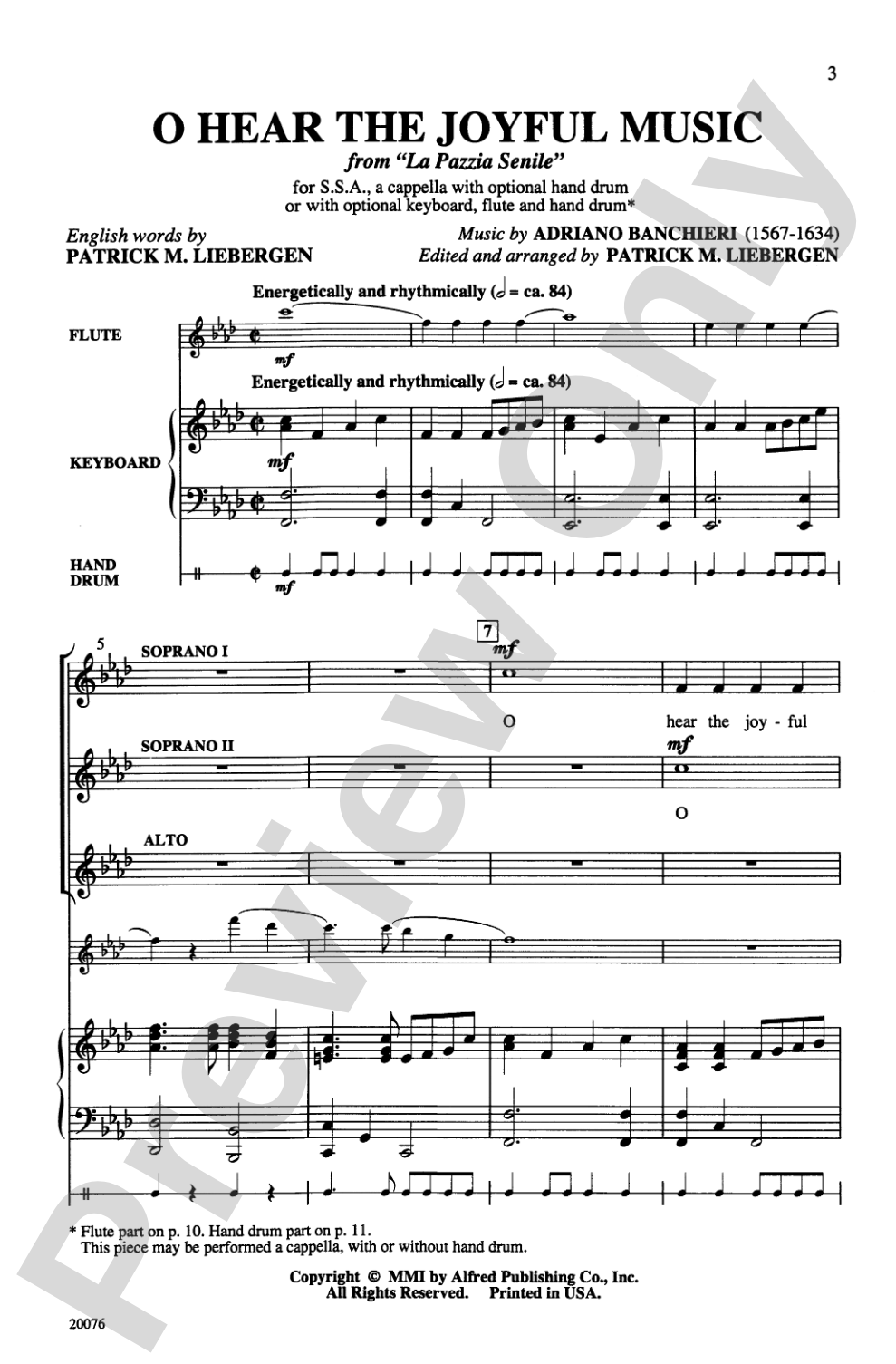
O Hear the Joyful Music Sheet Music Preview

O Hear the Joyful Music: SSA, a cappella Choral Octavo

Music by Adriano Banchieri / arr. Patrick M. Liebergen

Item: 00-PO-0004197

Digital Download
$2.25

Minimum order quantity: 20 copies

Description
Here's a no-nonsense choral masterwork from the Renaissance era skillfully edited and arranged for SSA voices by Patrick Liebergen. It's canonic in nature, with a strong melody which is echoed by all voice parts. The new text is a praise to music , making it suitable for year round use in concerts, festivals and adjudications. May be performed with or without the optional piano, flute and hand drum parts, all included in the publication. Included also are Editor's Notes and biographical information.

O Hear the Joyful Music: SSA, a cappella Choral Octavo isn't in MakeMusic Cloud just yet...but it could be. Let us know you'd like to see it, and you'll help shape what comes next. In the meantime, start a free trial and dive into thousands of interactive titles your students can play along with today.

Sample Audio
0:00
0:00
Sample Video
Additional Details
Series: Alfred Archive Edition: Alfred Choral Designs
Publisher: Alfred Music
Page Count: 12
SKU: 00-PO-0004197
Instrumentation: Opt. Piano, Flute & Hand Drum

More about this title

About the Composer: Adriano Banchieri

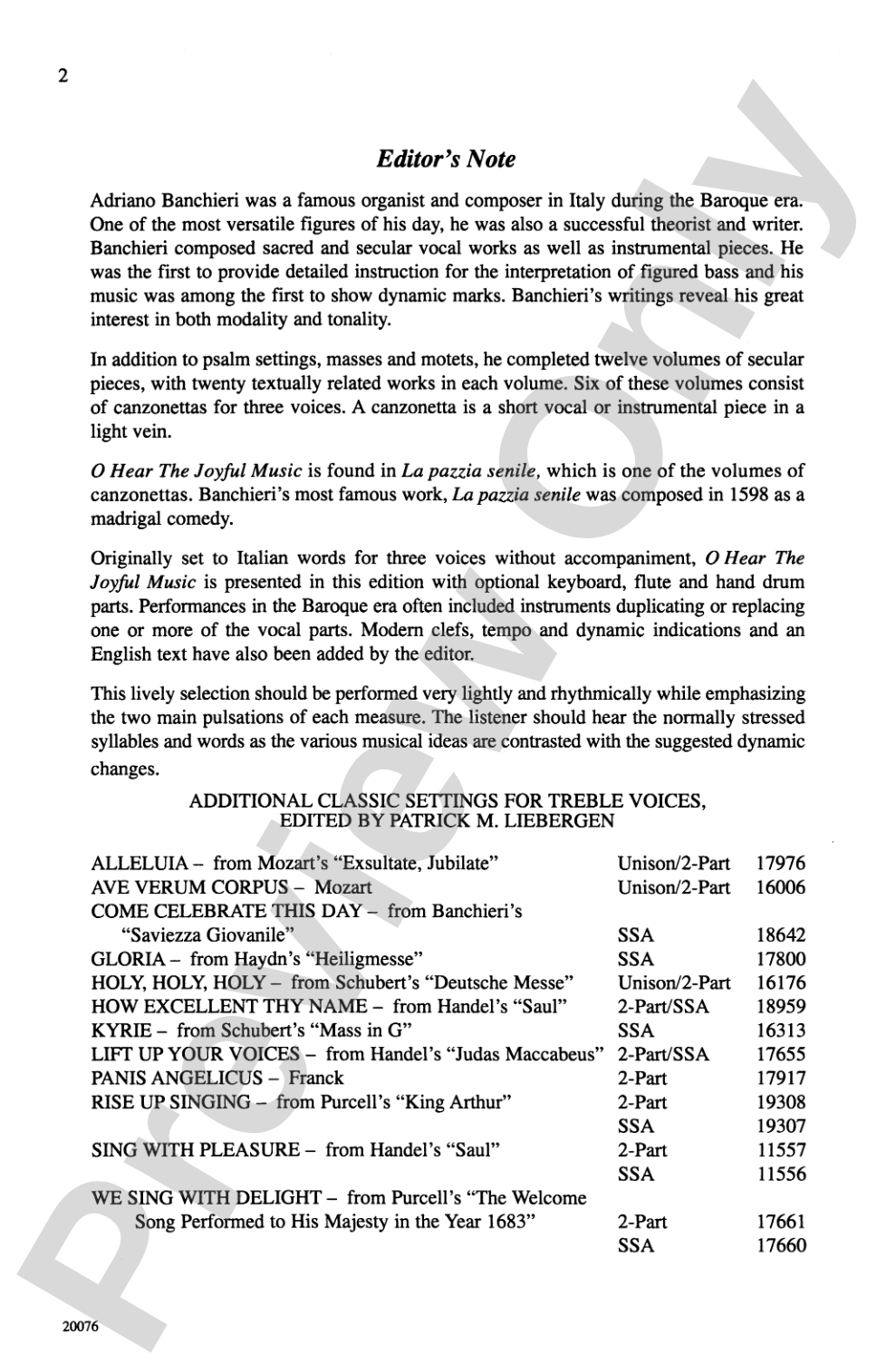
Adriano Banchieri (1568-1634) was an Italian composer, organist, and Benedictine monk whose output bridged the Renaissance and early Baroque periods. His sacred and secular works, including madrigals and canons, were widely performed across Italy and established him as a significant figure in the development of polyphonic choral writing during a time of rapid stylistic change.

Banchieri's gift for crafting singable, memorable melodies made his music accessible to both skilled ensembles and amateur singers. His canonic works in particular demonstrate the structural clarity and musical wit that made Renaissance counterpoint compelling for listeners and performers alike.

Why we love this

Liebergen's arrangement preserves the architectural elegance of Banchieri's canon while opening it to the SSA voicing that dominates school and community choirs. The new praise-text setting transforms a historical artifact into a piece that feels genuinely contemporary, yet the canonic interplay keeps the writing sophisticated enough to hold mature singers' attention during rehearsal and performance.

What to expect

A masterfully interlocking conversation between voices, where the same melodic idea gains new meaning each time it's restated. The text celebrates music itself, creating an uplifting, almost self-referential quality that resonates with singers and audiences alike.

Who it's for

High school and community choirs seeking a substantial choral work that combines musical substance with accessibility. Directors working with SSA groups will appreciate an arrangement that doesn't talk down to singers while accommodating limited upper-voice ranges.

How to get the most out of it

  • Establish the melodic line clearly in the first voice before the other parts enter. Once singers hear the shape, they can track their own imitation with confidence.
  • Experiment with the optional instrumental parts in rehearsal to gauge whether they enhance or obscure your sound. Hand drum and flute add color without requiring instrumental specialists.
  • Pay attention to text underlay at canonic entry points. Slight breath placement differences between voices can either blur or sharpen the moment each part takes up the melody.
  • If performing a cappella, lock in unison passages first; they anchor the ensemble before the canon spreads the voices apart.

How to use it

Pair this with lighter contemporary work to showcase your choir's range, or lead a concert section with pieces exploring Renaissance polyphony. Its flexible instrumentation makes it equally effective in a winter concert setting or festival adjudication, where judges will recognize both historical grounding and thoughtful modern arrangement.

Skills your students will build

  • Singing canonic entries with rhythmic precision and independent phrasing
  • Following melodic lines that pass between voice parts
  • Balancing blend when the same melody appears simultaneously in different registers
  • Interpreting Renaissance polyphonic style with contemporary text underlay

You May Also Like