
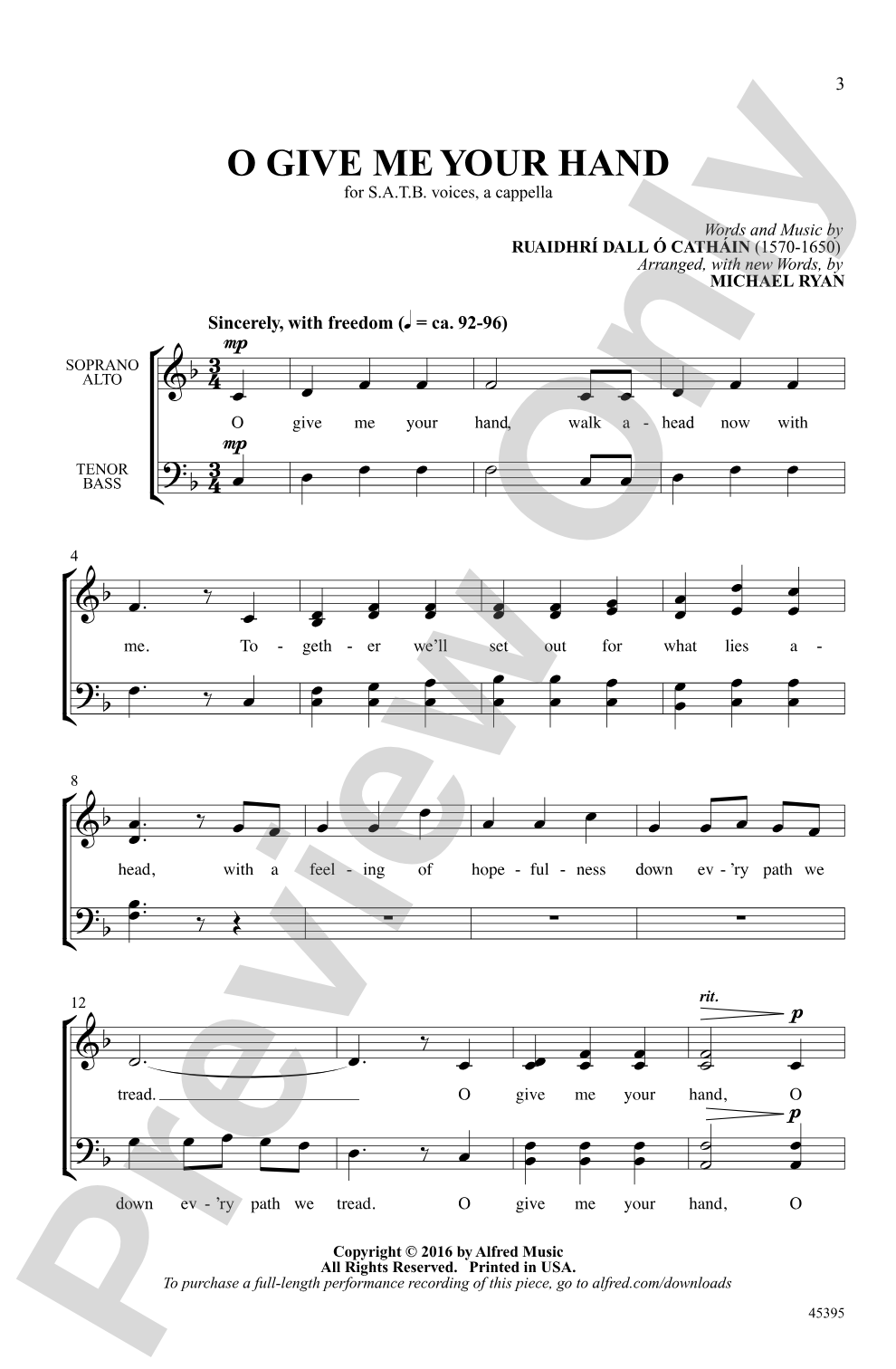

O Give Me Your Hand: SATB, a cappella Choral Octavo
Words and music by Ruaidhrí Dall Ó Catháin / arr., with new words, by Michael Ryan
Item: 00-PO-0003643
$1.90
Minimum order quantity: 20 copies
Pickup currently not available
Related Items
O Give Me Your Hand: SATB, a cappella Choral Octavo |
$1.90
|
View |
Description
Warm and encouraging, this a cappella arrangement of an Irish melody from the 1600s will touch both singers and listeners alike. Thoughtful use of the voices allows each part to shine, while expressive dynamics and lush harmonies emphasize the original text.


O Give Me Your Hand: SATB, a cappella Choral Octavo isn't in MakeMusic Cloud just yet...but it could be. Let us know you'd like to see it, and you'll help shape what comes next. In the meantime, start a free trial and dive into thousands of interactive titles your students can play along with today.
Request This Title
Tell us you want it.
Start Your Free Trial
Explore everything that's ready to play right now.
Sample Audio
1
Audio File
--:--
0:00
0:00
Sample Video
Additional Details
Series:
Alfred Choral Designs
Publisher:
Alfred Music
Page Count:
8
SKU:
00-PO-0003643
More about this title
About the Composer: Ruaidhrí Dall Ó Catháin
Ruaidhrí Dall Ó Catháin (1600-1676) was a blind Irish harper and composer whose work represents a vital thread in the cultural history of 17th-century Ireland. Despite the turbulent political landscape of his time, he composed music that endured in the oral tradition for centuries, influencing both folk and art music across the Irish diaspora.
His melodies are marked by lyrical grace and emotional directness, qualities that have made them beloved subjects for arrangement and reinterpretation by musicians across generations. As an educator, you'll find his work offers a window into how melody can survive and flourish independently of written notation, a testament to the power of memorable musical lines.
Why we love this
Michael Ryan's arrangement preserves the haunting simplicity of this Irish melody while building sophisticated harmonic depth that rewards careful listening. The piece avoids overwrought voice-leading; instead, each part carries genuine musical material, making it engaging for singers at intermediate levels and satisfying for audiences tired of recycled arrangements. It's the kind of secular choral work that programs beautifully alongside both traditional hymnody and contemporary material.
What to expect
There's an intimate tenderness here, the quality of voices gathered close and singing with genuine affection rather than showmanship. The 1600s Irish melody carries a quiet resilience; harmonies emerge that feel both ancient and somehow inevitable, as if they were waiting inside the tune all along. This is music that rests in the room rather than filling it.
Who it's for
This arrangement suits intermediate to advanced SATB choirs looking for repertoire that sits comfortably in the voice but demands musical maturity in interpretation. Community choirs, church choirs transitioning into more sophisticated arrangements, and classical vocal ensembles will all find it accessible and rewarding. Solo singers preparing duets or small ensemble pieces may also benefit from the clear voice writing.
How to get the most out of it
- Shape long lines with subtle dynamic contours rather than holding dynamics static. The warm character emerges when singers understand the phrase architecture and breathe where the melody naturally suggests.
- Balance the voices so no single part dominates, even when it carries the primary tune. This ensures the lush harmonies remain the defining feature rather than a backdrop.
- Attend carefully to tuning in the harmonic progressions, particularly in chord changes where voices move in similar motion. Intonation precision here is what transforms these chords from pleasant to genuinely moving.
- Allow a natural, conversational tempo that breathes with the text. Avoid rushing; the piece's warmth depends on singers having time to shape their phrases and make the harmonies bloom.
How to use it
Consider this for a concert segment celebrating global choral traditions or Irish heritage. It pairs well with both Renaissance sacred repertoire and contemporary secular works, making it versatile for variety programming. The piece's moderate length and straightforward emotional directness make it suitable for community benefit concerts or moments when you want genuine connection rather than technical display.
Skills your students will build
- Sustained four-part ensemble blend in a cappella singing
- Phrasing across longer melodic lines with minimal text repetition
- Voice-leading awareness and understanding harmonic color through tuning
- Balancing individual part security with collective harmonic listening