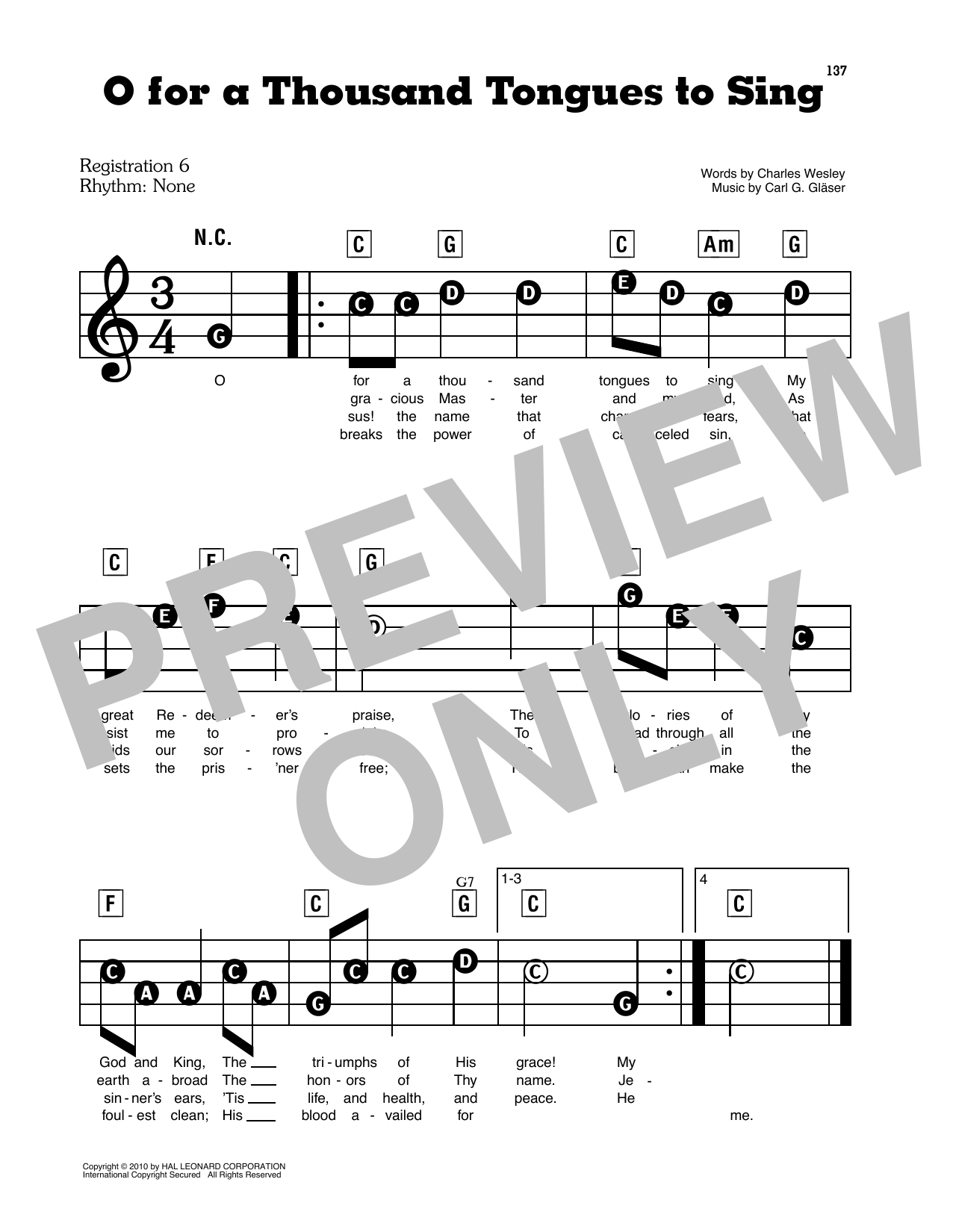
O For A Thousand Tongues To Sing Sheet Music Preview

O For A Thousand Tongues To Sing: E-Z Play Today

As performed by Charles Wesley

Item: 35-DS00459038

Digital Download
$4.99
Description

O For A Thousand Tongues To Sing: E-Z Play Today isn't in MakeMusic Cloud just yet...but it could be. Let us know you'd like to see it, and you'll help shape what comes next. In the meantime, start a free trial and dive into thousands of interactive titles your students can play along with today.

Sample Audio
No sample audio found.
Sample Video
Additional Details
Publisher: Hal Leonard
Page Count: 1
SKU: 35-DS00459038

More about this title

About the Artist: Charles Wesley

Charles Wesley (1707-1788) was a prolific English hymnodist and Methodist leader whose output shaped congregational singing for generations. As the brother of John Wesley and a founding figure in Methodism, Charles composed or wrote over 6,000 hymn texts, many of which remain central to Christian worship today. His facility with verse and melody made him one of the most influential religious songwriters in the English-speaking world.

Why we love this

This hymn sits at the intersection of accessibility and substance. Piano accompaniments of this era reward careful voicing work without demanding virtuosity, and the text's declarative joy inspires genuine musical commitment from players. It's an essential repertoire piece for pianists building a functional church music library.

What to expect

Confident and expansive, with a melodic line that invites listeners into affirmation. The harmonic language feels grounded and assured, creating space for the text to resonate without distracting ornamentation.

Who it's for

Pianists preparing repertoire for worship services, students learning traditional hymn accompaniment, and performers building proficiency with congregational songs. This works for anyone seeking foundational sacred music that connects historical practice to contemporary performance.

How to get the most out of it

  • Shape each phrase toward its peak rather than playing through mechanically; the text carries emotional weight that the harmonic motion supports.
  • Balance the melody so it remains prominent without forcing it; traditional hymn voicings work best when upper voices blend naturally.
  • Keep the tempo steady and unhurried to let the fullness of the harmonies register with listeners.

How to use it

Slot this into any worship service or sacred music recital as a reliable closer or transition piece. It also serves well in educational settings where students need experience with hymn textures and period-appropriate voicing.

Skills your students will build

  • Traditional hymn accompaniment voicing
  • Melodic shape and phrasing in congregational contexts
  • Harmonic independence between hands
  • Sustaining steady tempo across repeated harmonic patterns

You May Also Like