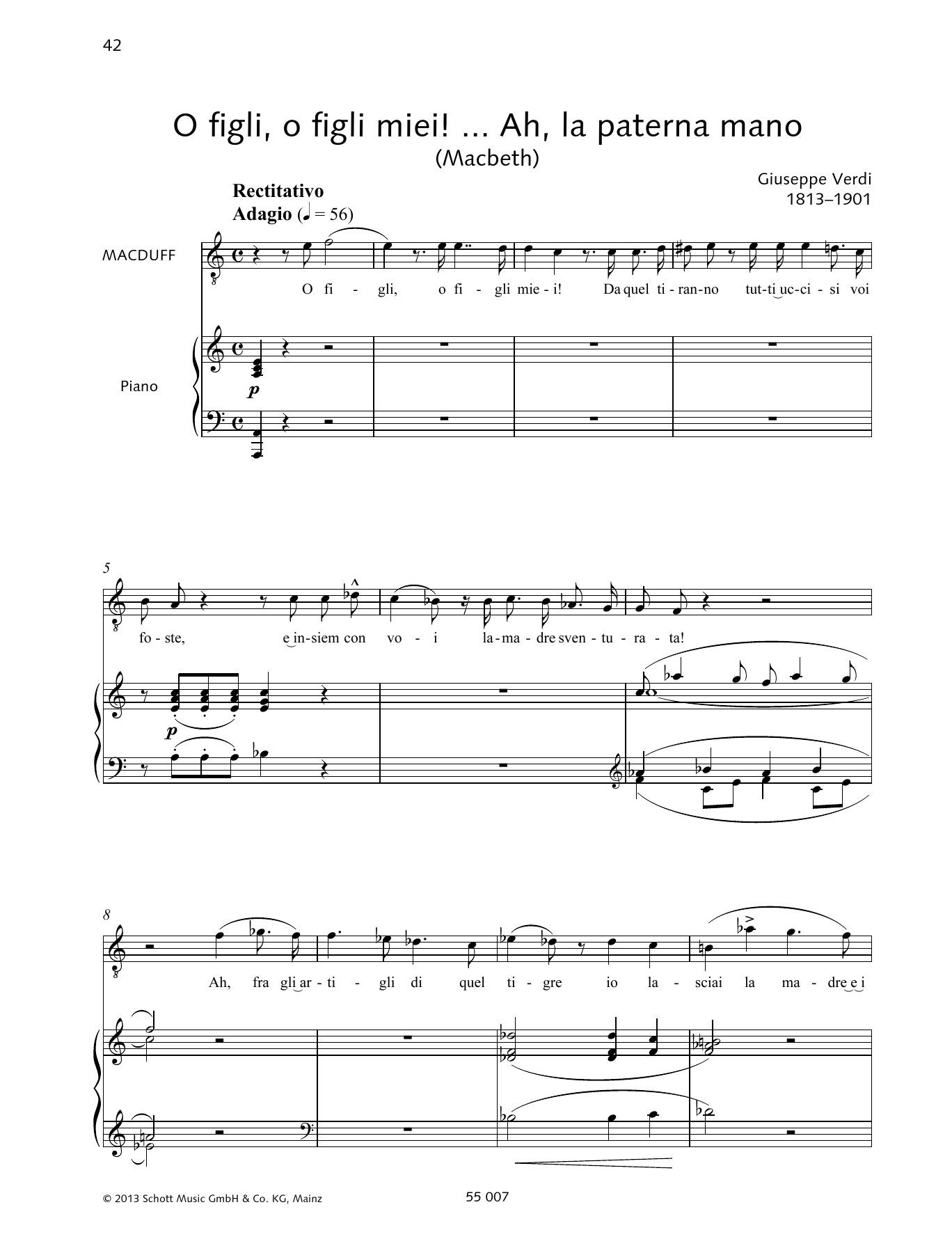
O figli, o figli miei! ... Ah, la paterna mano Sheet Music Preview

O figli, o figli miei!... Ah, la paterna mano: Piano Vocal

By Giuseppe Verdi / Arranged by Francesca Licciarda

Item: 35-DS00369908

Digital Download
$4.99
Description

O figli, o figli miei!... Ah, la paterna mano: Piano Vocal isn't in MakeMusic Cloud just yet...but it could be. Let us know you'd like to see it, and you'll help shape what comes next. In the meantime, start a free trial and dive into thousands of interactive titles your students can play along with today.

Sample Audio
No sample audio found.
Sample Video
Additional Details
Publisher: Hal Leonard
Page Count: 4
SKU: 35-DS00369908

More about this title

About the Composer: Giuseppe Verdi

Giuseppe Verdi (1813-1901) shaped Italian opera across more than five decades, writing works that demanded both vocal power and dramatic intelligence from singers. His gift for melody and his ability to build emotional momentum through orchestration and harmonic language made him a dominant force in 19th-century music, and his operas remain central to the repertoire.

Verdi's vocal writing grew increasingly sophisticated as his career progressed. He understood the human voice intimately, composing passages that sit naturally for singers while pushing them toward greater expressivity and control. For music educators, his works offer rich material for studying dramatic text setting, phrase architecture, and the relationship between vocal line and accompaniment.

Why we love this

This aria captures one of Verdi's most affecting moments: a father's anguish and tenderness layered into a single outpouring of emotion. The accompaniment supports rather than overwhelms the singer, giving the voice room to shape the text with genuine weight. It's the kind of piece that teaches singers what matters most in performance: clarity of intention, respect for the poetry, and the discipline to let silence and simplicity do their work.

What to expect

A moment of profound vulnerability wrapped in 19th-century elegance. The music moves between restraint and yearning, with Verdi's gift for melody giving voice to a father's protective love and private sorrow. The harmonic language supports this emotional transparency, turning a brief opera excerpt into something intimate and deeply human.

Who it's for

Intermediate to advanced singers exploring the Italian repertoire, whether preparing for an audition, building a concert program, or studying Verdi's compositional language in a voice studio. This arrangement gives pianists a substantial accompanying role that rewards musical sensitivity and harmonic awareness.

How to get the most out of it

  • Shape the opening phrases with clear breath points that honor the punctuation of the Italian text; Verdi's phrasing often follows the language's natural speech rhythms rather than symmetrical 8-bar patterns.
  • Balance the vocal line's expressive gestures against the piano accompaniment's harmonic richness; avoid letting either element dominate, as the drama lives in their conversation.
  • Explore the emotional color shifts within the aria by adjusting vowel warmth and breath support at key harmonic moments, particularly where Verdi modulates or emphasizes unexpected chords.

How to use it

Program this alongside other father-child moments in opera or lieder to trace how different composers approach familial emotion. It works equally well as a recital piece for a singer developing Verdi technique or as repertoire for voice study when students are learning how accompaniment patterns can enhance rather than compete with the vocal narrative.

Skills your students will build

  • Reading and performing Italian text with idiomatic phrasing
  • Balancing expressive vocal gestures with harmonic accompaniment
  • Shaping longer phrase arcs that extend beyond regular metrical groupings
  • Interpreting dynamic and textual nuance within a through-composed form

You May Also Like