
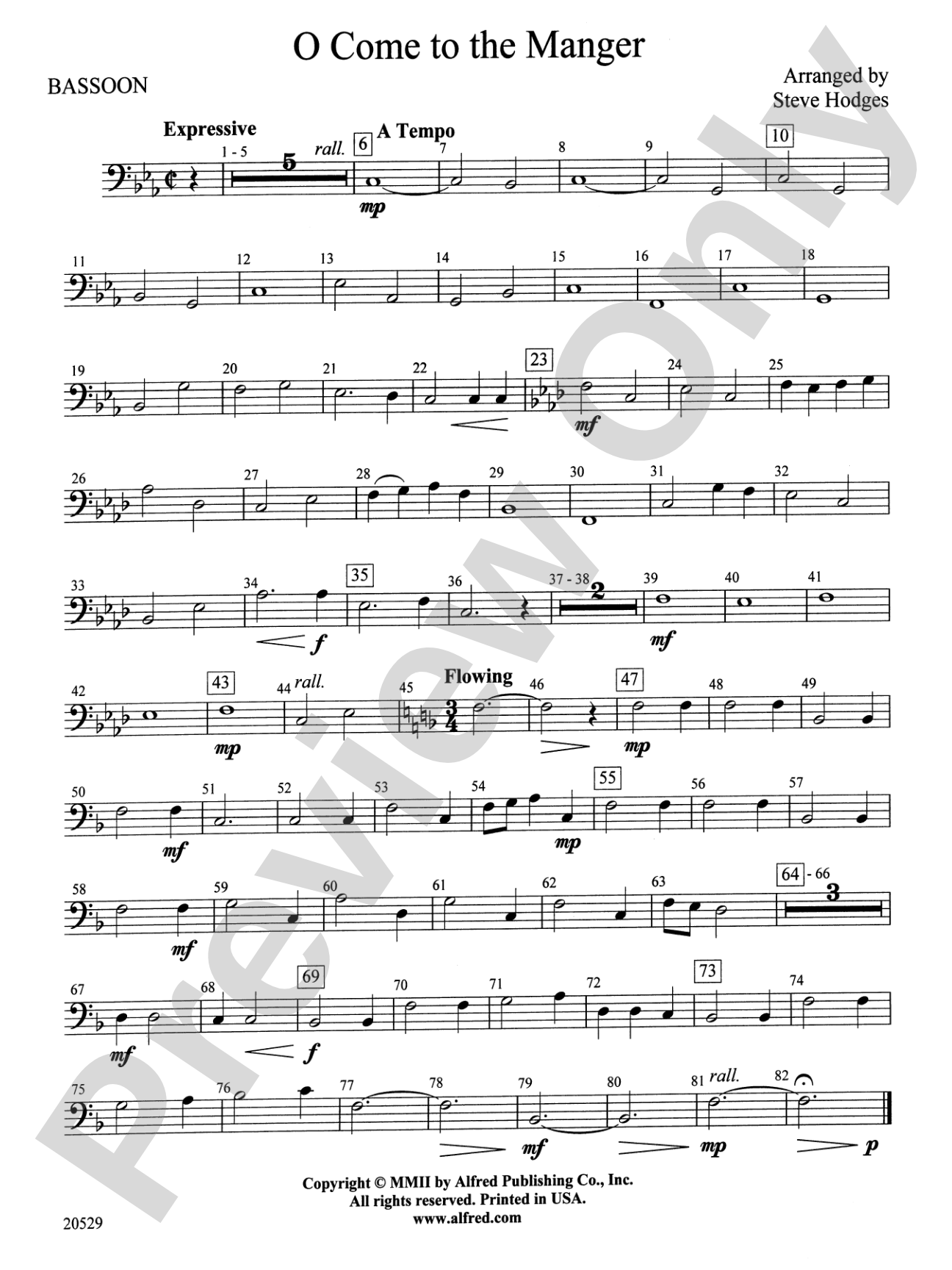

O Come to the Manger: Bassoon
Arr. Steve Hodges
Grade: 1.5 (Easy)
Item: 00-PC-0000396_B1
$3.00
Pickup currently not available
Description
Steve Hodges has taken two famous "manger" tunes and combined them in one piece. Audiences will immediately recognize "O Come, O Come Emmanuel" which leads to a tender arrangement of "Away in a Manger." The two tunes are then juxtaposed for the climax, which subsides and ends as gently as it started.


Don't just read it, hear it, play along with it, and watch your students grow with it. In MakeMusic Cloud, O Come to the Manger: Bassoon comes alive with professional accompaniment, adjustable tempo, and built-in practice tools that turn solo practice into real progress.
Open in the Player
Jump straight in and assign it today.
Start Your Free Trial
Open this title and explore the full library in minutes.
Sample Audio
1
Audio File
--:--
0:00
0:00
Sample Video
No sample videos found.
Additional Details
Series:
Challenger Band Series
Publisher:
Alfred Music
Page Count:
124
SKU:
00-PC-0000396_B1
More about this title
About the Arranger: Steve Hodges

Steve Hodges holds degrees from Western Oregon University (B.S.) and Central Washington University (M.M. Ed.). Over four decades as a public school band and choral director, he developed a distinctive voice in concert band writing that balances accessibility with musical substance.
Since 1986, Hodges has composed and arranged more than 120 works for concert band published by Alfred Music, along with choral arrangements through Staff Music and Shawnee Press. His music reaches far beyond the classroom: his pieces have appeared at festivals and conventions worldwide, been commissioned by honor bands across North America, and licensed by major television networks including TBS and ESPN. He holds membership in ASCAP and has received numerous standard awards. Now retired and living in The Dalles, Oregon, Hodges remains active in community music and finds particular joy when his grandchildren report playing his compositions in their school ensembles.
Why we love this
Hodges understood exactly what directors need from a holiday opener: a piece that lands immediately with the audience through familiar melodic material, yet offers enough musical substance to engage players at this accessible level. The juxtaposition of two beloved "manger" tunes creates a natural arc without requiring virtuosic technical demands, making it rewarding to rehearse and genuinely moving to hear.
What to expect
The piece unfolds with the quiet recognition of a beloved carol, then shifts into intimate tenderness as the second melody enters. The climax brings both themes together in a moment of quiet triumph before subsiding into the same gentle space where the journey began, leaving listeners with warmth rather than spectacle.
Who it's for
This arrangement serves Grade 1.5 concert bands that want to program meaningful holiday music without overextending technical abilities. It works equally well for bands early in the season building foundational skills or for ensembles seeking an emotionally satisfying winter concert selection.
How to get the most out of it
- Shape the opening statement of "O Come, O Come Emmanuel" with a warm, singing tone throughout the winds. This melody carries the emotional weight of recognition, so resist the urge to overstate dynamics early.
- Balance the transition to "Away in a Manger" carefully. The tender arrangement needs sufficient support from the low brass and reeds to maintain harmonic color, but the texture should thin noticeably from the opening section.
- Build the climax where both tunes are juxtaposed with confidence, allowing the counterpoint to speak clearly without muddying the ensemble sound. Each section should know which melody it carries.
- Return to the gentle ending with the same care you gave the opening. The final resolution should feel inevitable rather than abrupt, allowing the last chord to sustain with full resonance before releasing.
How to use it
Program this as an opening piece or as part of a mixed holiday set. Its straightforward accessibility makes it an excellent centerpiece for community concert programs or those mixed with more demanding works. The emotional arc also works well as a quiet moment in a longer concert flow.
Skills your students will build
- Balancing melodic lines with accompaniment textures
- Sustaining legato phrase shapes across multiple measures
- Transitioning smoothly between contrasting musical sections
- Blending instrumentation to create warm harmonic color
- Responding to subtle dynamic shaping and expressive intent