
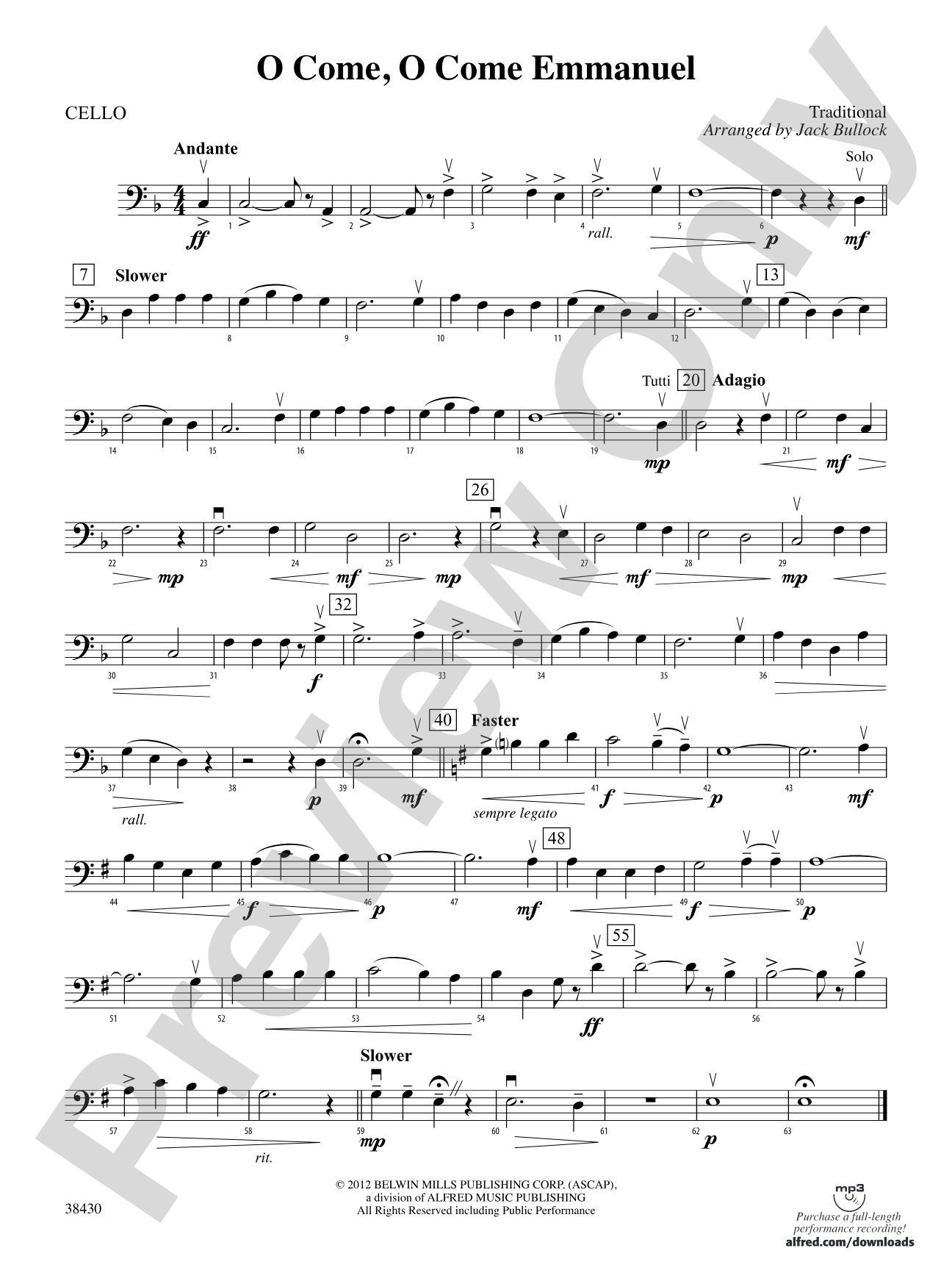

O Come, O Come Emmanuel: Cello
Traditional / arr. Jack Bullock
Grade: 2.5
Item: 00-PC-0015495_VC1
$5.99
Pickup currently not available
Description
One of the most revered songs of Advent, this plaintive melody with mixed three- and four-measure phrases reflects the 15th century, when it was composed. However, this distinctive melody and message is always current during the holiday season and this arrangement can be played by strings with piano or by full orchestra. Rejoice!


Don't just read it, hear it, play along with it, and watch your students grow with it. In MakeMusic Cloud, O Come, O Come Emmanuel: Cello comes alive with professional accompaniment, adjustable tempo, and built-in practice tools that turn solo practice into real progress.
Open in the Player
Jump straight in and assign it today.
Start Your Free Trial
Open this title and explore the full library in minutes.
Sample Audio
1
Audio File
--:--
0:00
0:00
Sample Video
No sample videos found.
Additional Details
Series:
Belwin Intermediate String/Full Orchestra
Publisher:
Alfred Music
Page Count:
120
SKU:
00-PC-0015495_VC1
More about this title
About the Arranger: Jack Bullock

Jack Bullock brings decades of experience as performer, composer, and educator to every arrangement he creates. A trumpet player who performed with the Miami Philharmonic Orchestra and Miami Opera Company, as well as with regional and touring dance bands, he understands the demands and possibilities of ensemble writing from the inside. He holds degrees in music education at the undergraduate, graduate, and doctoral levels.
With more than 600 published works across concert band, orchestra, jazz ensemble, and marching band, Bullock has shaped music education curricula and training materials used in classrooms nationwide. He taught instrumental music for 20 years, including seven years at Ithaca College's School of Music as an assistant band director and four years as chair of the Music Education Department. His work appears in Music Expressions, Alfred Music and Belwin's innovative school music curriculum, and he co-authored the Belwin 21st Century Band Method. Since 1980, he has been an ASCAP member.
Why we love this
Bullock's treatment respects the timeless gravity of this 15th-century text while writing orchestration that works for ensembles at the intermediate level. The flexibility to perform with strings and piano or full orchestra means you can use this arrangement whether your orchestra is small, large, or somewhere in between. The mixed phrase lengths create rhythmic interest that prevents the arrangement from feeling stiff, and the Grade 2.5 level keeps the technical demands reasonable so that expressive playing becomes the focus.
What to expect
The melody carries the weight of centuries while remaining accessible and direct. There is a meditative quality to the arrangement, with the mixed phrasing creating subtle unexpected turns that give the familiar tune a sense of discovery. The orchestration lets the hymn breathe, creating space for reflection rather than grandeur.
Who it's for
Orchestra directors looking for substantial repertoire that bridges the gap between beginning and advanced ensembles. Intermediate orchestras preparing holiday concerts will find a piece that respects both the tradition and the technical level of their players. Programs seeking music that combines accessibility with musical depth benefit from this arrangement's straightforward but expressive approach.
How to get the most out of it
- Shape the phrases according to their natural breathing points rather than conducting uniform four-measure phrases. The mixed three- and four-measure sections should feel organic, not mechanical.
- Balance the melodic line across the ensemble so the hymn's message carries clearly. Check that violas and inner strings aren't overshadowing the primary voice.
- Let the plaintive quality emerge through careful attention to dynamics and tone color rather than through slow tempos. Maintain forward motion even in moments of reflection.
- If using the string and piano option, ensure the keyboard part has enough definition to support harmonic clarity without drowning out the orchestral sound.
How to use it
Program this as the anchor of your Advent or early Christmas concert, where it can frame other holiday selections or stand alone as a moment of quiet contemplation. The Grade 2.5 level makes it suitable for combined orchestra concerts where ensembles of different abilities perform together. Consider pairing it with other traditional hymn arrangements or contrasting it with contemporary holiday music to showcase different approaches to the season.
Skills your students will build
- Conducting or performing mixed phrase structures (3/4 and 4/4 measure patterns within a single piece)
- Balance and blend across orchestral sections while highlighting a primary melodic line
- Expressive playing at the intermediate level without relying on extreme tempo variations
- Harmonic awareness through sustained chords and supporting parts that clarify the arrangement's structure