
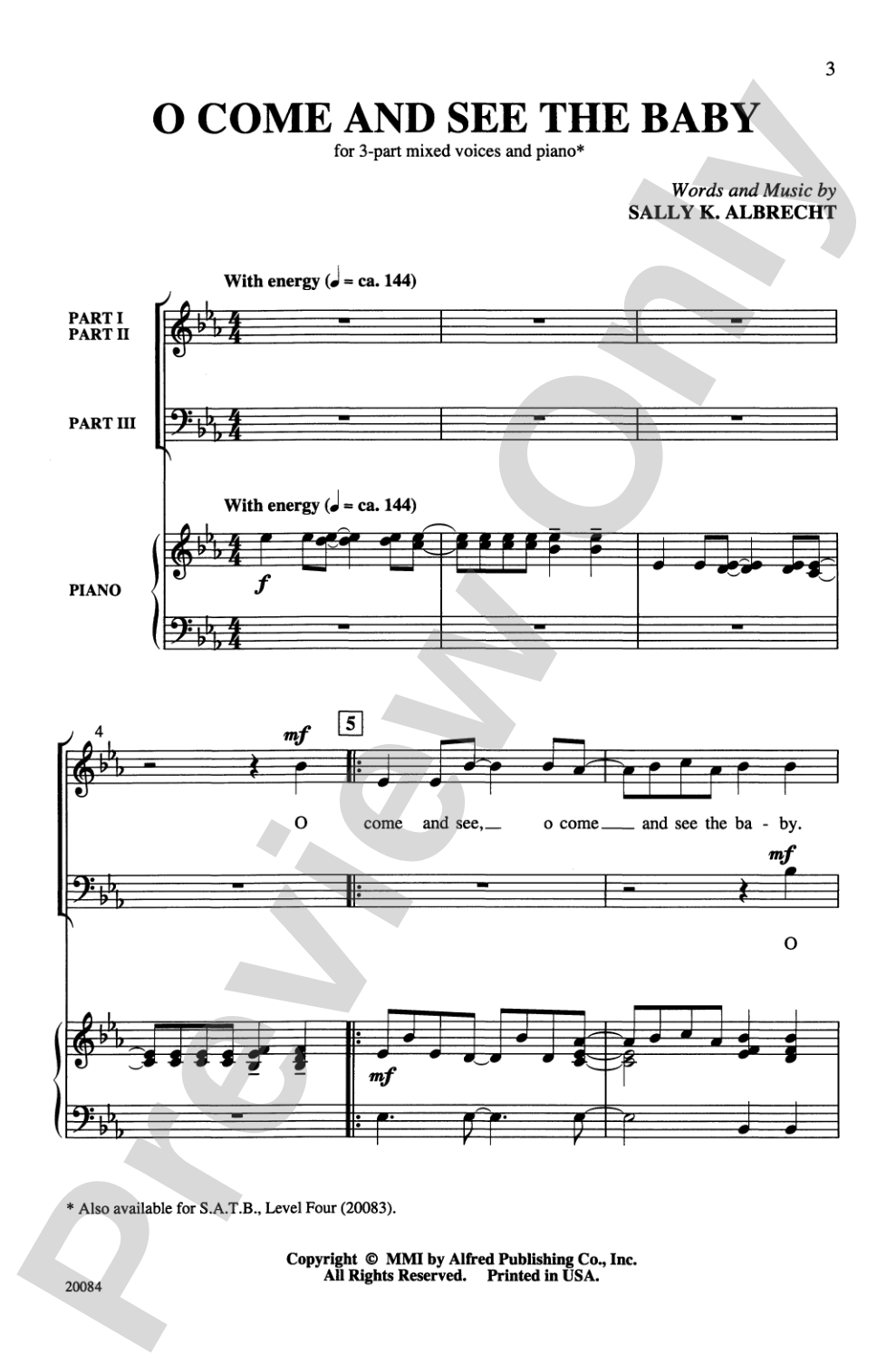
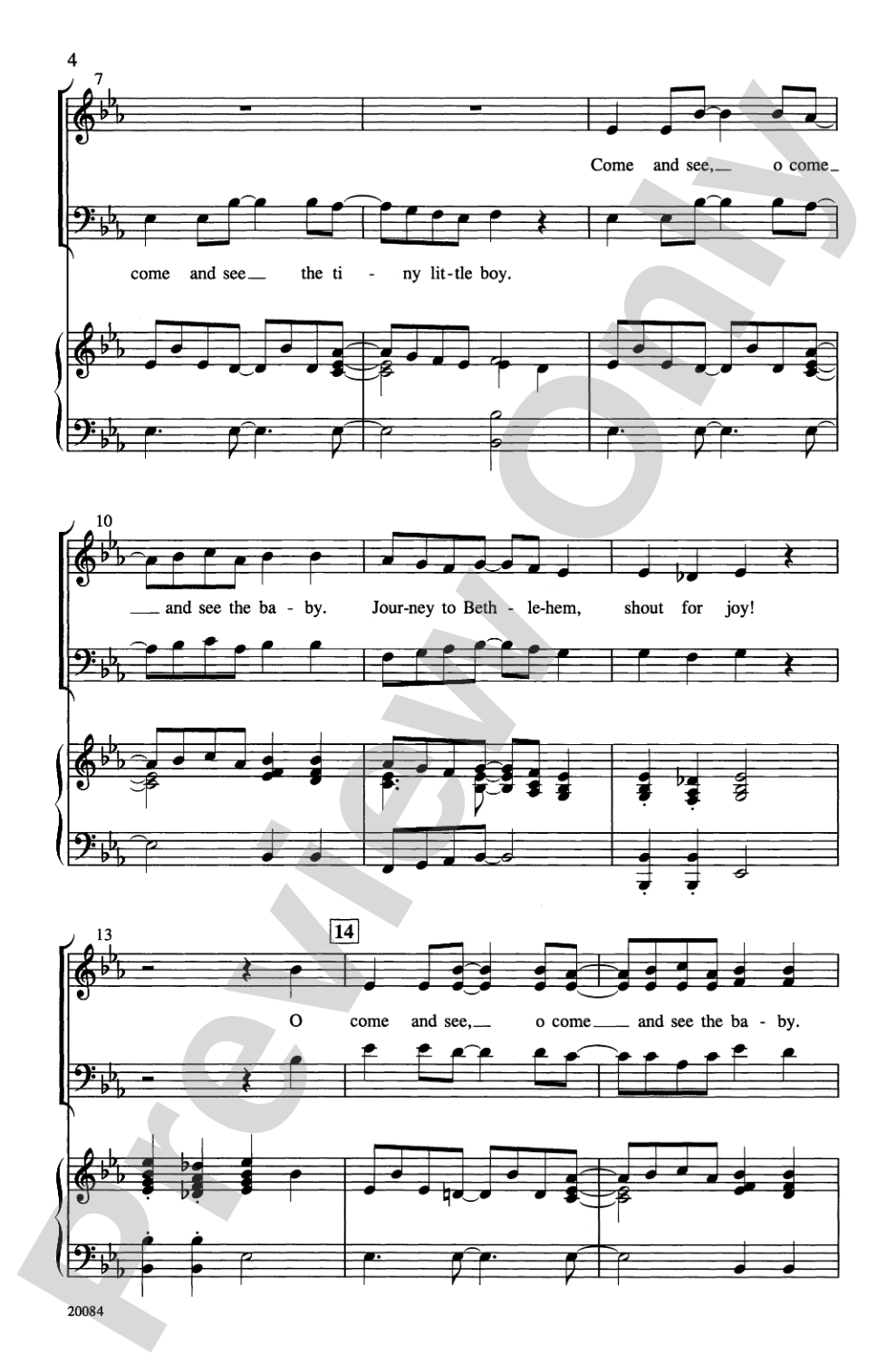

O Come and See the Baby: 3-Part Mixed Choral Octavo
Music by Sally K. Albrecht
Item: 00-PO-0004200
$2.25
Minimum order quantity: 20 copies
Pickup currently not available
Description
A piano fanfare opens this vibrant new original Christmas work by Sally Albrecht. Strong part writing and rhythmic interest add excitement and joy. Then, unexpectedly yet perfectly, the choir sings a touch of Joy to the World: "Joy to the world, a tiny baby is born! let earth receive her King!" Features a brief, optional descant for high voices. Great for mixed choirs of all ages. Appropriate for school or church.


O Come and See the Baby: 3-Part Mixed Choral Octavo isn't in MakeMusic Cloud just yet...but it could be. Let us know you'd like to see it, and you'll help shape what comes next. In the meantime, start a free trial and dive into thousands of interactive titles your students can play along with today.
Request This Title
Tell us you want it.
Start Your Free Trial
Explore everything that's ready to play right now.
Sample Audio
1
Audio File
--:--
0:00
0:00
Sample Video
No sample videos found.
Additional Details
Series:
Alfred Archive Edition: Alfred Choral Designs
Publisher:
Alfred Music
Page Count:
12
SKU:
00-PO-0004200
More about this title
About the Composer: Sally K. Albrecht

Sally K. Albrecht has shaped choral music education for over three decades, first as Director of School Choral, Vocal, and Elementary Publications at major educational publishers, most recently at Alfred Music, and continuing as a prolific composer with more than 600 published choral works and 75 larger musicals and songbooks in circulation. Her contributions to the field have earned her the ASCAP Special Music Award annually since 1987, and she has led honor choirs and festival ensembles at prestigious venues including Lincoln Center, Carnegie Hall, and The Kennedy Center.
Albrecht earned her B.A. in Music and Theater from Rollins College (Florida) in 1976, then completed both an M.A. in Drama and an M.M. in Accompanying from the University of Miami. She has taught at Oakland University, Jersey City State College, and Meredith College. Her leadership extends beyond composition and conducting; she served as Chair of the Board of Trustees for Omicron Delta Kappa National Leadership Honor Society and received their "Pillar of Leadership" award. In 2021, both the University of Miami Frost School of Music and Rollins College recognized her with Distinguished Alumna awards.
Why we love this
Albrecht opens with genuine musical surprise here: a bright piano fanfare that immediately signals celebration, then pulls the choir into strong, rhythmically engaging original material before the reverent callback to "Joy to the World." The descant option gives your strongest voices an expressive layer without creating two separate pieces, and the SAB voicing sits naturally across mixed choirs, whether you're working with middle schoolers or adult singers.
What to expect
The piece radiates warmth and celebration from its first bright piano gesture through to its joyful conclusion. There is genuine surprise in the pivot to "Joy to the World," creating a moment that feels both reverent and exultant, as if two different musical worlds collide and resolve into shared rejoicing.
Who it's for
This octavo works for mixed choirs at any age or experience level, from middle school ensembles encountering contemporary sacred music to adult church choirs seeking something fresh and singable. The accessible but never simplistic part writing means developing singers can succeed while mature ensembles will appreciate the harmonic sophistication and rhythmic detail.
How to get the most out of it
- Let the opening piano fanfare establish the piece's infectious energy clearly; this sets the emotional tone for everything that follows and preps singers to enter with full voice and joy.
- Balance the original choral material with the familiar "Joy to the World" text so both sections feel equally important; resist the urge to overshadow the new writing with the beloved hymn.
- If using the descant, rehearse it separately first, then layer it in once the main SAB parts are secure; this prevents the high voices from being pulled out of the primary vocal line too early.
- Shape the rhythmic interest Albrecht builds into the part writing by isolating tricky sections in slow tempo, then gradually increasing speed until the syncopation feels natural rather than forced.
How to use it
Program this as a centerpiece in a Christmas concert, where its original music and familiar reference point satisfy both contemporary and traditional programming appetites. It also works well in a winter concert that mixes sacred and secular works, since it bridges both sensibilities without apology.
Skills your students will build
- Secure intonation in block harmony while maintaining rhythmic independence
- Part independence through rhythmically active SAB writing
- Sight-reading contemporary hymn arrangements and original choral settings
- Blend and balance between independent voice lines and unified vocal texture
- Text projection and emotional contrast between original and familiar material