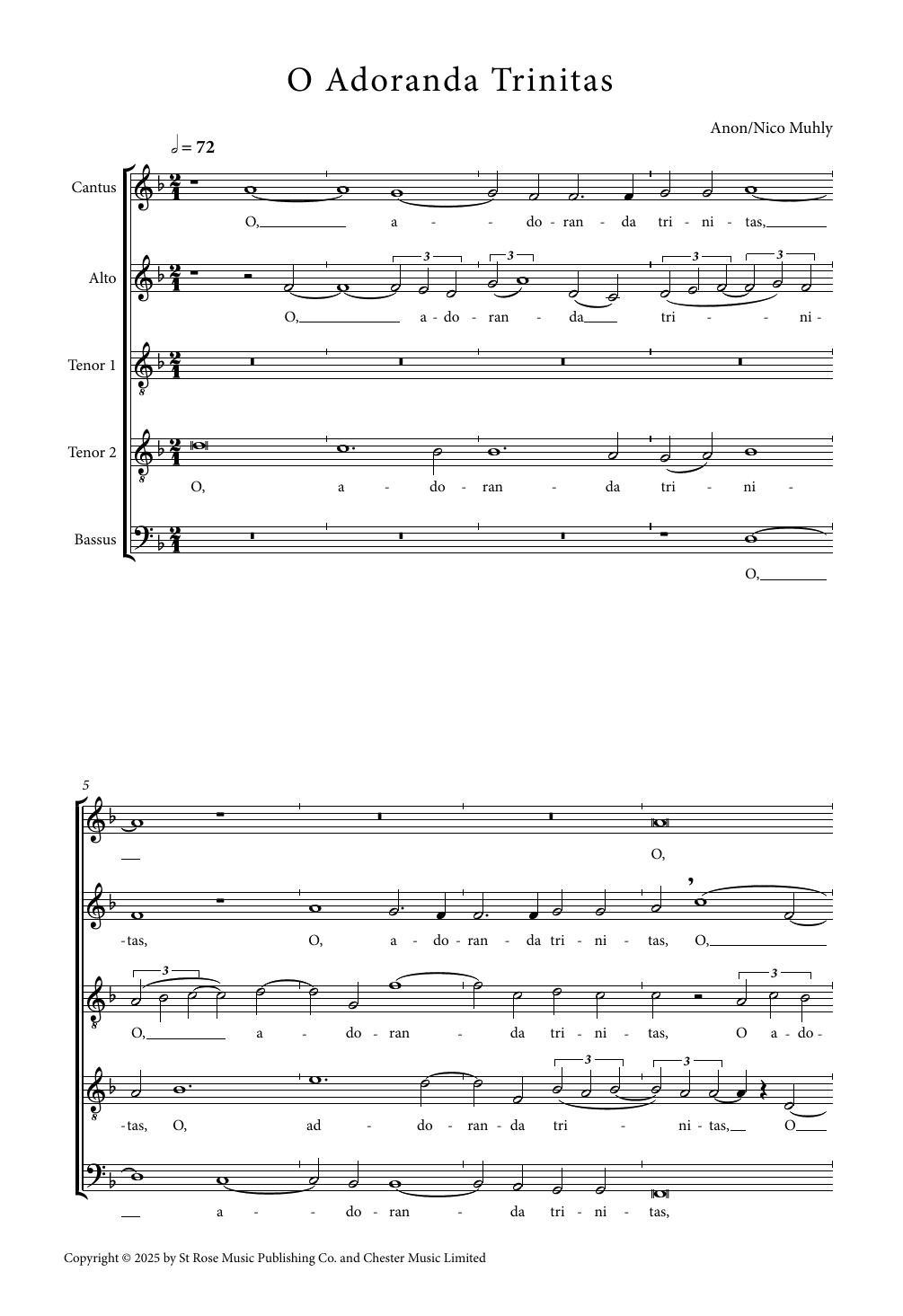
O adoranda trinitas Sheet Music Preview

O adoranda trinitas: SATTB Choral Octavo

By Nico Muhly

Item: 35-DS01913496

Digital Download
$2.95
Description

O adoranda trinitas: SATTB Choral Octavo isn't in MakeMusic Cloud just yet...but it could be. Let us know you'd like to see it, and you'll help shape what comes next. In the meantime, start a free trial and dive into thousands of interactive titles your students can play along with today.

Sample Audio
No sample audio found.
Sample Video
Additional Details
Publisher: Hal Leonard
Page Count: 8
SKU: 35-DS01913496

More about this title

About the Composer: Nico Muhly

Nico Muhly is an American composer whose vocal writing draws on both classical traditions and contemporary harmonic language. His choral works are prized for their accessibility without sacrificing musical sophistication, making them frequent choices for collegiate and professional ensembles seeking repertoire that challenges singers while remaining performable within realistic rehearsal timelines.

Muhly's compositional voice balances clarity with complexity. He writes idiomatically for the human voice, respects the intelligence of performers, and crafts pieces that reward careful listening through intricate counterpoint and surprising harmonic turns.

Why we love this

Muhly's setting of this sacred Latin text achieves something genuinely difficult: it sounds both modern and timeless. The harmonic language is sophisticated without becoming precious, and the SATTB voicing sits naturally in the voice, making it a strong choice for ensembles seeking meaningful sacred repertoire that doesn't rely on familiar melodic formulas.

What to expect

The piece unfolds with a sense of reverent contemplation, built from interlocking vocal lines that suggest complexity without abandoning warmth. There is something almost austere in its beauty; the harmonic language is modern, yet the overall effect is devotional and intimate rather than experimental.

Who it's for

This octavo works well for collegiate choirs, professional ensembles, and advanced high school groups with solid sight reading and part independence. Singers should be comfortable with contemporary harmonic language and accustomed to listening to multiple melodic lines simultaneously.

How to get the most out of it

  • Balance the soprano and alto lines carefully in passages where they interweave; these voices often carry important thematic material and benefit from transparent, focused tone rather than volume.
  • Attend to the text setting closely. Muhly's approach to word painting is subtle; honor the natural phrasing of Latin vowels and consonants rather than imposing interpretive shapes onto the music.
  • Use score study to help singers understand the harmonic context of their own lines. This music rewards singers who know what the other voices are doing, especially where chromatic movement occurs.
  • Shape phrases through subtle dynamic inflection rather than dramatic gesture. The piece unfolds with its own internal logic; trust the composition to communicate.

How to use it

Place this alongside other contemporary sacred settings to anchor a concert exploring how modern composers engage with liturgical text. It pairs particularly well with Renaissance motets or with other Muhly works, creating a program that spans centuries while maintaining musical coherence.

Skills your students will build

  • Reading contemporary harmonic language and non-traditional voice leading
  • Maintaining independent vocal lines within dense textures
  • Singing with stylistic awareness for 21st-century sacred music
  • Balancing timbre and projection across multiple simultaneous melodic strands

You May Also Like