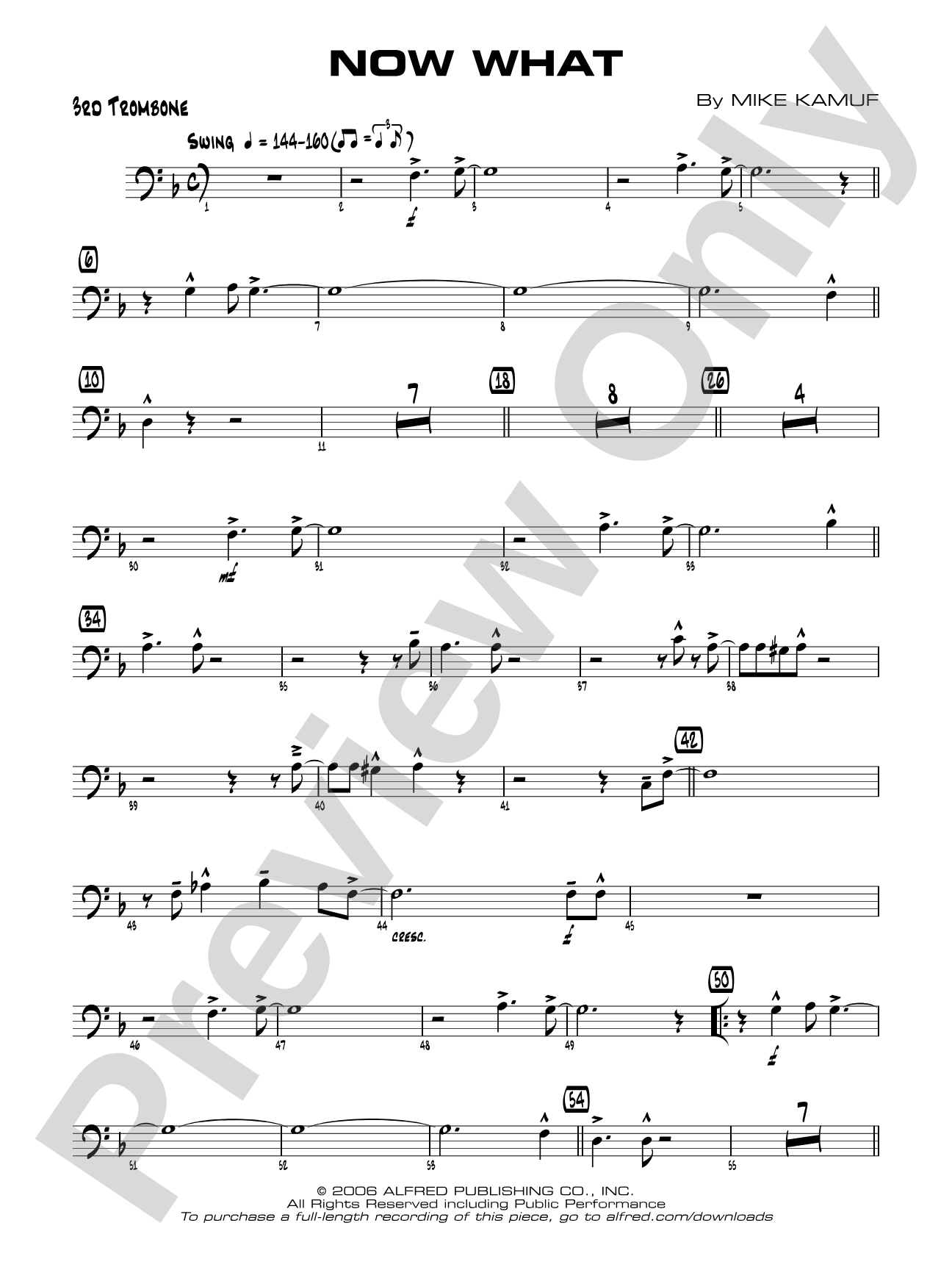
Now What: 3rd Trombone Sheet Music Preview

Now What: 3rd Trombone

By Mike Kamuf

Grade: 2 (Medium Easy)

Item: 00-PC-0014270_TN3

Digital Download
$3.00
Description
Now What is a swing tune, written in the style of Miles Davis' "So What." It provides a great opportunity to learn, play, listen, and solo in a simple two-chord modal style. Written solos for trumpet and alto sax are included, but everybody can solo in this superb chart. Outstanding! This title is available in MakeMusic Cloud.

Don't just read it, hear it, play along with it, and watch your students grow with it. In MakeMusic Cloud, Now What: 3rd Trombone comes alive with professional accompaniment, adjustable tempo, and built-in practice tools that turn solo practice into real progress.

Sample Audio
0:00
0:00
Sample Video
Additional Details
Series: Young Jazz Ensemble
Publisher: Alfred Music
Page Count: 98
SKU: 00-PC-0014270_TN3

More about this title

About the Composer: Mike Kamuf

Mike Kamuf has built a reputation as a composer and arranger who understands what young jazz ensembles need to sound and feel authentic. His work in the Young Jazz Ensemble series demonstrates a gift for crafting material that captures the essence of jazz language while remaining accessible to developing musicians.

Kamuf's arrangements balance pedagogical clarity with genuine musicality. He writes parts that challenge students without overwhelming them, a rare skill that makes his charts popular in middle school and early high school jazz programs.

Why we love this

Kamuf nails what makes modal jazz work in an educational setting: the harmonic simplicity frees students to focus on phrasing, timbre, and individual voice without getting tangled in chord changes. The written solos for trumpet and alto sax give inexperienced improvisers a concrete model to follow, while the two-chord foundation invites the entire section to step up and trade. You get a piece that teaches listening and ensemble sensitivity alongside jazz literacy.

What to expect

Relaxed and spacious, with the quiet confidence of a jam session. The two-chord landscape creates an almost meditative quality that lets listeners drift into the groove, while the written solos and section responses give the piece shape and momentum. It swings with purpose, never rushing.

Who it's for

Jazz ensemble directors working with intermediate ensembles who want to introduce modal improvisation in a manageable, engaging way. Students benefit from hearing and playing a direct echo of a jazz standard, and ensemble members at all levels can find their voice in the solos.

How to get the most out of it

  • Establish the swing feel early in rehearsal by having the rhythm section lock in the backbeat before the horns enter; the groove is everything in a modal tune like this.
  • Encourage soloists to listen to Miles Davis' original "So What" to absorb the sound world and phrasing style that inspired this chart.
  • Balance the written solos against section backgrounds carefully; those backgrounds should breathe and support, not bury the soloist.
  • Give students permission to release tension during open solo sections; modal jazz rewards space and silence as much as notes.

How to use it

Feature this as a concert anchor for a jazz-focused set, or program it mid-concert to showcase your ensemble's ability to swing and solo with maturity. The accessible level and engaging sound make it a strong choice for parent concerts or school assemblies where you want to demonstrate jazz as a living, improvisation-based art form.

Skills your students will build

  • Modal improvisation over a two-chord vamp
  • Swing articulation and phrasing
  • Listening and responding to soloists while playing section backgrounds
  • Building solo lines from scalar material without relying on chord progressions
  • Ensemble communication in a groove-based setting

You May Also Like