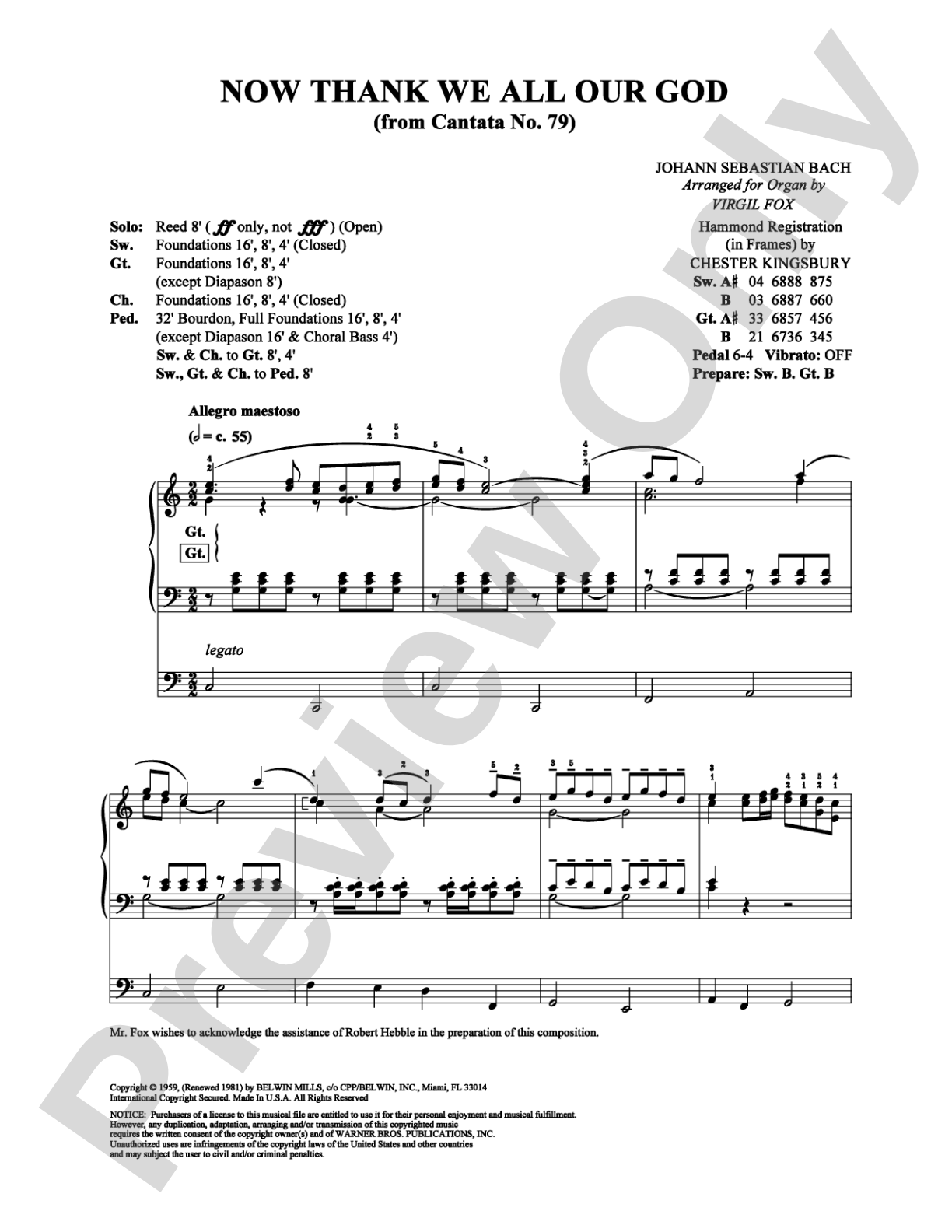
Now Thank We All Our God (from Cantata No. 79): Organ Digital Sheet Music

Now Thank We All Our God (from Cantata No. 79): Organ Digital Sheet Music

Johann Sebastian Bach, Virgil Fox

Item: 00-PS-0003259

Digital Download
$3.99
Description

Now Thank We All Our God (from Cantata No. 79): Organ Digital Sheet Music isn't in MakeMusic Cloud just yet...but it could be. Let us know you'd like to see it, and you'll help shape what comes next. In the meantime, start a free trial and dive into thousands of interactive titles your students can play along with today.

Sample Audio
No sample audio found.
Sample Video
Additional Details
SKU: 00-PS-0003259

More about this title

About the Arranger: Virgil Fox

Virgil Fox (1911-1980) was an American organist and composer who became one of the most celebrated recital performers of the twentieth century. His virtuosic command of the instrument and his gift for reimagining classical works for organ made him a dominant figure in American organ music during the mid-twentieth century.

Fox's arrangements brought baroque and classical repertoire to new audiences through his skillful orchestrations for organ. His work bridged sacred and concert traditions, demonstrating that organ music could reach listeners far beyond the church sanctuary.

Why we love this

Fox's arrangement captures the hymnic strength of Bach's original while showcasing the organ's full expressive range. This version gives organists genuine musical substance without requiring the orchestral forces of the cantata.

What to expect

Stately and reverent, with the gravity of thanksgiving expressed through rich harmonic movement. The piece radiates the clarity and structural integrity of Bach while opening up opportunities for the organist to shape tone and color.

Who it's for

Organists seeking substantial, well-crafted solo material grounded in the Lutheran chorale tradition. This arrangement suits church services, recitals, or teaching contexts where students need experience with contrapuntal writing and registration choices.

How to get the most out of it

  • Establish a steady, dignified tempo that honors the chorale's processional character; avoid rushing the harmonic rhythm.
  • Balance registration between hands to ensure the melody sings above the inner voices; registration changes should reinforce phrasing rather than obscure it.
  • Shape phrases through subtle dynamics and articulation; the organ's natural sustain means clarity comes from rhythmic precision and voice leading, not pedal manipulation.
  • Draw out the warmth in lower octaves during fuller passages, but keep the overall sound transparent enough to hear all four voices.

How to use it

Include this as a prelude or postlude in services centering on gratitude and praise. It also works as a centerpiece in a recital devoted to organ arrangements of baroque sacred music, pairing well with other chorale-based works.

Skills your students will build

  • Reading multi-manual organ notation with independent pedal part
  • Voice leading and counterpoint in four-part writing
  • Registration planning to balance and blend distinct voices
  • Sustaining shape and momentum across longer phrases in a non-percussive instrument
  • Interpreting historical arrangement practices from the twentieth century

You May Also Like