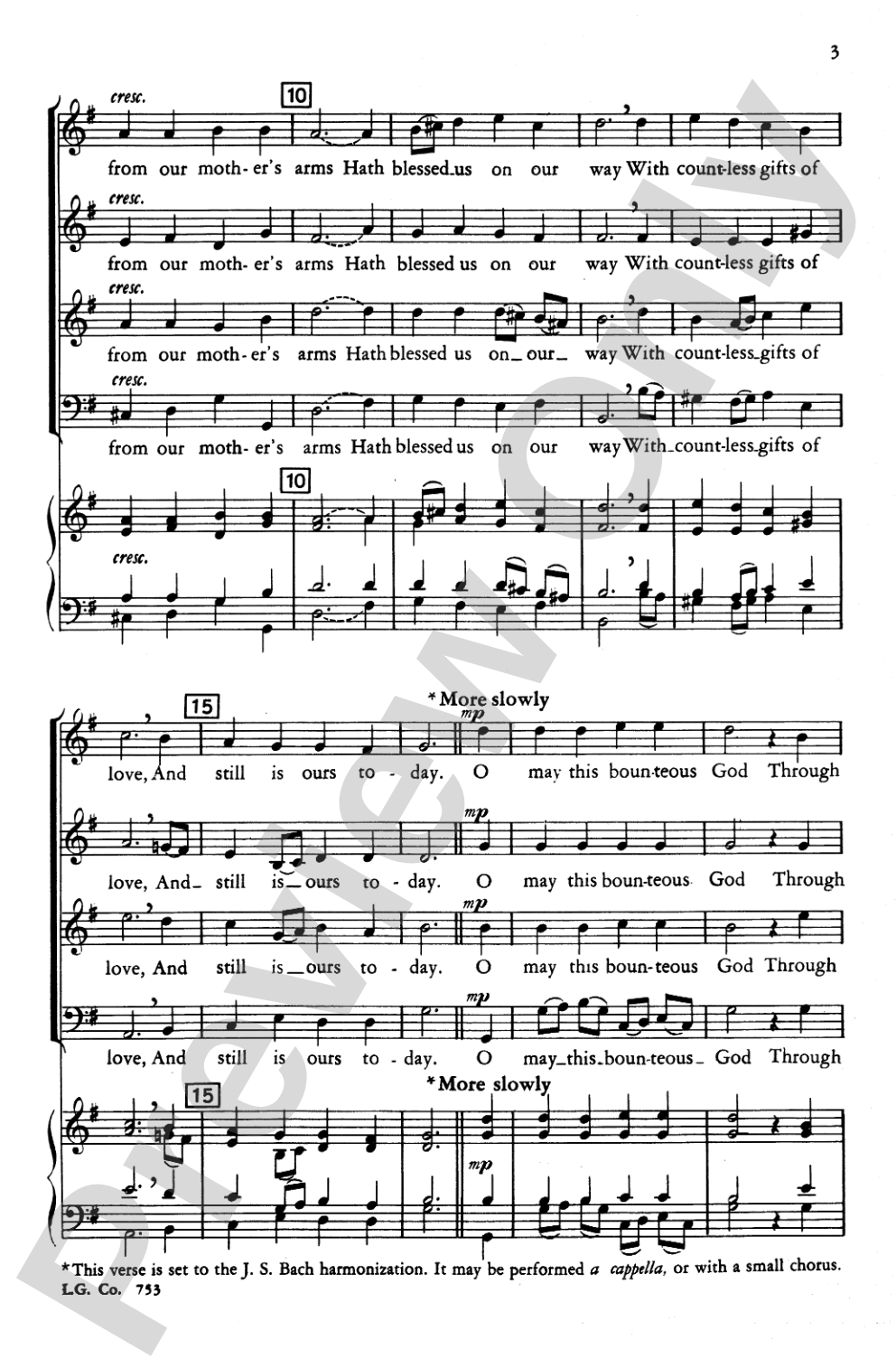
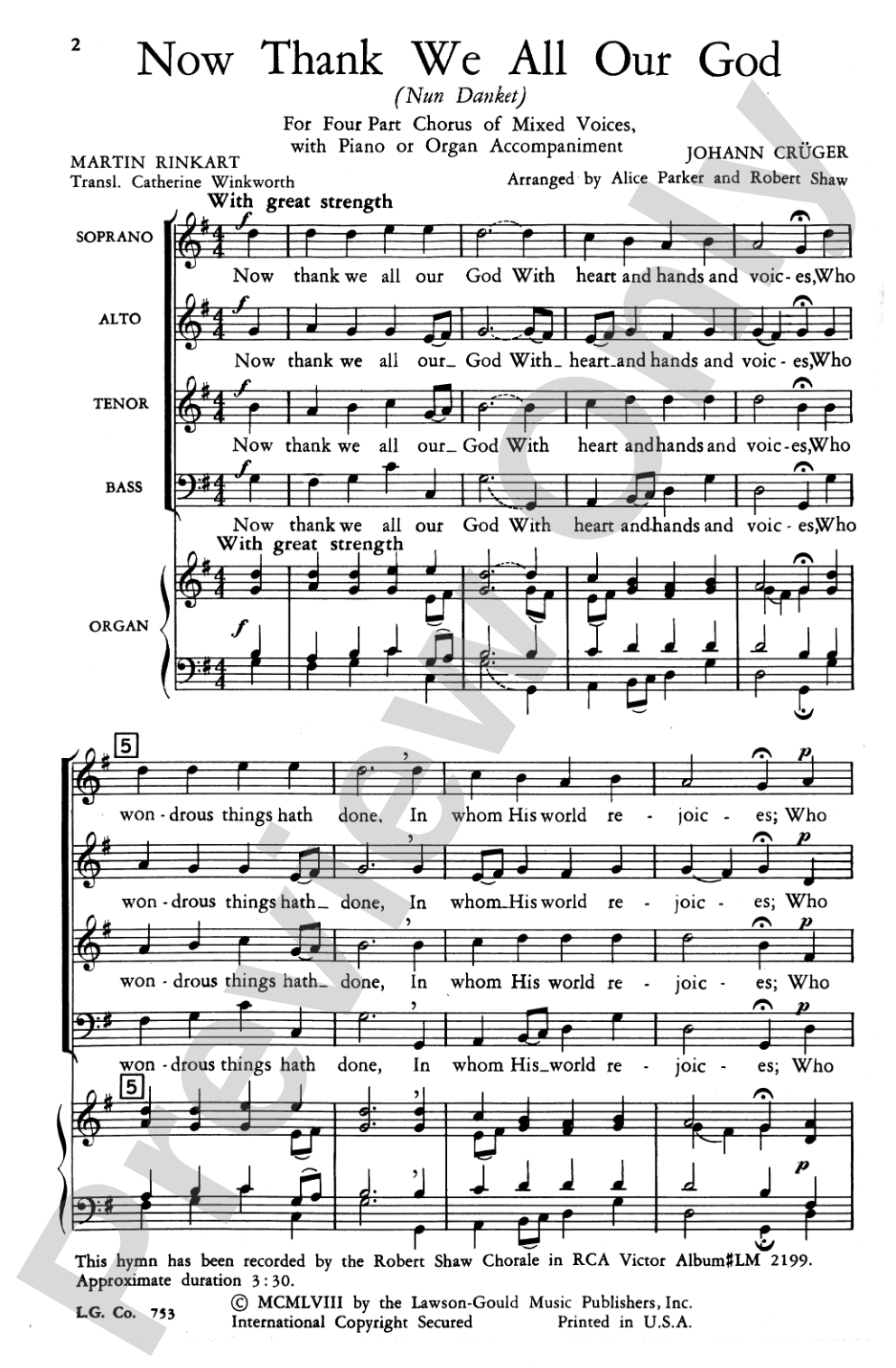
Now Thank We All Our God Sheet Music Preview

Now Thank We All Our God: SATB Choral Octavo

By Johann Crüger / arr. Robert Shaw and Alice Parker

Item: 00-PO-0004944

Digital Download
$2.25

Minimum order quantity: 20 copies

Description

Now Thank We All Our God: SATB Choral Octavo isn't in MakeMusic Cloud just yet...but it could be. Let us know you'd like to see it, and you'll help shape what comes next. In the meantime, start a free trial and dive into thousands of interactive titles your students can play along with today.

Sample Audio
No sample audio found.
Sample Video
Additional Details
Series: Alfred Archive Edition: Robert Shaw Choral Series
Publisher: Alfred Music
Page Count: 8
SKU: 00-PO-0004944

More about this title

About the Composer: Johann Crüger

Johann Crüger (1598–1662) was a German Lutheran cantor and composer whose hymn melodies became foundational to the Protestant chorale tradition. Working in Berlin during a period of religious upheaval, he created music that balanced theological depth with accessibility, allowing congregations to sing their faith with conviction. His melodies remain among the most enduring in Western sacred music.

Crüger's "Nun danket alle Gott" (Now Thank We All Our God) first appeared in his 1647 collection Praxis pietatis melica and quickly became a standard of Lutheran worship. The melody's straightforward, singable contour and its pairing with Martin Behm's text of gratitude secured its place in hymnals across centuries and denominations. His work demonstrates how a composer's gift for memorable line and harmonic clarity can outlive the composer by centuries.

Why we love this

Robert Shaw and Alice Parker's arrangement honors the hymn's noble simplicity while giving it architectural weight through sophisticated voice leading and strategic harmonic movement. This version rewards choirs that can sustain long lines and manage dynamic shape without losing the tune's essential directness. It's the rare arrangement that sounds both timeless and freshly considered.

What to expect

Dignified and warm, with the feeling of a gathered community raising its voice in sustained gratitude. The melody soars with quiet confidence while the harmonies beneath it unfold with unhurried inevitability. There's both intimacy and grandeur here, the sense that something small and true is being held up to the light.

Who it's for

This arrangement serves SATB choirs with solid part-singing skills and experience balancing written harmony with hymn-tune clarity. It works equally well for church choirs preparing a Thanksgiving service and concert choirs seeking sacred repertoire that speaks to both believers and listeners unfamiliar with the text's religious context.

How to get the most out of it

  • Treat the hymn tune as your primary melodic anchor; all voice parts should support and enhance its journey, not compete with it. Balance inner voices carefully so the soprano line remains clear even when surrounded by active harmony.
  • Shape phrases by voice, not just by the whole choir. Each part line has its own natural breath points; respect those even as the overall phrase breathes as a unit.
  • Let the text guide your dynamic arc. Gratitude and thanksgiving suggest forward motion and warmth rather than restraint; avoid undersinging this music.
  • Emphasize the harmonic moments where Shaw and Parker depart from straight chorale style. These moments are intentional and will feel special if the choir recognizes them as such.

How to use it

Anchor a Thanksgiving concert or service around this piece; its length and weight suit a closing work that sends the audience out thoughtfully. Alternatively, program it alongside other sacred works from different eras to show how one melody can be honored across centuries of arranging styles.

Skills your students will build

  • Sustaining long harmonic lines without losing intonation or phrase direction
  • Balancing hymn-tune melody with active inner-voice counterpoint
  • Interpreting text-driven dynamics and pacing in sacred choral writing
  • Recognizing and executing intentional harmonic departures from standard chorale style

You May Also Like