
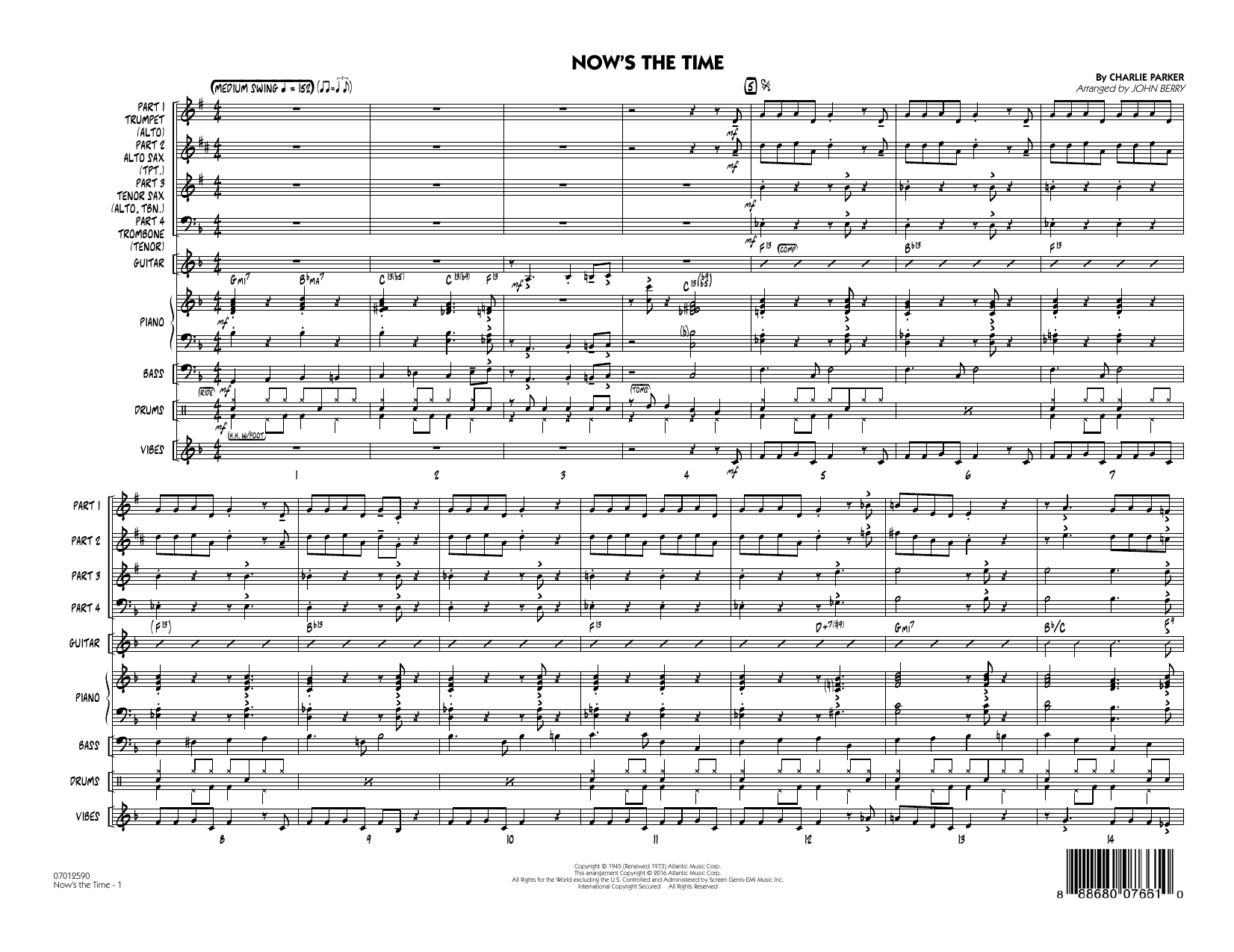

Now's the Time: Jazz Ensemble Conductor Score & Parts
As performed by Charlie Parker / Arranged by John Berry
Grade: 2
Item: 35-PK00319305
$30.00
Pickup currently not available
Buy Extra Parts (Digital PDF Download)
| Product | Price | Quantity |
|---|---|---|
| Now's the Time - Conductor Score (Full Score) | $7.50 | |
| Now's the Time - Part 1 - Bb Trumpet | $6.00 | |
| Now's the Time - Part 1 - Eb Alto Sax | $6.00 | |
| Now's the Time - Part 2 - Eb Alto Sax | $6.00 | |
| Now's the Time - Part 2 - Bb Trumpet | $6.00 | |
| Now's the Time - Part 3 - Bb Tenor Sax | $6.00 | |
| Now's the Time - Part 3 - Eb Alto Sax | $6.00 | |
| Now's the Time - Part 3 - Trombone | $6.00 | |
| Now's the Time - Part 4 - Trombone | $6.00 | |
| Now's the Time - Part 4 - Bb Tenor Sax | $6.00 | |
| Now's the Time - Guitar | $6.00 | |
| Now's the Time - Piano | $6.00 | |
| Now's the Time - Bass | $6.00 | |
| Now's the Time - Drums | $6.00 | |
| Now's the Time - Vibes | $6.00 |
Parts Added to Cart!
Description
This medium swing standard by jazz master Charlie Parker gives even young players a great opportunity to learn style and an introduction to improvising.


Now's the Time: Jazz Ensemble Conductor Score & Parts isn't in MakeMusic Cloud just yet...but it could be. Let us know you'd like to see it, and you'll help shape what comes next. In the meantime, start a free trial and dive into thousands of interactive titles your students can play along with today.
Request This Title
Tell us you want it.
Start Your Free Trial
Explore everything that's ready to play right now.
Sample Audio
No sample audio found.
Sample Video
No sample videos found.
Additional Details
Publisher:
Hal Leonard
SKU:
35-PK00319305
More about this title
About the Artist: Charlie Parker
Charlie Parker revolutionized jazz in the 1940s by developing bebop, a style that prioritized harmonic sophistication and melodic invention over dance-floor accessibility. His compositions became standards not because they were simple, but because they balanced technical brilliance with melodic clarity that other musicians wanted to play and audiences wanted to hear.
Parker's legacy in music education extends far beyond his historical importance. His tunes teach harmonic awareness, phrasing, and the relationship between written melody and improvised variation. Young players studying his work learn how a master craftsman builds sophistication gradually rather than all at once.
Why we love this
Grade 2 arrangements of jazz standards often oversimplify the harmonic language or flatten the rhythmic feel, but this John Berry setting preserves Parker's melodic intent while keeping ensemble coordination manageable. Young players hear and play the real tune, not a watered-down version. That authenticity makes the payoff of learning swing style and basic improvisation feel earned rather than artificial.
What to expect
The melody sits in an accessible range but moves with the restless energy of bebop. Medium swing tempo feels relaxed rather than rushed, giving players room to phrase without fighting the groove. The overall character is optimistic and straightforward, neither overly complex nor dumbed down.
Who it's for
Conductors leading Grade 2 jazz ensembles who want students to encounter bebop melody and swing language without the technical complexity of higher level standards. This works equally well for first time jazz students and for traditional concert bands adding a jazz unit to their curriculum.
How to get the most out of it
- Let the rhythm section drive the tempo by having them rehearse independently first; a solid groove underneath gives soloists confidence to stretch and phrase naturally.
- Build solo space gradually by starting with full ensemble readings, then opening up written parts as soloists take turns. Players learn to listen while others improvise rather than checking out.
- Mark clear section boundaries in parts so transitions between head and solos feel confident rather than tentative. A verbal cue from the conductor combined with visual clarity prevents the common rushing that happens when players aren't sure what comes next.
- Record a rehearsal and play it back during the following session. Hearing how the ensemble sounds together builds awareness of balance and timing in ways individual practice cannot.
How to use it
Program this alongside blues or other Grade 2 jazz standards to build a complete unit on swing idiom and basic improvisation. It works especially well as the first public performance piece for a developing jazz ensemble because the tune is recognizable enough that audiences hear success even in a young group's interpretation. Save it for late fall or winter after rhythm section fundamentals are solid.
Skills your students will build
- Reading and playing straight-eighth swing feel with proper articulation and phrasing
- Understanding basic 12-bar and jazz chord changes
- Constructing simple melodic improvisations over given chord progressions
- Listening and responding to other section members while improvising
- Balancing ensemble unity with individual expression in a jazz context