
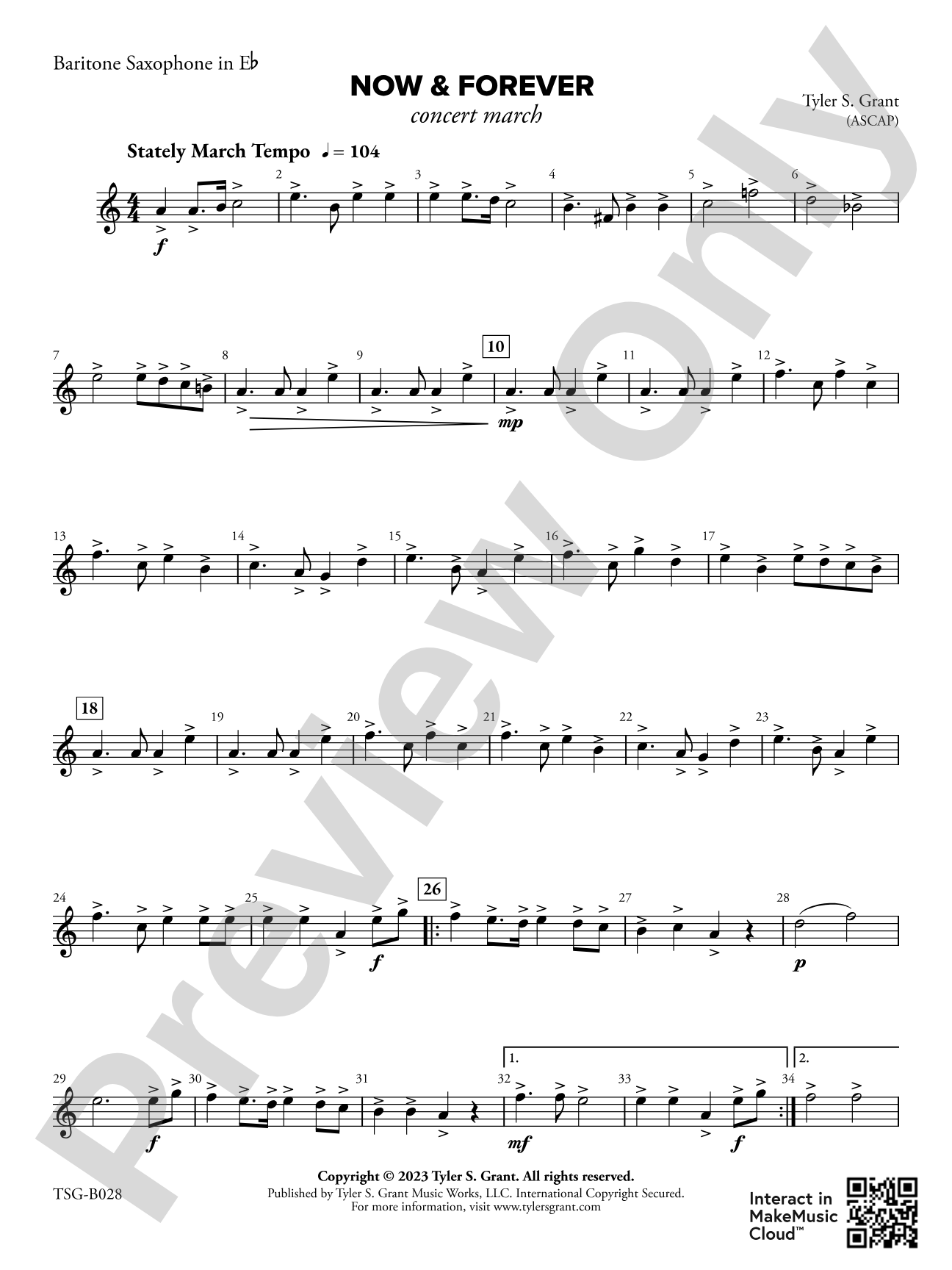

Now & Forever: E-flat Baritone Saxophone
Concert March
By Tyler S. Grant
Grade: 2
Item: 98-PC-TGB028_BTX
$4.50
Pickup currently not available
Description
Now & Forever by Tyler S. Grant is a stately march that will transport your students to the plains of North Dakota! While using a traditional march structure, this work incorporates contemporary orchestration and colorful percussion. Perfect for concert and contest! Recorded by the Atlanta Wind Symphony. (3:15)


Now & Forever: E-flat Baritone Saxophone isn't in MakeMusic Cloud just yet...but it could be. Let us know you'd like to see it, and you'll help shape what comes next. In the meantime, start a free trial and dive into thousands of interactive titles your students can play along with today.
Request This Title
Tell us you want it.
Start Your Free Trial
Explore everything that's ready to play right now.
Sample Audio
1
Audio File
--:--
0:00
0:00
Sample Video
Additional Details
Series:
Tyler S. Grant Music Works
Publisher:
Tyler S. Grant Music Works, LLC.
SKU:
98-PC-TGB028_BTX
More about this title
About the Composer: Tyler S. Grant

Tyler S. Grant has built a reputation as a composer and arranger whose works appear regularly on state and regional honor ensemble rosters, and whose pieces consistently land on curated repertoire lists from publishers and music organizations worldwide. His commissions have come steadily since 2010, and his compositions have reached audiences at major venues including Carnegie Hall, The Midwest Clinic, and the Macy's Thanksgiving Day Parade. His fanfare "Panoramic Fanfare" won the Dallas Wind Symphony's 2014 Call for Fanfares Competition and has since traveled through collegiate and professional ensembles across North America.
Beyond the composer's studio, Grant conducts and clinics regularly, having worked with over 100 school instrumental programs across 15 states and appeared as a conductor at The Midwest Clinic and all-state bands from Nebraska to North Carolina. He studied conducting at the University of Alabama under Randall Coleman, and his pedagogical work includes contributions to Alfred Music's Sound Innovations: Ensemble Development series. Grant credits composer Brian Balmages as a formative influence on his development as a musician.
Why we love this
Grant's marches sit at an intersection that matters for Grade 2 programs: they honor the traditional march form that students understand and enjoy, yet inject contemporary orchestration and percussion writing that keeps the piece interesting for directors who program thoughtfully. The combination of accessibility and musical substance makes this a piece that doesn't feel like a step backward, even as it works perfectly for developing ensembles.
What to expect
The piece evokes the wide-open spaces and deliberate character of the Great Plains, moving with confidence and clarity. Contemporary instrumental colors add shimmer and depth to the traditional march framework, creating something that feels both familiar and refreshed.
Who it's for
Grade 2 concert bands that are ready for more sophisticated repertoire without needing to step up significantly in difficulty. This works equally well for groups preparing for festival or contest and ensembles looking for concert material that engages both performers and audiences.
How to get the most out of it
- Maintain consistent forward motion in the march tempo; let the stately character come from tone quality and phrase shaping rather than from dragging the pulse.
- Balance the contemporary percussion writing by having those players listen carefully to the melodic content; the colorful effects should enhance rather than overshadow the band's primary voices.
- Shape the phrases as you would a lyrical piece, avoiding the common trap of treating march accompaniment patterns as merely functional filler.
How to use it
Position this as your main concert march, or pair it with lighter fare on a festival program where you want to showcase the band's musicality alongside its technical precision. The recorded reference from the Atlanta Wind Symphony gives students a benchmark for ensemble sound and interpretation.
Skills your students will build
- Maintaining steady tempo and pulse within a march context
- Listening to and balancing colorful percussion orchestration
- Executing traditional march accompanying patterns with musical intent
- Responding to phrase-based conducting and expressive shaping
- Reading contemporary orchestration techniques at Grade 2 level