
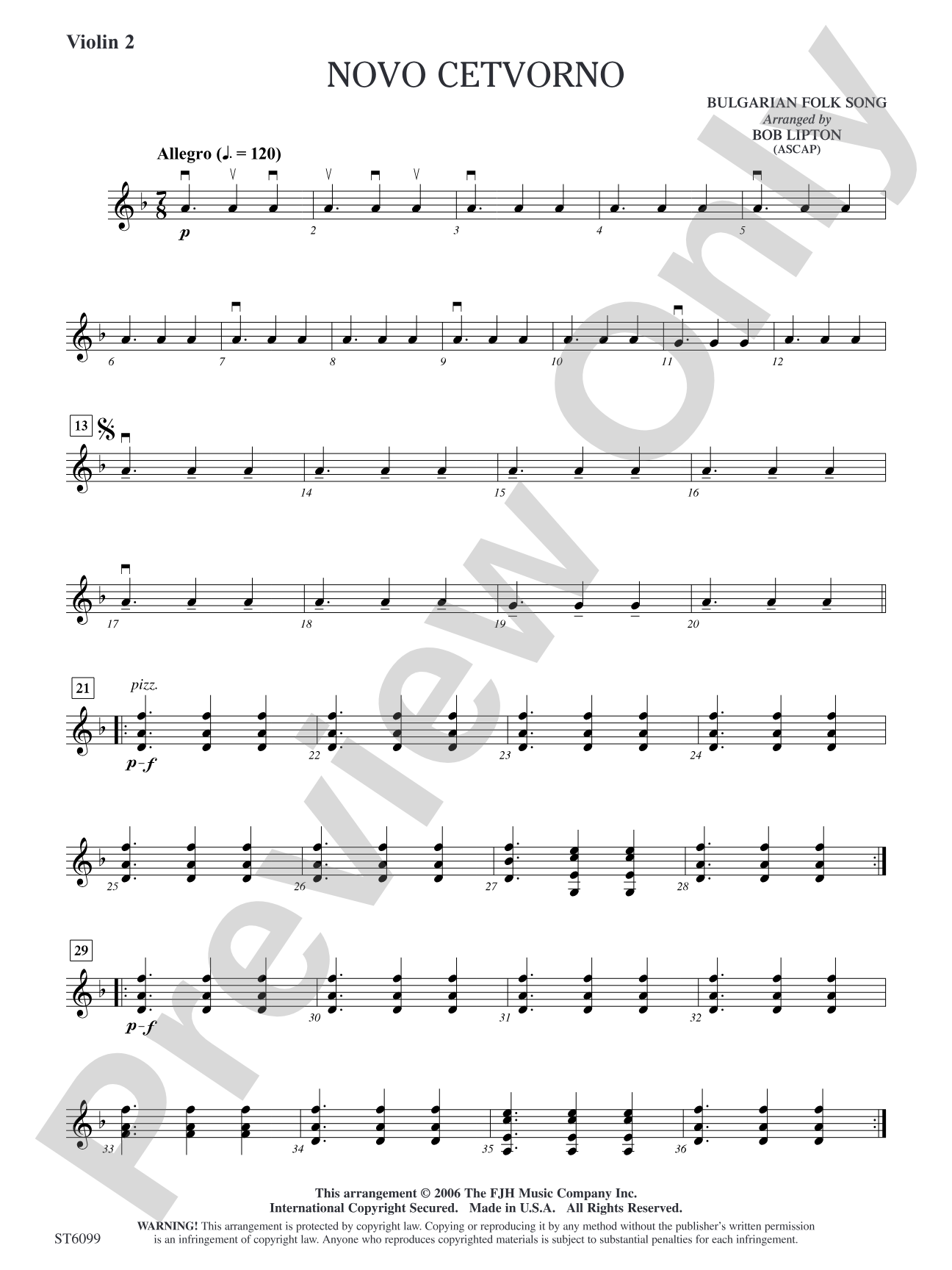

Novo cetvorno: Violin 2
Arranged by Bob Lipton
Grade: 4
Item: 98-PC-DST6099_VN2
$7.00
Pickup currently not available
Description
Based on a traditional Bulgarian line dance, this rhythmic work with percussion has a unique sound in a 7/8 meter written in such a way that students can pick it up quite easily. In the key of D minor, Novo cetvorno lays under the fingers extremely well so students can focus on the pulse of the piece. An easy grade 4 that will add a new dimension to your group's abilities!


Novo cetvorno: Violin 2 isn't in MakeMusic Cloud just yet...but it could be. Let us know you'd like to see it, and you'll help shape what comes next. In the meantime, start a free trial and dive into thousands of interactive titles your students can play along with today.
Request This Title
Tell us you want it.
Start Your Free Trial
Explore everything that's ready to play right now.
Sample Audio
1
Audio File
--:--
0:00
0:00
Sample Video
No sample videos found.
Additional Details
Series:
FJH String Orchestra
Publisher:
The FJH Music Company, Inc.
SKU:
98-PC-DST6099_VN2
More about this title
About the Arranger: Bob Lipton

Bob Lipton earned his B.M. in music education from San Francisco State University and has spent nearly two decades directing orchestra and band programs in Silicon Valley schools. His performance background spans multiple ensembles and genres: he has soloed on tuba with orchestras throughout the San Francisco Bay Area, toured internationally with the Colombia Artists Bel Canto Brass, and appeared at venues ranging from jazz festivals to the Filmfare Awards in Mumbai.
Beyond the classroom, Lipton remains active as a performer and arranger, collaborating with brass quintets and drawing on his diverse musical experiences to inform his writing for student ensembles. His arrangements for school orchestras and bands reflect both his pedagogical expertise and his grounding in real performance practice.
Why we love this
Lipton has crafted an arrangement that respects the authentic character of Bulgarian folk music while genuinely serving the needs of developing string players. The 7/8 meter becomes an asset rather than a barrier because the fingering patterns and pulse align so naturally; students internalize the rhythm through their hands, not through counting alone. You'll find this holds its own against more conventional grade 4 fare while introducing your ensemble to a sound and rhythmic vocabulary they won't encounter elsewhere.
What to expect
Energetic and grounded, with the earthy quality of a traditional line dance translated into orchestral color. The 7/8 meter gives the piece an unhurried momentum, propelling forward without rushing; the D minor warmth and organic fingering patterns make it feel almost inevitable once students find the pulse. Percussion punctuates the rhythm with genuine character rather than mere accompaniment.
Who it's for
String orchestra directors looking to expand their ensemble's rhythmic and cultural palette without sacrificing accessibility. Grade 4 students who benefit from music that feels comfortable under the fingers while introducing unfamiliar metric territory. Any program seeking fresh contest or festival material that stands out from standard repertoire.
How to get the most out of it
- Lock in the pulse as an ensemble before layering the percussion; the rhythmic complexity lives in the meter itself, not in rushing or dragging.
- Let the D minor tonality sit warmly in the lower strings; resist the urge to brighten this piece with excessive vibrato.
- Balance the traditional dance character against the written articulation; sprightly rhythm should feel grounded, not hurried.
- Use the conductor score to shape the phrasing across the folk melody's natural contours rather than measuring phrase length in bars.
How to use it
Program this as a set piece for contests or festivals where freshness and cultural depth count; it's substantial enough to stand alone but pairs well with more standard repertoire. Slot it into the year once your ensemble has developed basic comfort with D minor and standard articulation patterns, using it as a natural bridge into non-standard meters. The modest technical demands free up rehearsal time for ensemble cohesion and expressive depth.
Skills your students will build
- Reading and internalizing 7/8 meter
- Left hand position in D minor across all strings
- Ensemble pulse and rhythmic independence from the conductor
- Sensitivity to non-Western folk music idioms
- Coordination with percussion accompaniment