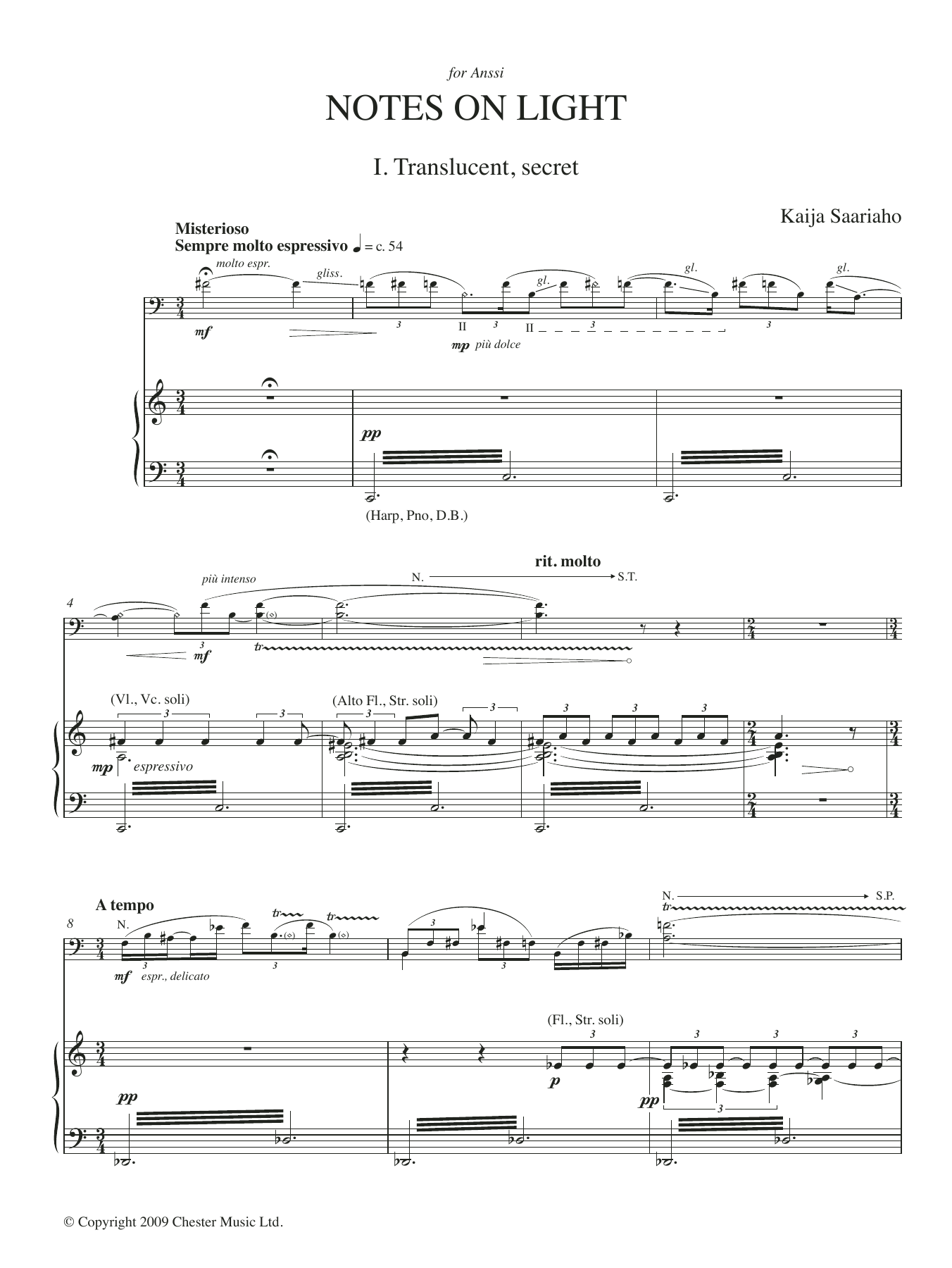
Notes on Light (piano reduction) Sheet Music Preview

Notes on Light (piano reduction): Cello and Piano

By Kaija Saariaho

Item: 35-DS01519417

Digital Download
$45.00
Description

Discover MakeMusic Cloud: thousands of interactive titles your students can play along with today.

Sample Audio
No sample audio found.
Sample Video
Additional Details
Publisher: Hal Leonard
Page Count: 70
SKU: 35-DS01519417

More about this title

About the Composer: Kaija Saariaho

Kaija Saariaho is a Finnish composer whose work has fundamentally shaped contemporary classical music since the 1980s. Her compositions blend spectralist techniques with lyrical sensibility, creating textures that shimmer and evolve with remarkable subtlety. Her operas, orchestral works, and chamber pieces have been performed worldwide and have earned her recognition as one of the most significant living composers.

Saariaho's writing for solo instruments and ensemble reveals her deep understanding of timbre and harmonic color. She builds musical narratives through transformation rather than traditional development, a quality that makes her work both intellectually rigorous and emotionally compelling. Her contributions to the repertoire have opened new possibilities for how composers approach sound itself.

Why we love this

Notes on Light showcases Saariaho's gift for creating intimate, contemplative music that rewards close listening. The piano reduction captures the work's luminous quality while remaining practical for rehearsal and study, allowing cellists and pianists to explore her distinctive harmonic language and gestural approach without requiring full orchestral forces.

What to expect

Notes on Light unfolds like light refracting through water, with each phrase revealing new harmonic possibilities. The music breathes with restraint and precision, creating moments of surprising warmth within an otherwise cool, introspective soundworld. Beauty emerges from attention to detail rather than dramatic gesture.

Who it's for

Advanced cellists and pianists comfortable with contemporary concert music and non-traditional harmonic language. This work suits musicians seeking to deepen their engagement with spectralist techniques and modern European composition.

How to get the most out of it

  • Treat microtonal gestures and chromatic inflections as essential to phrasing, not as ornamental details. These subtle shifts shape the work's emotional arc.
  • Balance transparency with resonance in the piano part. Saariaho's harmonies rely on careful voice leading, so clarity matters more than weight.
  • Let silence function as active material. The spaces between phrases are integral to the work's meditative quality.
  • Coordinate carefully around register changes and shifts in texture. The reduction should reveal the logic of the original orchestration.

How to use it

Position this work on a chamber or recital program where it can anchor a set of contemporary pieces or provide a thoughtful counterpoint to Romantic or Classical repertoire. Its 70 pages suggest a substantial but not overwhelming commitment, making it viable for faculty recitals, student showcases, or concert series dedicated to modern chamber music.

Skills your students will build

  • Interpreting spectralist compositional techniques and harmonic color as structural elements
  • Reading and performing contemporary notational practice with precision
  • Balancing phrasing across chromatic harmonic progressions
  • Ensemble coordination with minimal textural cues and traditional landmarks

You May Also Like