
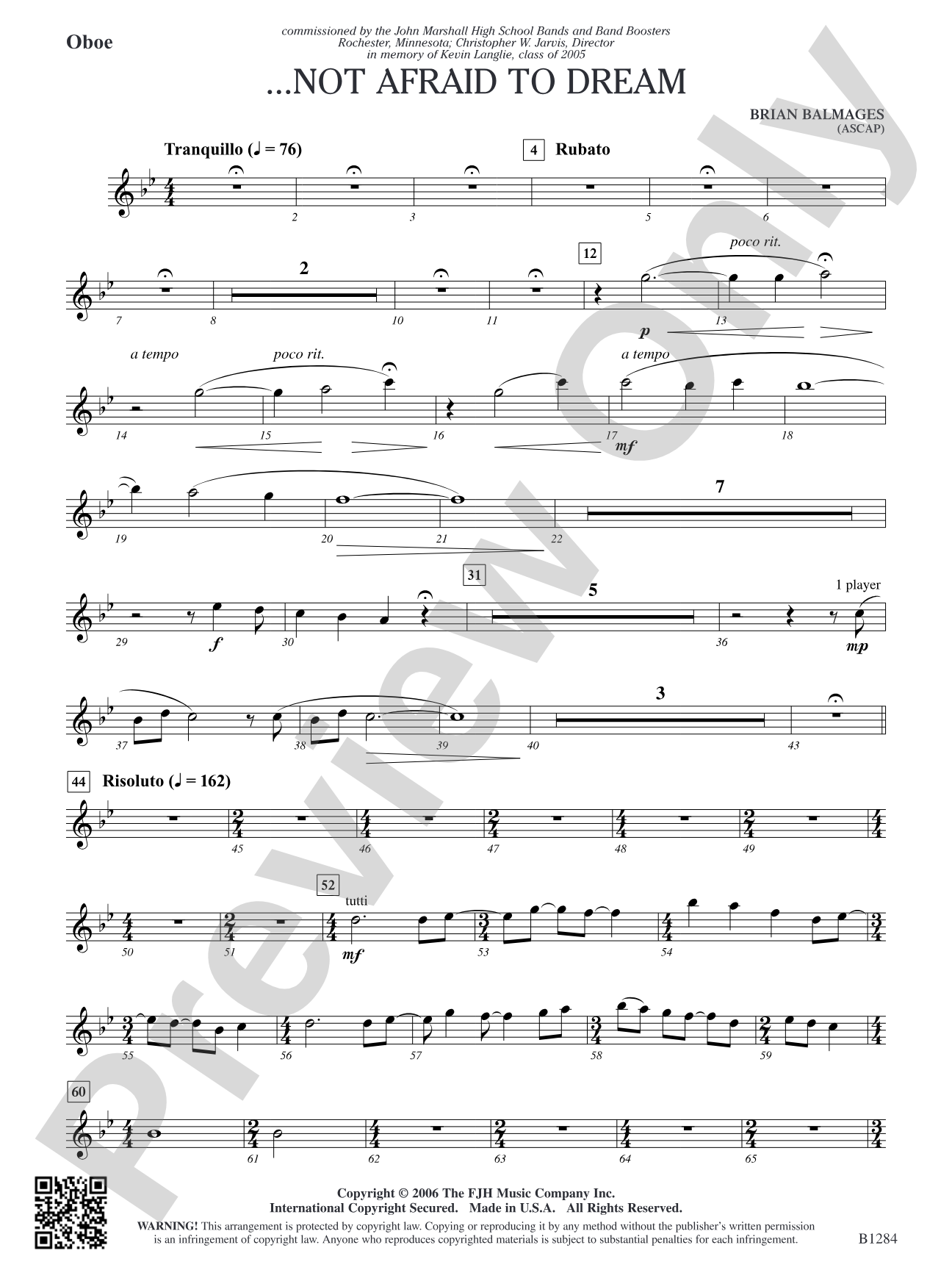

...Not Afraid to Dream: Oboe
By Brian Balmages
Grade: 3
Item: 98-PC-DB1284_O1
$7.00
Pickup currently not available
Description
Both tragic and inspirational, this work takes you on an emotional roller coaster. In memory of a high school senior, the piece receives its title from the eulogy delivered by his band director. The opening uses a variety of chimes to create a very subdued setting. After a beautiful and grieving opening, the piece moves into a celebration of life. Unforgettable and powerful, the theme continues to develop and transform until the undeniable spirit of youth comes back in triumph. Inspiring!


...Not Afraid to Dream: Oboe isn't in MakeMusic Cloud just yet...but it could be. Let us know you'd like to see it, and you'll help shape what comes next. In the meantime, start a free trial and dive into thousands of interactive titles your students can play along with today.
Request This Title
Tell us you want it.
Start Your Free Trial
Explore everything that's ready to play right now.
Sample Audio
1
Audio File
--:--
0:00
0:00
Sample Video
No sample videos found.
Additional Details
Series:
FJH Concert Band
Publisher:
The FJH Music Company, Inc.
SKU:
98-PC-DB1284_O1
More about this title
About the Composer: Brian Balmages

Brian Balmages has established himself as a composer and conductor whose work traverses orchestral, band, and chamber music with equal facility. His scores have reached audiences in prestigious venues including Carnegie Hall, the Kennedy Center, and the Sydney Opera House, performed by ensembles ranging from professional orchestras to elementary school groups. He holds membership in the American Bandmasters Association and received the A. Austin Harding Award from the American School Band Directors Association. His composition Love and Light won the 2020 NBA William D. Revelli Composition Contest.
Balmages has conducted extensively with all-state and regional ensembles, university groups, and professional orchestras worldwide, with notable guest appearances at the Midwest Clinic, Western International Band Clinic, and the College Band Directors Conference. He completed his undergraduate studies at the University of Miami and received the inaugural James Madison University Distinguished Alumni Award from the School of Visual and Performing Arts. In 2017, he was commissioned by the University of Miami to compose music for the presidential inauguration of Dr. Julio Frenk. Currently, he serves as Director of MakeMusic Publications and Digital Education for Alfred and MakeMusic.
Why we love this
This piece balances emotional weight with accessibility, allowing Grade 3 bands to tackle genuinely moving material without compromising musicianship. The structural arc from grief to celebration mirrors the emotional journey of a memorial, giving students context for the interpretive choices they make. Balmages' orchestration draws maximum impact from the ensemble without requiring extended techniques or extreme ranges.
What to expect
The opening settles into a hushed, introspective space where chimes ring out like bells in quiet remembrance. As the piece unfolds, it gradually builds momentum, transforming grief into affirmation until the final section surges with youthful energy and undeniable hope.
Who it's for
Grade 3 concert bands preparing repertoire for festivals, memorial services, or concert programs that honor meaningful moments in their school or community. Conductors seeking music that challenges students emotionally while remaining within their technical grasp will find this score rewarding.
How to get the most out of it
- Honor the opening chimes colors by asking players to listen carefully to each decay; this quiet beginning sets the emotional foundation for everything that follows.
- Shape the transition into the celebration section deliberately rather than abruptly. Let the harmonic and melodic changes guide the tempo shift so the ensemble experiences it as a natural progression.
- Balance the "undeniable spirit of youth" final section with clarity in the middle voices. Young bands often focus on melody and bass; bring out the inner counterpoint so the triumph feels fully orchestrated.
- Consider the pacing of the eulogy that inspired this work. Your interpretation of tempos and rubato should reflect genuine emotion rather than rushing through emotional peaks.
How to use it
Program this as a featured work on a concert dedicated to school commemorations, memorial events, or spring festival performances where emotional depth will resonate with audiences. It pairs well with lighter concert fare, serving as a centerpiece that gives the program substantive weight without overwhelming younger ensembles.
Skills your students will build
- Sustaining lyrical phrasing through longer melodic lines
- Dynamic control in soft passages and gradual crescendos
- Balance between sectional voices during harmonic transitions
- Responding to emotional context and interpretive direction
- Ensemble precision during tempo and meter changes