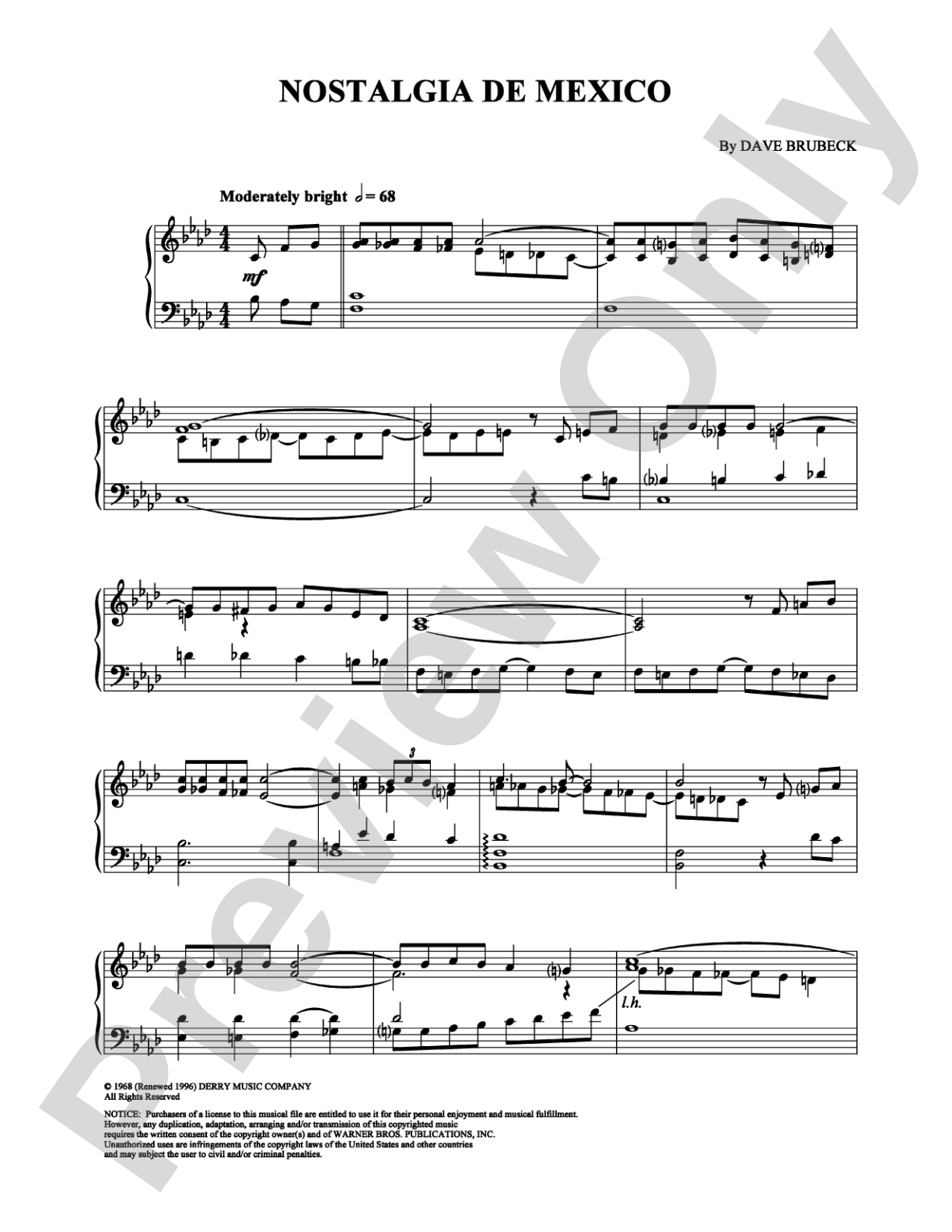
Nostalgia de Mexico: Piano Digital Sheet Music

Nostalgia de Mexico: Piano Digital Sheet Music

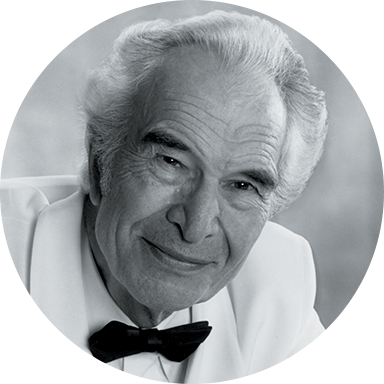
Dave Brubeck

Item: 00-PS-0000971

Digital Download
$3.99
Description

Nostalgia de Mexico: Piano Digital Sheet Music isn't in MakeMusic Cloud just yet...but it could be. Let us know you'd like to see it, and you'll help shape what comes next. In the meantime, start a free trial and dive into thousands of interactive titles your students can play along with today.

Sample Audio
No sample audio found.
Sample Video
Additional Details
SKU: 00-PS-0000971

More about this title

About the Artist: Dave Brubeck

Dave Brubeck

Dave Brubeck stands as one of jazz's most influential pianists and composers, equally comfortable improvising at the keyboard and crafting carefully notated works spanning multiple genres. His legacy extends far beyond "Take Five" and the groundbreaking album "Time Out" (the first jazz record to sell a million copies); he composed choral pieces, hymns, orchestral works, chamber music, ballet suites, and large-scale works for chorus and orchestra that have been performed by major ensembles worldwide, including the London Symphony Orchestra and the Cathedral Choral Society at the National Cathedral.

Brubeck studied composition with Darius Milhaud at Mills College following his World War II service, an influence that shaped his lifelong approach of merging jazz language with classical forms. Beyond his prolific output as both performer and composer, he was a crucial figure in breaking racial barriers in mid-20th-century America. His honors include the Presidential Medal of the Arts, a Grammy Lifetime Achievement Award, induction into the American Classical Music Hall of Fame, and recognition from the London Symphony Orchestra and the Austrian government.

Why we love this

Brubeck's ability to write jazz-inflected compositions that feel both improvisational and meticulously crafted makes this piece ideal for pianists ready to explore the intersection of composition and jazz language. You get the sophistication of a master improviser's approach to form and harmony without sacrificing the clarity of a fully notated score, making it accessible for study yet rewarding enough for serious recital work.

What to expect

Nostalgia de Mexico evokes a reflective yet vibrant mood, balancing wistful harmonic colors with the rhythmic vitality that defines Brubeck's best writing. The piece captures both the warmth of memory and the forward momentum of jazz, creating a space where introspection and joy coexist without sentimentality.

Who it's for

This piece suits intermediate to advanced pianists with some experience in jazz idioms who want to study how a compositional master worked within that language. It appeals to recital pianists seeking contemporary American work that avoids both overly experimental notation and purely commercial material, as well as jazz pianists looking to deepen their understanding of form through Brubeck's approach.

How to get the most out of it

  • Listen to Brubeck's own recordings of his work to absorb his approach to phrasing and time feel, then find your own voice within the harmonic language rather than copying his interpretation exactly.
  • Treat syncopated rhythms and displaced accents as compositional choices that shape the melody, not as decoration; lean into them subtly so they feel natural rather than forced.
  • Balance the jazz vocabulary (chromatic runs, seventh chords, modal thinking) with the classical precision Brubeck always maintained; clarity serves this music better than a slouchy touch.
  • Explore the space between written notes and what Brubeck left to the performer's discretion; use rubato thoughtfully to let the piece breathe without losing its structural integrity.

How to use it

This works beautifully as a bridge piece in a recital that spans classical and jazz repertoire, or as a centerpiece in a program exploring American composers of the twentieth century. It also serves advanced students well as both a performance piece and a score study in how jazz harmony and classical structure can inform each other.

Skills your students will build

  • Jazz harmony and seventh chord voicings in a classical context
  • Syncopation and rhythmic displacement within notated form
  • Phrasing across jazz and classical vocabularies
  • Interpreting rubato and space in jazz-influenced composition
  • Understanding form and development in contemporary American music

You May Also Like