
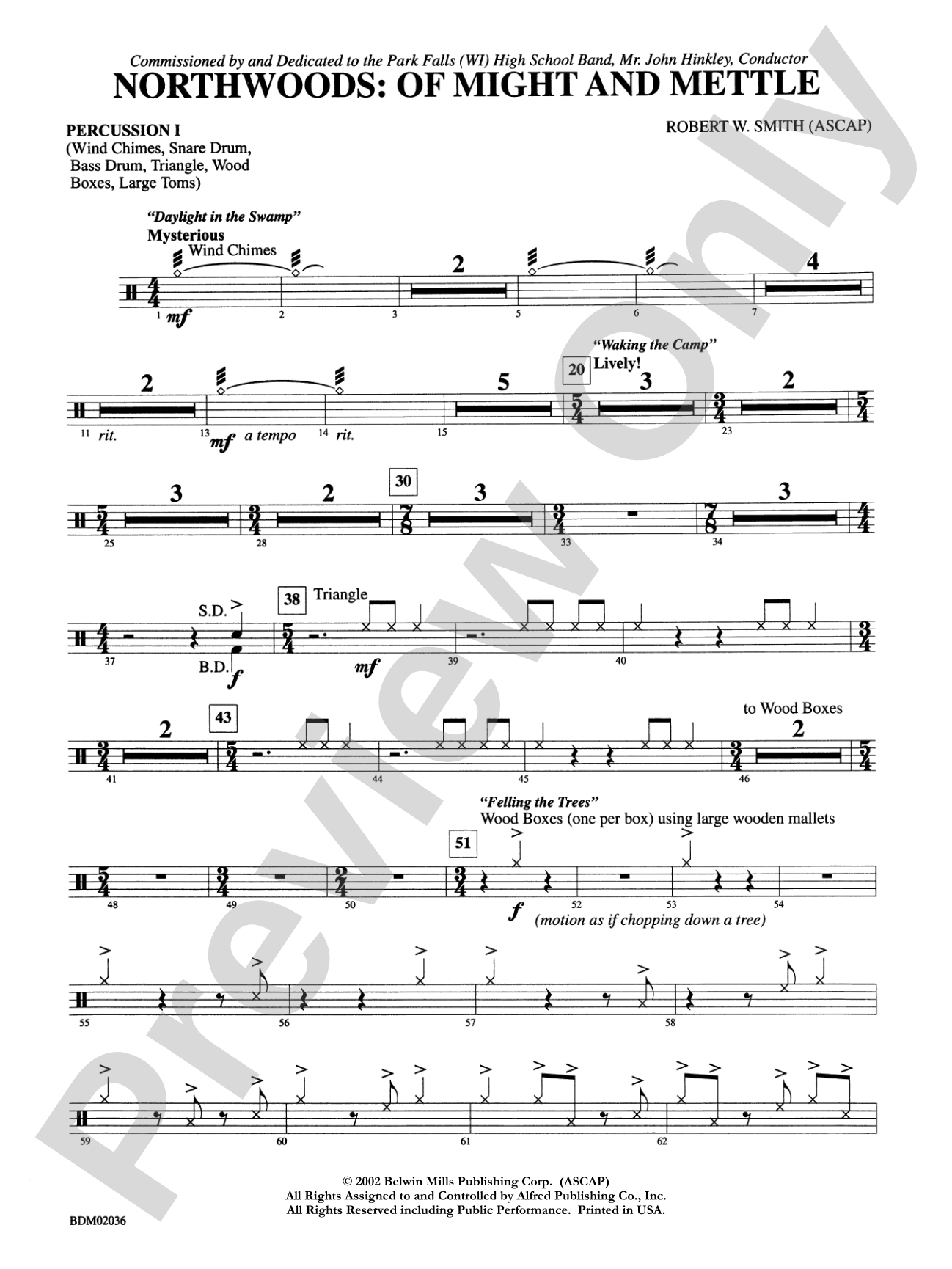

Northwoods: Of Might and Mettle: 1st Percussion
By Robert W. Smith
Grade: 4 (Medium)
Item: 00-PC-0002169_PC1
$3.00
Pickup currently not available
Description
This is a musical depiction of the day of a lumberjack in the late 1800s during the great logging drives in Wisconsin. The work begins with "Daylight in the Swamp," a mysterious setting reminiscent of the early morning conditions. It then transitions to "Waking the Camp" and develops to "Felling the Trees," a very dynamic segment. "The Ice Breaks" and "On the River" draw the composition to a serious conclusion. A most creative work. This is Robert W. Smith at his very best. (6:46)


Don't just read it, hear it, play along with it, and watch your students grow with it. In MakeMusic Cloud, Northwoods: Of Might and Mettle: 1st Percussion comes alive with professional accompaniment, adjustable tempo, and built-in practice tools that turn solo practice into real progress.
Open in the Player
Jump straight in and assign it today.
Start Your Free Trial
Open this title and explore the full library in minutes.
Sample Audio
1
Audio File
--:--
0:00
0:00
Sample Video
No sample videos found.
Additional Details
Series:
Belwin Symphonic Band
Publisher:
Alfred Music
Page Count:
276
SKU:
00-PC-0002169_PC1
More about this title
About the Composer: Robert W. Smith

Robert W. Smith stands among the most performed composers of band and orchestral music in North America. His catalog exceeds 400 works, the majority published through Alfred Music, and his compositions have earned international recognition across Europe, Australia, and Asia. Smith holds a Bachelor of Music Education from Troy State University and a Master of Music from the University of Miami.
Beyond the concert hall, Smith's music has reached audiences through television broadcasts, Olympic ceremonies, and major cultural events including the Macy's Thanksgiving Day Parade and Opening Day at Dodger Stadium. As both composer and clinician, he has conducted throughout the United States and abroad, earning a reputation for works that balance accessibility with artistic substance. His symphonic works, particularly The Divine Comedy and The Odyssey, alongside foundational pieces like The Tempest, have become cornerstones of the developing and concert band repertoire.
Why we love this
Smith crafts narrative through pure instrumental color, and this five-part arc from swamp to river delivers cinematic sweep without sacrificing the musical substance that makes it contestable at the Grade 4 level. The dramatic arc serves both entertainment and education: students experience how thematic development, orchestration, and tempo changes carry a story forward while building genuine performance challenges in the dynamic "Felling the Trees" section. This is storytelling that respects the intelligence of young musicians and their audiences.
What to expect
The journey unfolds from shadowy calm through escalating labor and natural drama to a powerful conclusion. Smith paints with instrumental textures that evoke the American landscape and the physicality of early industry, building cumulative momentum that mirrors both the passage of a working day and the arc of a river in flood.
Who it's for
Band directors programming a mid-level concert or festival entry who want a piece that engages students through storytelling while delivering solid musical and technical demands. This work rewards ensembles ready to handle dynamic contrasts, varied articulation, and sustained ensemble balance across multiple distinct sections.
How to get the most out of it
- Shape the opening "Daylight in the Swamp" with restraint and atmospheric clarity; let the mystery emerge from precise intonation and careful balance rather than heavy expression, which will make the energy shift to "Waking the Camp" land with greater impact.
- Lock the forward momentum in "Felling the Trees" by establishing a steady pulse with the woodwind and brass layers; this section demands rhythmic cohesion across the band to avoid the driving figures from feeling scattered.
- Balance the narrative weight in "The Ice Breaks" and "On the River" by ensuring lower voices have clear definition; these concluding sections need textural clarity so the conclusion reads as conclusive, not just loud.
- Mark cue points for all sections during rehearsal, labeling them by section title rather than measure number; musicians will internalize the story arc and respond more musically to transitions when they understand the programmatic framework.
How to use it
Program this as a centerpiece concert work that demonstrates your band's musical maturity and narrative musicianship without requiring the performance duration of a full symphony. The programmatic content also works well in festival settings where adjudicators appreciate thematic clarity and purposeful orchestration choices.
Skills your students will build
- Dynamic control across extended crescendos and diminuendos
- Sectional independence and balance in multi-textured passages
- Sustained tone quality and intonation during lyrical sections
- Rhythmic precision in syncopated and driving figures
- Interpreting programmatic intent through musical gesture and phrasing