North Country Celebration: 1st Percussion Sheet Music Preview

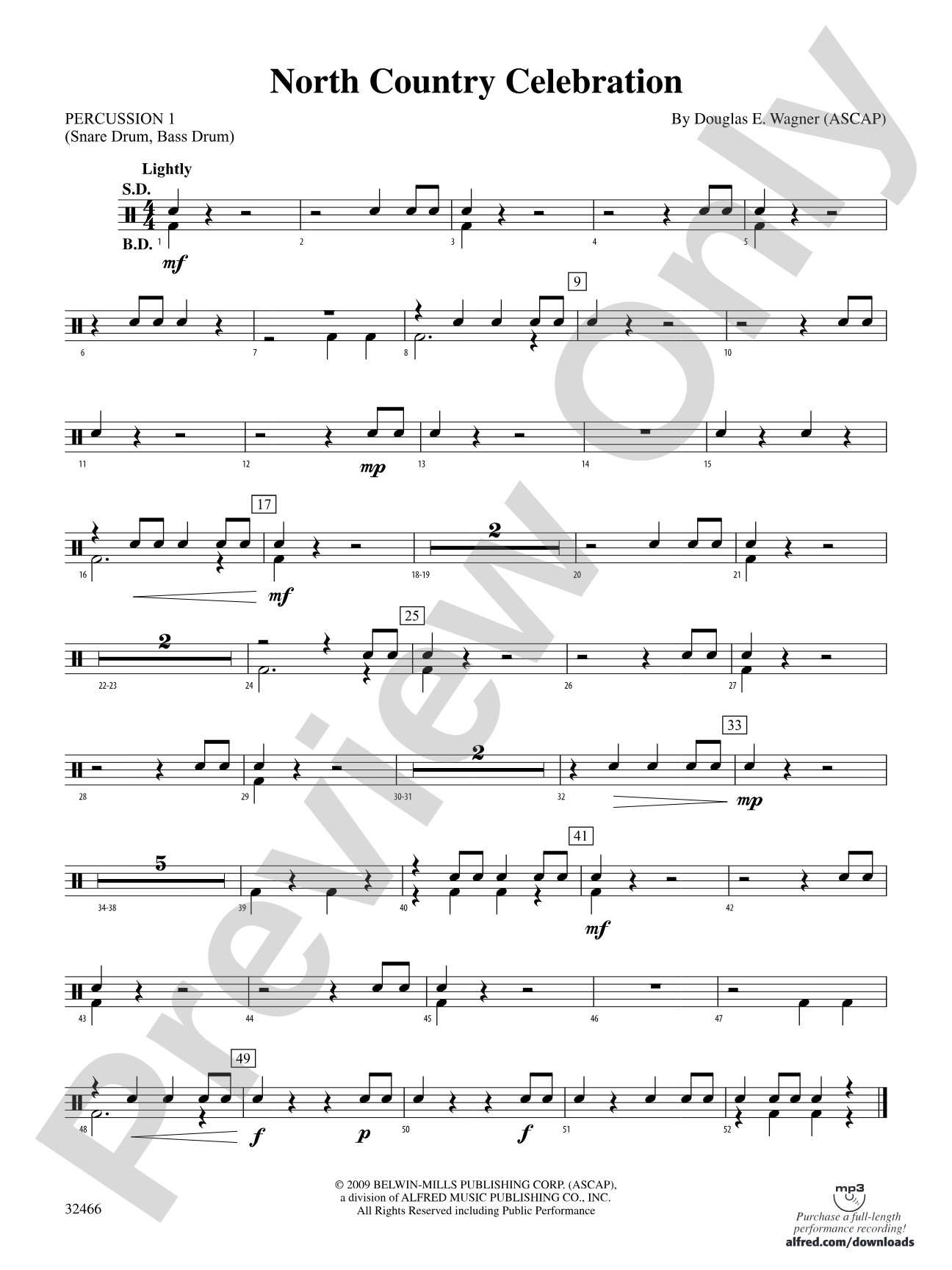
North Country Celebration: 1st Percussion

By Douglas E. Wagner

Grade: 1 (Very Easy)

Item: 00-PC-0014352_PC1

Digital Download
$3.00
Description
With a theme that is reminiscent of an English Morris Dance tune, this cheerful original is scored to lie easily under the fingers of beginning wind players. Cast in a modified rondo form, ample doublings and rich chord voicings help to achieve a solid top-to-bottom ensemble sound. Subtle articulations and dynamic nuances add just the right dash of color in this musically satisfying offering for concert audiences. Bravo! This title is available in MakeMusic Cloud.

Don't just read it, hear it, play along with it, and watch your students grow with it. In MakeMusic Cloud, North Country Celebration: 1st Percussion comes alive with professional accompaniment, adjustable tempo, and built-in practice tools that turn solo practice into real progress.

Sample Audio
0:00
0:00
Sample Video
Additional Details
Series: Belwin Beginning Band
Publisher: Alfred Music
Page Count: 132
SKU: 00-PC-0014352_PC1

More about this title

About the Composer: Douglas E. Wagner

Douglas E. Wagner

Douglas E. Wagner grew up in Chicago and earned both undergraduate and graduate degrees in music from Butler University. He spent three decades as a high school music educator and administrator before dedicating himself full-time to composition.

Since 1973, Wagner has published more than 3,500 compositions across virtually every ensemble setting: school and church choirs, concert bands, orchestras, handbells, organ, piano, and voice. His works have reached millions of performers worldwide, appearing regularly in concert halls, on broadcasts, and at festivals throughout the United States and internationally. He now resides in Indianapolis, Indiana.

Why we love this

Wagner built this piece around a Morris Dance melody, which immediately gives it authentic folk character without requiring students to stretch beyond their technical reach. The modified rondo structure provides clear architectural logic for young musicians to follow, while the doublings and voicings ensure that even with limited skill, the band will produce a cohesive, satisfying sound. It's the kind of opener that makes a young band sound better than expected and gives students confidence they can make real music.

What to expect

Bright, approachable, and genuinely folk-inspired, this piece carries the charm of an English country celebration without pretension. There's a sense of rhythmic lift and good humor throughout; students hear themselves making something cheerful and complete rather than trudging through an exercise.

Who it's for

This work suits Grade 1 concert bands and beginning wind ensembles at the middle school or high school level, particularly in the first months when students are still building fundamental skills. It works equally well for contest and concert settings where you need genuine musicality at an accessible technical level.

How to get the most out of it

  • Balance the melody line clearly by having players who carry it listen to each other across sections; in beginning bands, the tendency is for everyone to play equally loud regardless of function.
  • Attend to the articulations marked in the score, especially in sections where staccato and legato alternate. These touches transform the piece from competent to characterful.
  • Let the rondo form guide phrasing naturally; mark major section returns so students hear the architecture, not just individual measures going by.
  • Keep the tempo steady and comfortable. This piece is about clarity and ensemble cohesion, not pushing tempo.

How to use it

Open a concert with this work to establish a warm, inviting tone and build audience rapport immediately. It also pairs well on a festival program alongside other Grade 1 literature, and its modest length and energy make it an ideal warm-up performance before a piece that requires deeper focus.

Skills your students will build

  • Executing clear articulation contrasts (staccato versus legato)
  • Listening for balance across sections to support a unified ensemble sound
  • Understanding rondo form through performance
  • Sustaining steady tempo and intonation in a complete musical work
  • Reading and responding to dynamic nuances that shape phrasing

You May Also Like