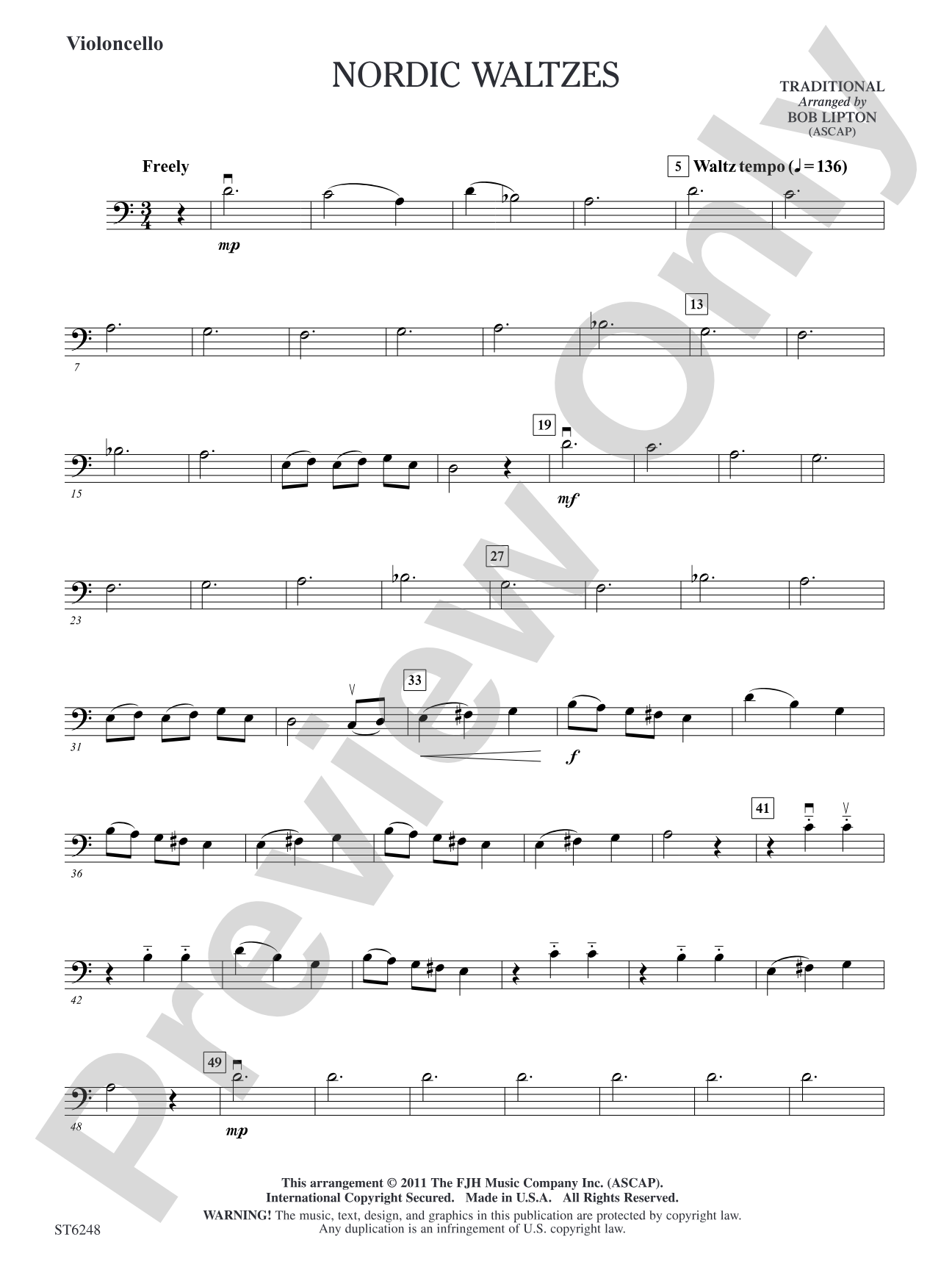
Nordic Waltzes: Violoncello Sheet Music Preview

Nordic Waltzes: Violoncello

Arranged by Bob Lipton

Grade: 3

Item: 98-PC-DST6248_VC1

Digital Download
$7.00
Description
Based on four hauntingly bittersweet waltzes from the 1700s, these Swedish dances are charming and timeless. Each waltz has a unique character, yet the four blend together seamlessly as the piece moves forward. A wonderful change of pace for any program!

Don't just read it, hear it, play along with it, and watch your students grow with it. In MakeMusic Cloud, Nordic Waltzes: Violoncello comes alive with professional accompaniment, adjustable tempo, and built-in practice tools that turn solo practice into real progress.

Sample Audio
0:00
0:00
Sample Video
Additional Details
Series: FJH String Orchestra
Publisher: The FJH Music Company, Inc.
SKU: 98-PC-DST6248_VC1

More about this title

About the Arranger: Bob Lipton

Bob Lipton

Bob Lipton holds a B.M. in music education from San Francisco State University and has spent nearly two decades teaching orchestra and band to middle school students in Silicon Valley. His performance background spans both classical and contemporary music; he has appeared with regional symphonies across Northern California and performed at prestigious venues including the San Francisco and Frankfurt Jazz festivals.

Beyond the classroom, Lipton maintains an active performance schedule as a tuba player and has arranged music for brass ensembles. His dual expertise in instrumental performance and music education informs his compositional and arranging work, which centers on making quality literature accessible to developing musicians.

Why we love this

Lipton distills four distinct 18th-century Swedish dances into a single, cohesive piece that feels both fresh and rooted in tradition. The arrangement respects the character of each waltz while creating natural momentum across the set, giving your orchestra a repertoire piece that works equally well in a concert program or festival setting without requiring a lengthy rehearsal investment.

What to expect

Imagine a twilight landscape of snow-covered fields: clear-eyed yet melancholic, each dance carries a gentle sway and an undercurrent of longing. The waltzes unfold with grace and restraint, blending Scandinavian character with classical elegance, creating a sense of timelessness that feels both intimate and expansive.

Who it's for

Grade 3 string orchestras that are ready to tackle repertoire with musical substance and harmonic sophistication. This arrangement suits ensembles with developing tone quality and secure ensemble balance, as it rewards careful listening and collaborative playing without extreme technical demands.

How to get the most out of it

  • Shape each waltz as its own miniature arc, bringing out the unique character Lipton establishes in the opening measures before transitioning smoothly to the next dance.
  • Balance the string sections so that melodic lines sing clearly; these older dances rely on lyrical phrasing rather than rhythmic intensity.
  • Use slight rubato and dynamic shaping to capture the bittersweet quality in the harmonic language, especially at phrase endings where the arrangement's voice leading becomes most expressive.
  • Support the transitions between waltzes with a steady tempo foundation so the four pieces feel like movements of a larger work, not disconnected selections.

How to use it

Program this as a sophisticated contrast to heavier, more rhythmically driven pieces on the same concert. It works particularly well as a closing selection for a festival performance or as part of a thematic program exploring European folk traditions, and its moderate length makes it an ideal fit for variety-based concert formats.

Skills your students will build

  • Phrasing and shaping in classical-style melody
  • Listening for balance across string sections in arrangement with independent voice lines
  • Sustaining tone quality through longer melodic passages
  • Ensemble cohesion in transitions between contrasting sections
  • Stylistic interpretation of dance forms from historical sources

You May Also Like