
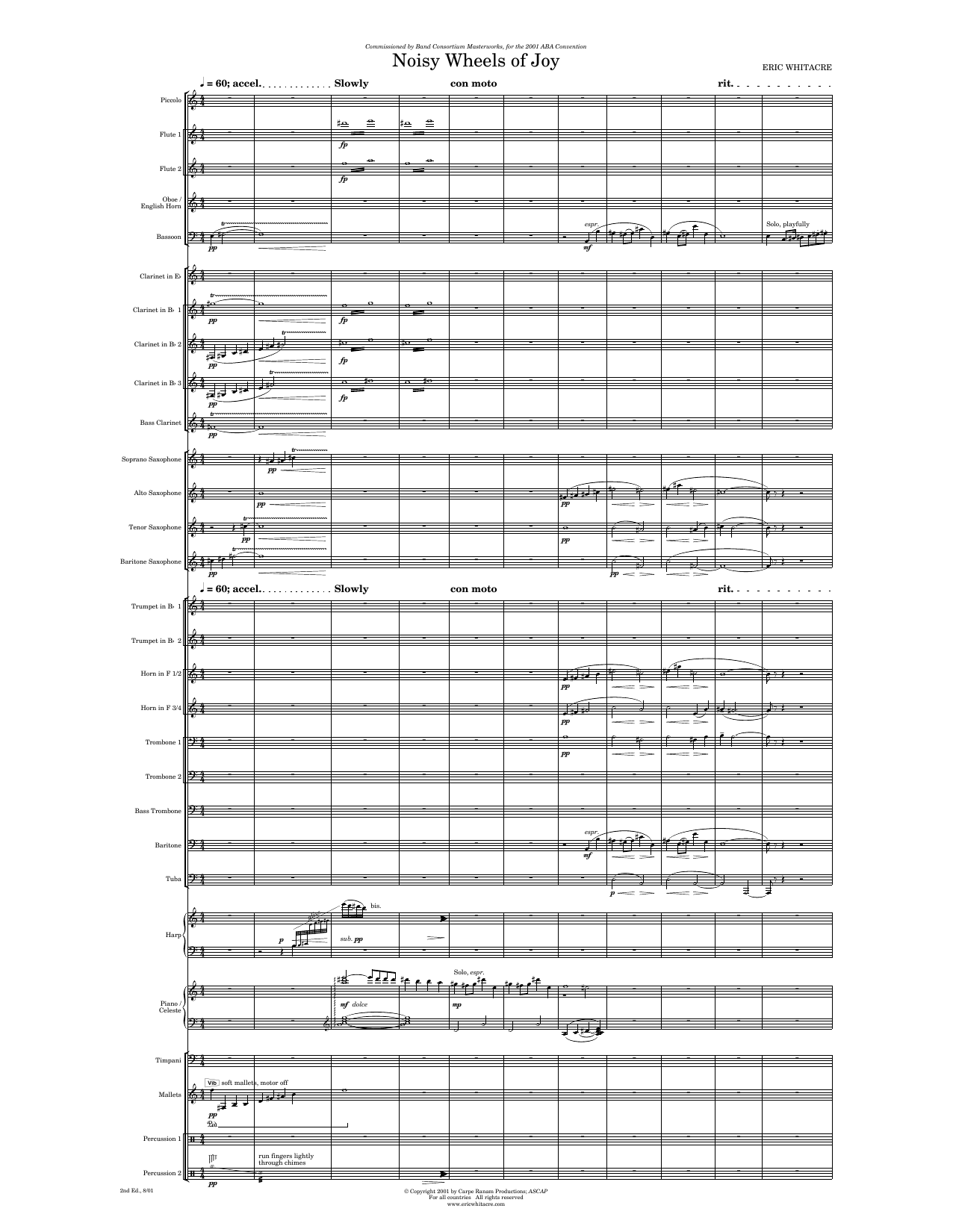

Noisy Wheels Of Joy: Concert Band Conductor Score & Parts
By Eric Whitacre
Grade: 4
Item: 35-PK01107020
$125.00
Pickup currently not available
Buy Extra Parts (Digital PDF Download)
Parts Added to Cart!
Description
Conceived as a raucous 'opera buffo' style overture, this new work from composer Eric Whitacre is the perfect way to start any concert. The beautiful theme and brilliant orchestration build to an exciting and breathtaking finale. "Noisy Wheels of Joy" was commissioned by the Band Composers Masterworks Consortium and premiered at the 2001 ABA convention by the UNLV Wind Symphony.


Noisy Wheels Of Joy: Concert Band Conductor Score & Parts isn't in MakeMusic Cloud just yet...but it could be. Let us know you'd like to see it, and you'll help shape what comes next. In the meantime, start a free trial and dive into thousands of interactive titles your students can play along with today.
Request This Title
Tell us you want it.
Start Your Free Trial
Explore everything that's ready to play right now.
Sample Audio
No sample audio found.
Sample Video
No sample videos found.
Additional Details
Publisher:
Hal Leonard
SKU:
35-PK01107020
More about this title
About the Composer: Eric Whitacre
Eric Whitacre stands among the most performed living composers, with a catalog that spans choral works, orchestral music, and wind band literature. His compositions are studied and performed globally, from high school ensembles to professional orchestras, and he has become a major voice in contemporary classical music through both his compositional voice and his work as a conductor and educator.
Whitacre's music combines accessible melodic writing with sophisticated harmonic language, making his works particularly valuable in education settings. His wind band pieces have become standard repertoire because they challenge musicians while remaining deeply musical and rewarding to perform.
Why we love this
Whitacre's gift for orchestration shines brilliantly here. The "opera buffo" conceit gives your ensemble permission to embrace theatrical energy without sacrificing musical substance, and the arc from that lyrical theme through mounting excitement to a genuinely thrilling finish provides the kind of concert opener that sets the right tone for an entire evening.
What to expect
Imagine a village carnival where the musicians are having as much fun as the audience. There's mischief and exuberance in the harmony and rhythm, a beautiful moment of repose in the central theme, then the whole celebration accelerates toward a joyous conclusion that feels both inevitable and surprising.
Who it's for
Advanced Grade 4 bands with solid fundamental skills in blending and articulation. The work suits ensembles that can handle the orchestration demands and respond to a conductor's shaping of the musical line.
How to get the most out of it
- Keep the opening theme singing and shaped; the later brilliance depends entirely on the contrast this establishes. Resist the temptation to rush even when excitement builds.
- Balance is critical in the orchestration. Whitacre's voicing often places important material across multiple sections. Ensure each part hears its role within the larger texture during sectional rehearsals.
- The finale's energy comes from precision as much as volume. Tighten rhythmic clarity through the acceleration; loose ensemble playing will diffuse the impact rather than amplify it.
- Mark your score carefully. Note where the texture shifts and where individual voices emerge from the fuller sound. This level of attention ensures clarity without losing the raucous charm Whitacre intends.
How to use it
This is your concert opener when you want to establish energy without chaos. Program it before a contrasting work such as a lyrical transcription or a march to create effective musical variety. It works equally well as a standalone feature or as the rousing start to a thematically connected second half.
Skills your students will build
- Balancing independent melodic lines within a complex full-band texture
- Responding to sudden shifts in orchestration and density
- Playing with theatrical awareness and intentional musical character
- Executing accelerating rhythmic material with precision
- Sustaining focused ensemble sound through extended crescendos