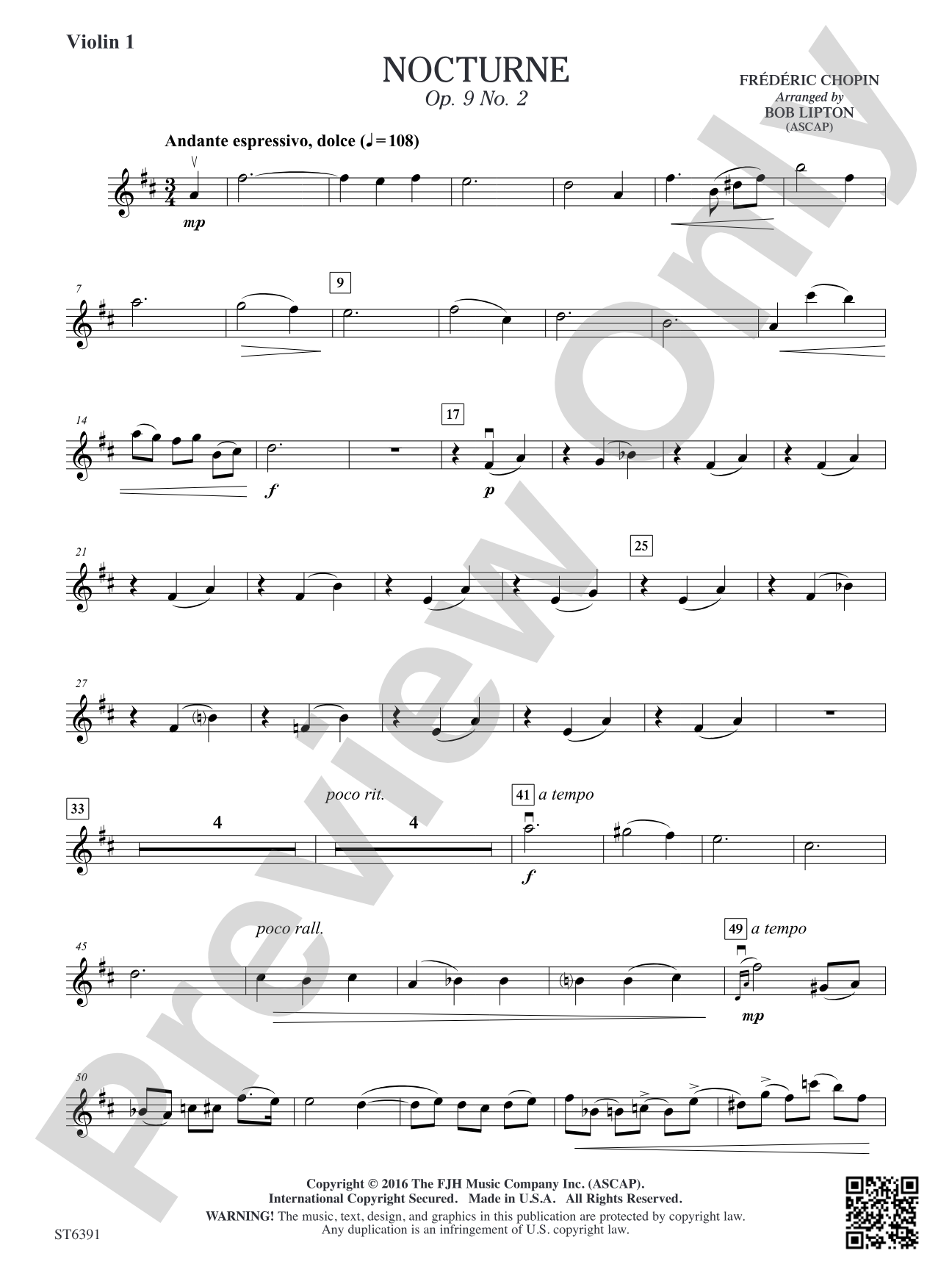
Nocturne: Violin 1 Sheet Music Preview

Nocturne: Violin 1

By Frédéric Chopin / arr. Bob Lipton

Grade: 3

Item: 98-PC-DST6391_VN1

Digital Download
$7.00
Description
The famous Nocturne by Chopin is beautifully orchestrated for string orchestra in this authentic, yet playable arrangement. Lipton has managed to preserve many elements of the original while also creating opportunities for each section to be involved melodically. A stunning setting that will captivate your audience.

Nocturne: Violin 1 isn't in MakeMusic Cloud just yet...but it could be. Let us know you'd like to see it, and you'll help shape what comes next. In the meantime, start a free trial and dive into thousands of interactive titles your students can play along with today.

Sample Audio
0:00
0:00
Sample Video
Additional Details
Series: FJH String Orchestra
Publisher: The FJH Music Company, Inc.
SKU: 98-PC-DST6391_VN1

More about this title

About the Composer: Frédéric Chopin

Frédéric Chopin (1810-1849) was a Polish composer and virtuoso pianist whose expressive, intimate works fundamentally transformed what the piano could communicate. His nocturnes, in particular, established a new genre of lyrical, song-like pieces that balanced technical demands with profound emotional depth, influencing generations of composers across multiple instrumental families.

Chopin's music remains central to music education because it bridges the gap between accessible melody and sophisticated harmonic language. His works teach students about rubato, phrase shaping, and the expressive possibilities of instrumental color, making him invaluable even when his original compositions are beyond a group's current level.

Why we love this

Bob Lipton's orchestration honors Chopin's intimate melodic gift while distributing the material across your string sections so every player has a moment to sing. This is the rare arrangement that feels both authentic to the original and genuinely engaging for mid-level orchestras, giving students a direct connection to one of music's most beloved melodists without oversimplifying the harmonic sophistication.

What to expect

The piece unfolds with a singing, almost vocal quality, inviting you into an intimate musical conversation. There's a gentle melancholy beneath the surface beauty, and Lipton's orchestration allows you to shift between moments of solitary reflection and warmth shared across the entire ensemble.

Who it's for

String orchestras at the Grade 3 level seeking a masterwork that stretches musicianship without overwhelming technical resources. This works equally well for middle school orchestras building expressive skills and high school ensembles looking for a program piece that sounds sophisticated and moves audiences.

How to get the most out of it

  • Shape the opening melody with gentle dynamic contours that follow the phrase breathing rather than playing each measure at the same volume; let the rubato emerge naturally from the line.
  • Balance the violin sections carefully when both are present, ensuring the first violins sing through without drowning out supporting lines that carry important harmonic or textural information.
  • Bring out sustained notes in the cello and viola sections, which often provide the harmonic foundation; these aren't accompaniment but a vital part of Chopin's voice.
  • Prepare your ensemble to shift between passages of intimate, chamber-like texture and fuller orchestral moments by adjusting articulation and bow weight rather than tempo.

How to use it

Program this as a concert opener or as a balancing contrast to a more energetic contemporary work, giving your audience time to settle and your orchestra a chance to establish the ensemble sound. It also pairs beautifully on a recital or chamber concert where you want to show range and musical maturity.

Skills your students will build

  • Sustaining long, shaped phrases without metronomic rigidity
  • Balancing between melody and supporting harmonic voices
  • Responding to subtle dynamic and tonal shifts within a legato texture
  • Voicing orchestral doublings so each line remains distinct
  • Understanding Romantic-era harmonic language through performance

You May Also Like