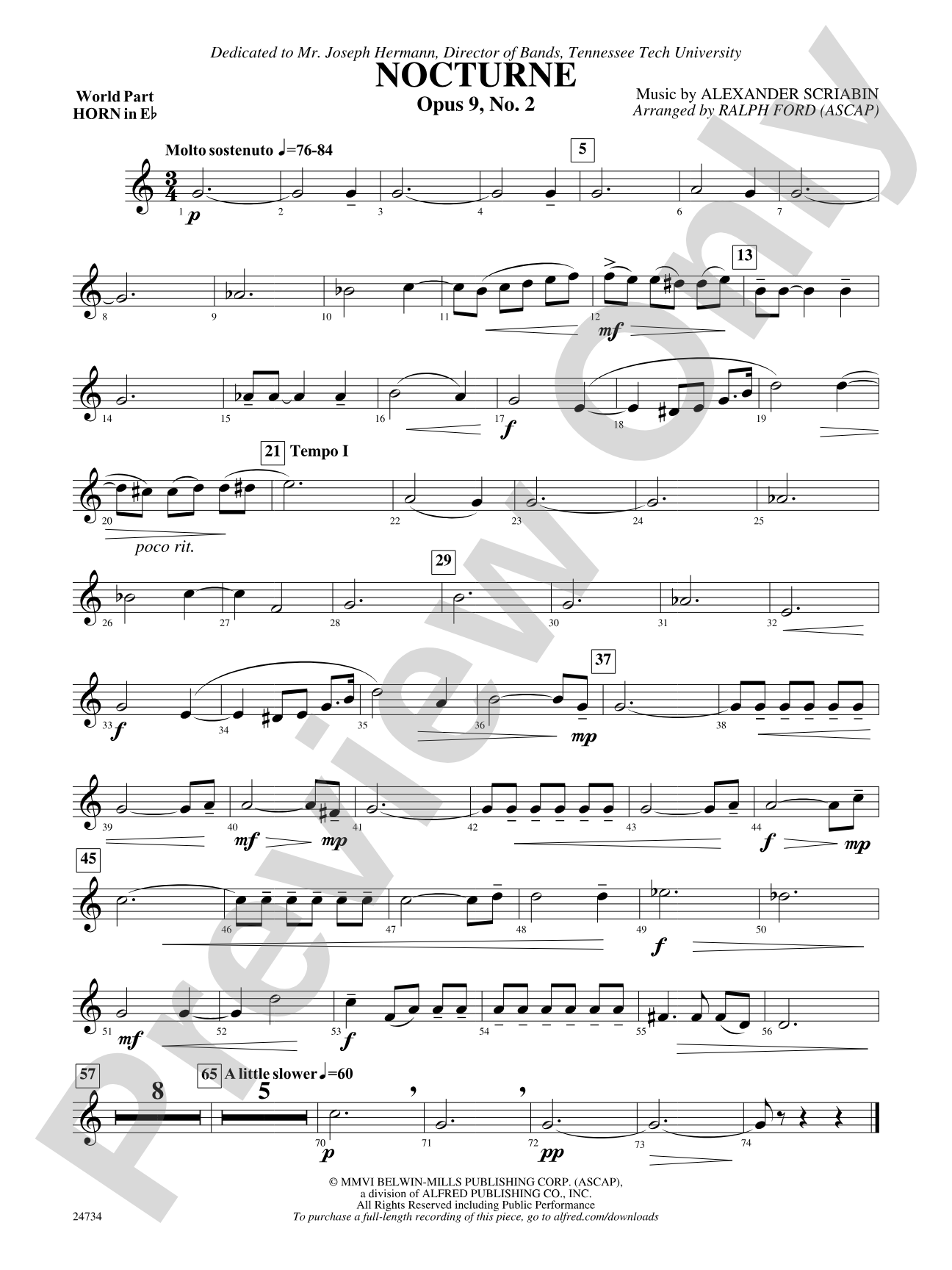
Nocturne (Opus 9, No. 2): (wp) 1st Horn in E-flat Sheet Music Preview

Nocturne (Opus 9, No. 2): (wp) 1st Horn in E-flat

By Alexander Scriabin / arr. Ralph Ford

Grade: 2 (Easy)

Item: 00-PC-0000885_wpEH1

Digital Download
$3.00
Description
This beautiful Scriban melody is an engaging addition to your young band's repertoire. With intriguing musical lines, thee melody weaves seamlessly through the ensemble. A most musical choice for your young band! Ralph Ford's arrangement of "Nocturne" will certainly guaranteed rave reviews."

Don't just read it, hear it, play along with it, and watch your students grow with it. In MakeMusic Cloud, Nocturne (Opus 9, No. 2): (wp) 1st Horn in E-flat comes alive with professional accompaniment, adjustable tempo, and built-in practice tools that turn solo practice into real progress.

Sample Audio
0:00
0:00
Sample Video
Additional Details
Series: Belwin Young Band
Publisher: Alfred Music
Page Count: 120
SKU: 00-PC-0000885_wpEH1

More about this title

About the Composer: Alexander Scriabin

Alexander Scriabin (1872-1915) was a Russian composer and pianist whose harmonic innovations pushed late Romantic music toward modernism. His early works, including the Nocturnes for solo piano, blend lyrical melody with increasingly sophisticated chord progressions, establishing him as a bridge between the 19th-century Romantic tradition and 20th-century compositional practice.

Scriabin's influence on music education extends beyond his virtuosic piano writing. His emphasis on sustained, singing lines and rich harmonic color makes his melodies ideal for transcription to band and orchestra. Teachers and arrangers continue to draw on his catalog because his music demands musicianship while remaining emotionally direct.

Why we love this

This arrangement opens a door to genuine concert literature for young bands. Rather than settling for simplified marches or fanfares, your students encounter a Romantic-era masterwork with real compositional substance. Ralph Ford's orchestration respects Scriabin's harmonic language while making it accessible to Grade 2 ensembles, so your band plays music that sounds mature without exceeding their technical reach.

What to expect

The Nocturne carries the quiet introspection of late evening, with a gentle, singing melody that floats above warm harmonic support. The piece invites restraint and sensitivity rather than dramatic display, creating space for students to listen to one another and shape longer musical lines together.

Who it's for

Grade 2 concert bands looking to perform substantive repertoire beyond typical young band anthologies. This arrangement suits directors who want their ensembles to engage with recognizable classical literature while building ensemble musicianship and phrasing awareness.

How to get the most out of it

  • Shape the melody with slight emphasis on longer note values to highlight Scriabin's natural phrasing; resist the urge to accent every beat.
  • Balance the inner voices carefully so the harmonic color emerges without covering the primary melodic line.
  • Take time with fermatas and written pauses; Scriabin's architecture depends on breathing room between phrases.
  • Listen for warmth in the woodwind blend, particularly when the melody passes between sections.

How to use it

Program this as a lyrical contrast on a concert that otherwise features marches, novelties, or contemporary works. Its straightforward Grade 2 difficulty makes it ideal for early-season rehearsals when you're building ensemble cohesion, or as a concert opener that sets a reflective mood before more energetic selections.

Skills your students will build

  • Sustained phrasing and melodic shaping across longer phrases
  • Harmonic balance and awareness of inner voice independence
  • Dynamic control in soft, expressive playing
  • Listening and blend in ensemble contexts
  • Interpretation of Romantic-era compositional style

You May Also Like