Zenobia Powell Perry (1915-2003) was a pianist and composer who spent her career championing art music rooted in African American musical traditions. She studied at Oberlin Conservatory and later taught at Central State University in Ohio, where she influenced generations of young musicians. Perry's compositions bridge classical forms with the harmonic richness and expressive depth of the African American musical heritage, making her work both pedagogically valuable and artistically substantial.
Why we love this
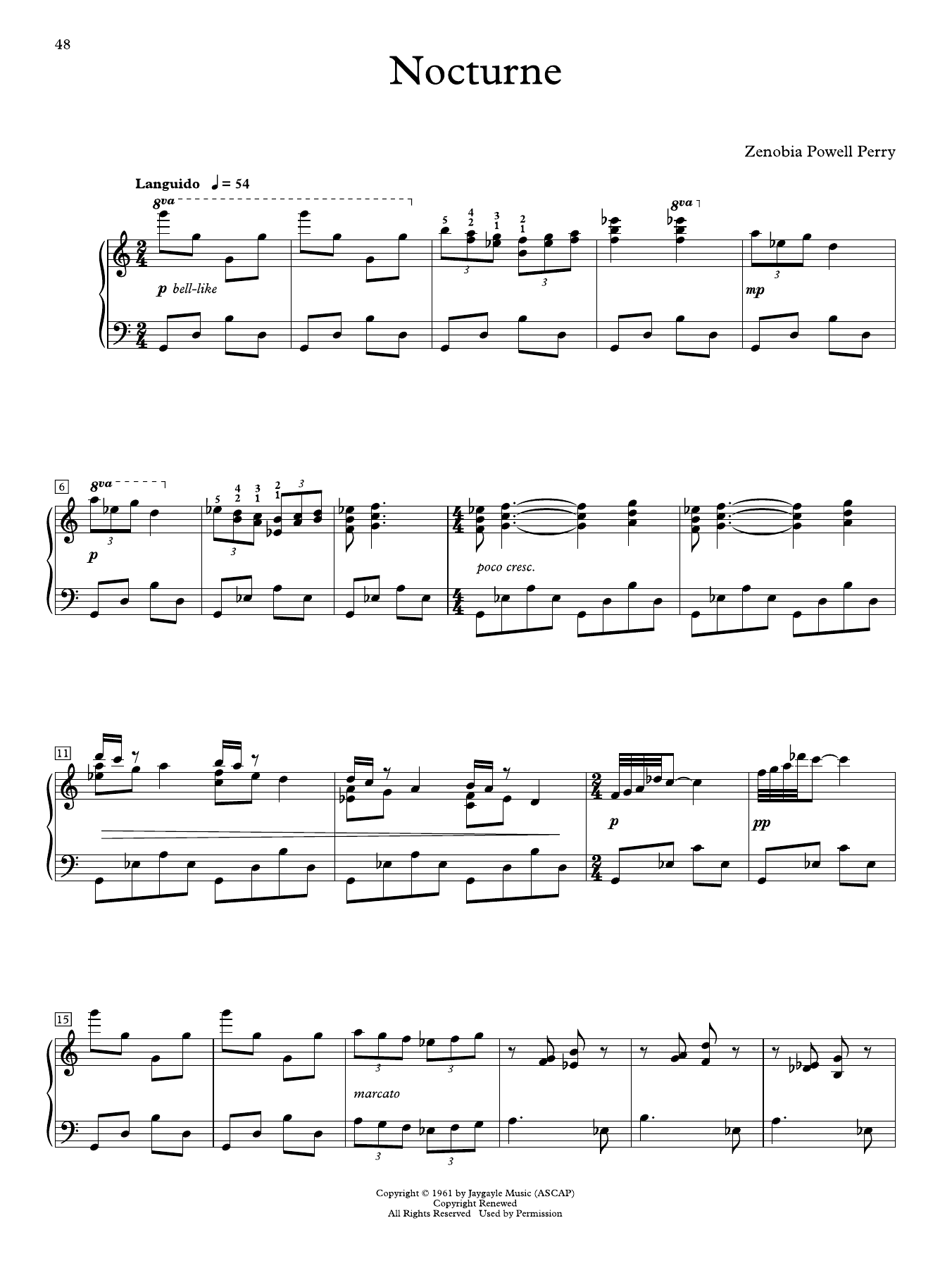
Perry's Nocturne brings an often-overlooked compositional voice into the standard educational piano repertoire. Rather than defaulting to European models, students encounter a work that expands their understanding of what the nocturne form can express. The piece's modest length and two-page span make it accessible without sacrificing musical substance.
What to expect
Intimate and contemplative, this nocturne creates a small but complete emotional space. The writing is lyrical without sentimentality, introspective in the way that invites the listener inward rather than demanding attention.
Who it's for
Late elementary to early intermediate pianists ready to explore repertoire beyond standard etude collections. Teachers seeking to diversify their students' exposure to classical forms and compositional voices will find this piece essential for broadening artistic perspective.
How to get the most out of it
Shape the opening melody with gentle phrasing, allowing slight rubato to breathe within the steady left-hand accompaniment. Perry's writing invites expressive freedom without melodrama.
Balance the right hand's lyrical line against the supporting harmonic foundation. Clarity in the middle voices prevents the texture from becoming muddy, which is crucial in intimate character pieces.
Pay attention to dynamic contrasts as they emerge. Even modest shifts from p to mp create shape and forward momentum across the two-page arc.
Listen for moments where the harmony shifts subtly. Perry often moves between related tonal areas without announcement, so harmonic awareness strengthens the piece's overall coherence.
How to use it
Pair this with other character pieces to build recital programs that move between different compositional traditions and eras. Students can perform it in a spring or fall studio class, or as part of a composer's exploration unit that celebrates underrepresented voices in classical music.
Skills your students will build
Sustaining a lyrical melodic line while maintaining independent left-hand accompaniment
Responding to subtle harmonic shifts within a single key area
Balancing multiple textural layers without losing clarity
Shaping short musical phrases with subtle dynamics rather than obvious gestures
Reading accidentals and chromatic movement within a conservative harmonic language
You May Also Like
Scan to Complete Your Purchase
Use your phone's camera to scan the code below
You'll log in on your phone and the order will be added to your account