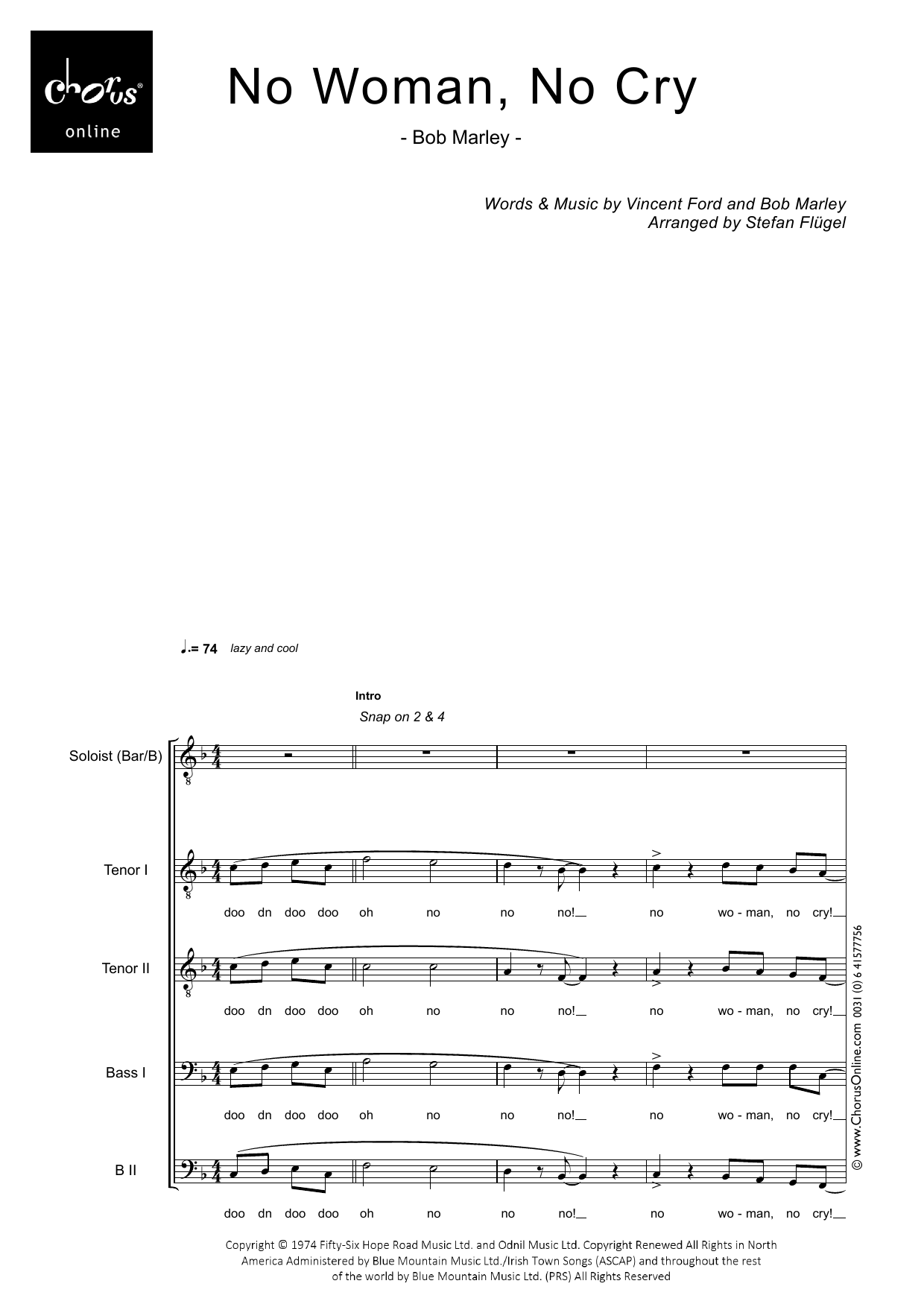
No Woman No Cry (arr. Stefan Flügel) Sheet Music Preview

No Woman No Cry (arr. Stefan Flügel): TTBB Choral Octavo

As performed by Bob Marley / Arranged by Stefan Flügel

Item: 35-DS00488422

Digital Download
$2.99
Description

No Woman No Cry (arr. Stefan Flügel): TTBB Choral Octavo isn't in MakeMusic Cloud just yet...but it could be. Let us know you'd like to see it, and you'll help shape what comes next. In the meantime, start a free trial and dive into thousands of interactive titles your students can play along with today.

Sample Audio
No sample audio found.
Sample Video
Additional Details
Publisher: Hal Leonard
Page Count: 13
SKU: 35-DS00488422

More about this title

About the Artist: Bob Marley

Bob Marley (1945–1981) transformed reggae from a regional Jamaican sound into a global movement, becoming one of the most influential songwriters of the twentieth century. His unflinching commitment to messages of peace, social justice, and spiritual resilience made him an enduring figure in popular music and a vital touchstone for understanding how popular song can carry profound meaning.

Why we love this

Stefan Flügel's arrangement opens this anthem to mixed voices without diluting its emotional core. The song's message of hope and community comfort feels especially powerful when sung by an ensemble, and the accessible four-part writing lets singers focus on the spirit of the piece rather than technical complexity.

What to expect

Warm, grounded, and deeply human. The four-part voices create space and intimacy at once, and the song's steady reggae pulse carries you forward without rushing. There is comfort in the melody and resolve in the harmony.

Who it's for

Choirs looking to expand their repertoire beyond traditional concert fare will find this arrangement both accessible and substantive. Groups performing secular settings, cultural programming, or concerts centered on social themes will connect with both the artistry and the message.

How to get the most out of it

  • Shape the phrases with breath rather than clipping syllables; the reggae feel depends on a relaxed, conversational rhythm that survives the transition to concert setting.
  • Balance the bass and tenor lines carefully in the verses so the harmonic foundation stays grounded while upper voices carry the melody.
  • Let the basses and tenors lock into a steady, understated groove; think of them anchoring rather than driving the rhythm.
  • Avoid over-shaping dynamic peaks; this song lives in the space between restraint and feeling, and subtlety will serve you better than intensity.

How to use it

Pair this with other global song traditions or spiritually resonant secular works to create a program that values voices beyond the European choral canon. It also serves as an excellent closer or encore piece, sending singers and listeners out with a message rooted in hope rather than bombast.

Skills your students will build

  • Singing with relaxed phrasing over a steady harmonic pulse
  • Balancing bass and tenor harmonic foundation in four-part writing
  • Understanding reggae rhythmic and harmonic language as a concert music genre
  • Connecting emotional meaning to vocal production and phrasing choices
  • Reading and performing a cappella mixed voicing across multiple ranges

You May Also Like