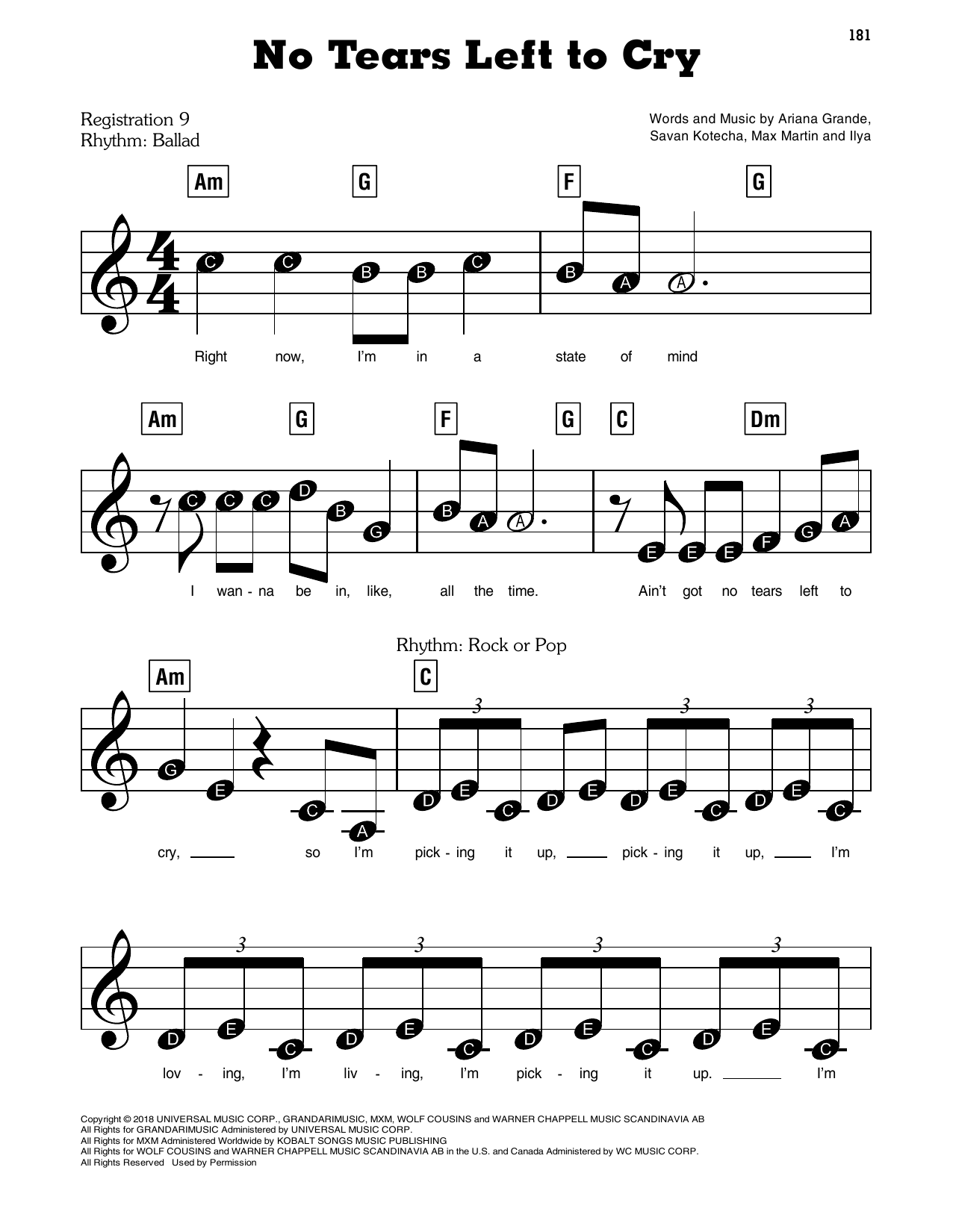
No Tears Left To Cry Sheet Music Preview

No Tears Left To Cry: E-Z Play Today

As performed by Ariana Grande

Item: 35-DS01122102

Digital Download
$4.99
Description

No Tears Left To Cry: E-Z Play Today isn't in MakeMusic Cloud just yet...but it could be. Let us know you'd like to see it, and you'll help shape what comes next. In the meantime, start a free trial and dive into thousands of interactive titles your students can play along with today.

Sample Audio
No sample audio found.
Sample Video
Additional Details
Publisher: Hal Leonard
Page Count: 7
SKU: 35-DS01122102

More about this title

About the Artist: Ariana Grande

Ariana Grande emerged as one of the defining pop voices of her generation, known for her four-octave range and distinctive whistle register. Her vocal control and interpretive maturity have made her music accessible to students across skill levels, from beginners exploring contemporary repertoire to advanced pianists studying modern pop arranging.

Why we love this

Students connect immediately with music they hear on streaming services and in their daily lives, and this Grande hit gives them legitimate repertoire that feels current and relevant. The E-Z Play arrangement distills the song's melodic core without sacrificing the emotional arc that makes the track resonate.

What to expect

The song carries an introspective quality, moving from vulnerability to quiet resilience. Musically, it unfolds with restraint, inviting the pianist to color the melody with careful dynamics and space rather than complexity.

Who it's for

This arrangement works well for early-intermediate piano students seeking modern material that builds confidence with contemporary idioms. It appeals equally to music teachers building a pop curriculum and to students preparing repertoire for recitals or informal performances.

How to get the most out of it

  • Pay attention to the vocal rhythm; Grande's phrasing often sits slightly behind the beat, creating a relaxed, contemporary feel that differs from classical interpretations of melody.
  • Balance the accompaniment texture so it supports rather than competes with the melody line, letting the piano serve the song's intimate moments.
  • Use the original recording as a reference for dynamics and tempo, which can guide your choices in sections where the chart provides flexibility.

How to use it

Consider pairing this with other pop standards to create a contemporary set within a mixed recital, or use it as a gateway piece to introduce students to arranging and interpretation of songs written in the last decade. It works particularly well for demonstrating how simplified notation can still convey the essential character of a modern hit.

Skills your students will build

  • Interpreting contemporary vocal phrasing in instrumental context
  • Managing rubato and flexible rhythm within notated accompaniment
  • Balancing melody and accompaniment texture in pop arranging
  • Reading simplified charts while maintaining musical intention

You May Also Like