
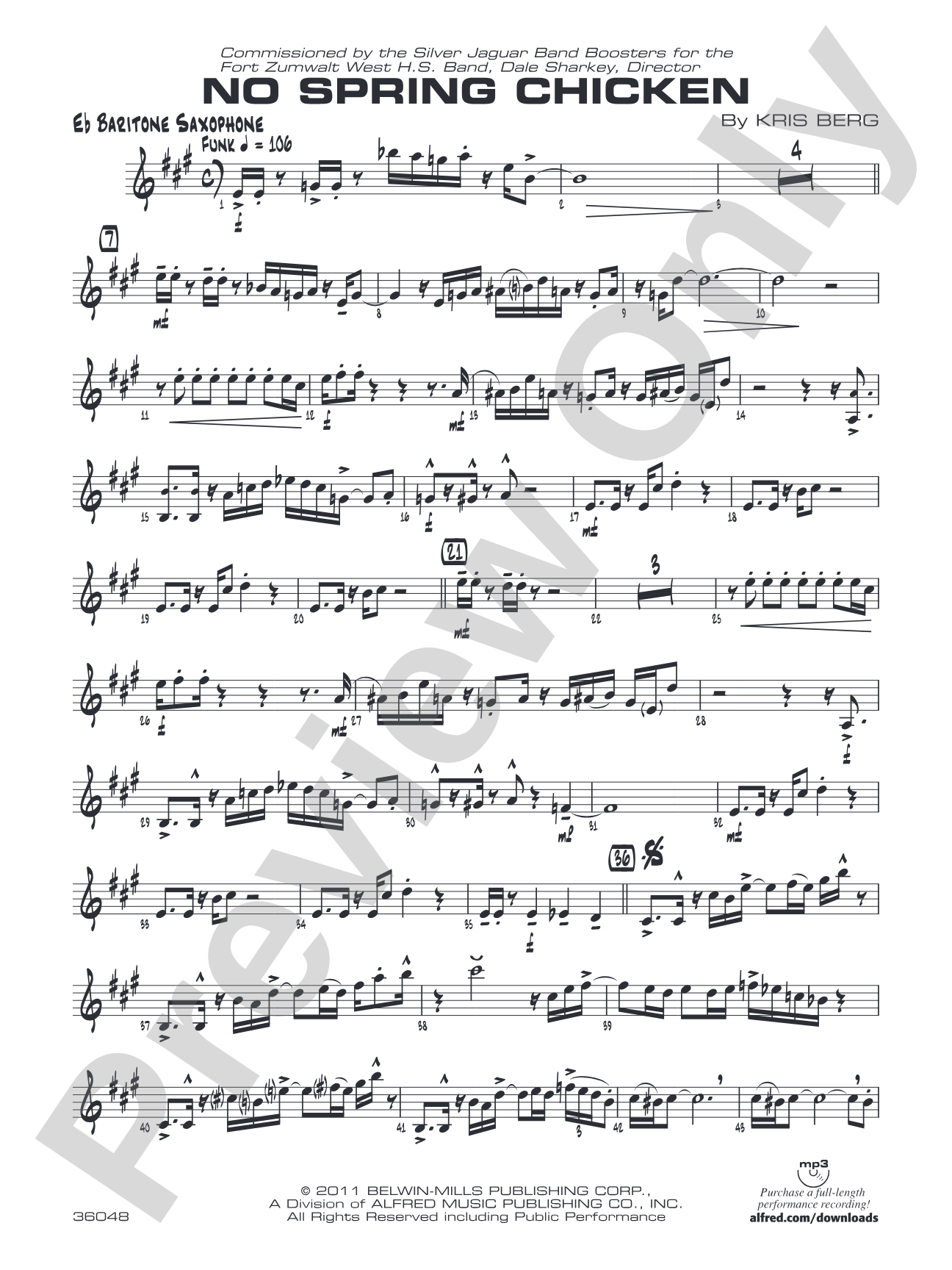

No Spring Chicken: E-flat Baritone Saxophone
By Kris Berg
Grade: 3 (Medium)
Item: 00-PC-0016695_BTX
$3.00
Pickup currently not available
Description
More chicken please! Kris Berg brings you another helping with "No Spring Chicken." The groove is totally funky, solos are written out for tenor and trumpet, lead trumpet range is to written B, the bass part is fun but not too difficult, and that's the meat of it. This title is available in MakeMusic Cloud.


Don't just read it, hear it, play along with it, and watch your students grow with it. In MakeMusic Cloud, No Spring Chicken: E-flat Baritone Saxophone comes alive with professional accompaniment, adjustable tempo, and built-in practice tools that turn solo practice into real progress.
Open in the Player
Jump straight in and assign it today.
Start Your Free Trial
Open this title and explore the full library in minutes.
Sample Audio
1
Audio File
--:--
0:00
0:00
Sample Video
No sample videos found.
Additional Details
Series:
Jazz Band Series
Publisher:
Alfred Music
Page Count:
94
SKU:
00-PC-0016695_BTX
More about this title
About the Composer: Kris Berg
Kris Berg leads the Jazz Studies program at Collin County Community College in Texas, where he earned both his bachelor's and master's degrees in jazz studies from the University of North Texas. His work as a composer and arranger has circulated internationally, with performances and recordings from ensembles around the world. Berg founded and directs both the Collin Jazz Fest and the Texas All-Star Jazz Camp, establishing himself as a significant voice in jazz education and festival programming.
As a best-selling composer and arranger for Belwin Jazz (Alfred Publishing), Berg has built a catalog of big band charts that serve educators and performers at all levels. He remains active as a clinician and artist for Yamaha Corporation of America, collaborating with major jazz voices including Kurt Elling, Randy Brecker, Peter Erskine, Bob Mintzer, and Clark Terry. Under his direction, Collin County's jazz ensembles have earned multiple invitations to perform at the Montreux Jazz Festival.
Why we love this
Berg writes with a clear understanding of what works in the rehearsal room and what lands on stage. The funky groove and written-out solos give students immediate musical material to sink into without overshooting their technical reach, while the accessible bass part invites players into active participation rather than keeping them on the sidelines. This is a piece that teaches ensemble cohesion through feel, not through complexity.
What to expect
The groove is direct and infectious, built on a foundation that swings hard but sits comfortably within reach. The written solos give horns a clear melodic statement rather than asking them to navigate open changes, while the overall vibe stays upbeat and fun without getting precious about the music.
Who it's for
Jazz ensembles at the intermediate level will find a solid piece that delivers a strong groove without demanding virtuosic solo chops or complex harmonic reading. Directors programming concert sets need a funky, audience-friendly selection that also teaches students how to anchor an ensemble sound. This works equally well for mixed or all-trumpet sections.
How to get the most out of it
- Lock the rhythm section (bass, drums, piano) early in rehearsals to establish the groove pocket; once they're locked, the horns will fall in naturally.
- Have the lead trumpet player work the upper register passages separately to build security around the written B; the part sits high but stays in a singable range.
- Emphasize the tenor and trumpet solos during sectionals so both players own their lines before full ensemble rehearsals; these are written opportunities, not improvisation challenges.
- Let the bass line breathe and swing independently rather than doubling it with other voices; Berg's bass writing is the foundation of the funk.
How to use it
Slot this into a concert as a mid-set energy lift or closer when you want the audience engaged and tapping along. It pairs well with straightforward blues-based or funk-rooted repertoire and gives students a break from more harmonically dense material without sacrificing musical substance.
Skills your students will build
- Locking into a funk groove and maintaining rhythmic precision across the ensemble
- Playing written solo lines with confidence and articulation
- Reading extended range on lead trumpet (up to written B)
- Supporting the ensemble as a bass player with an active, swinging part
- Balancing tight section work with individual voice in a jazz setting