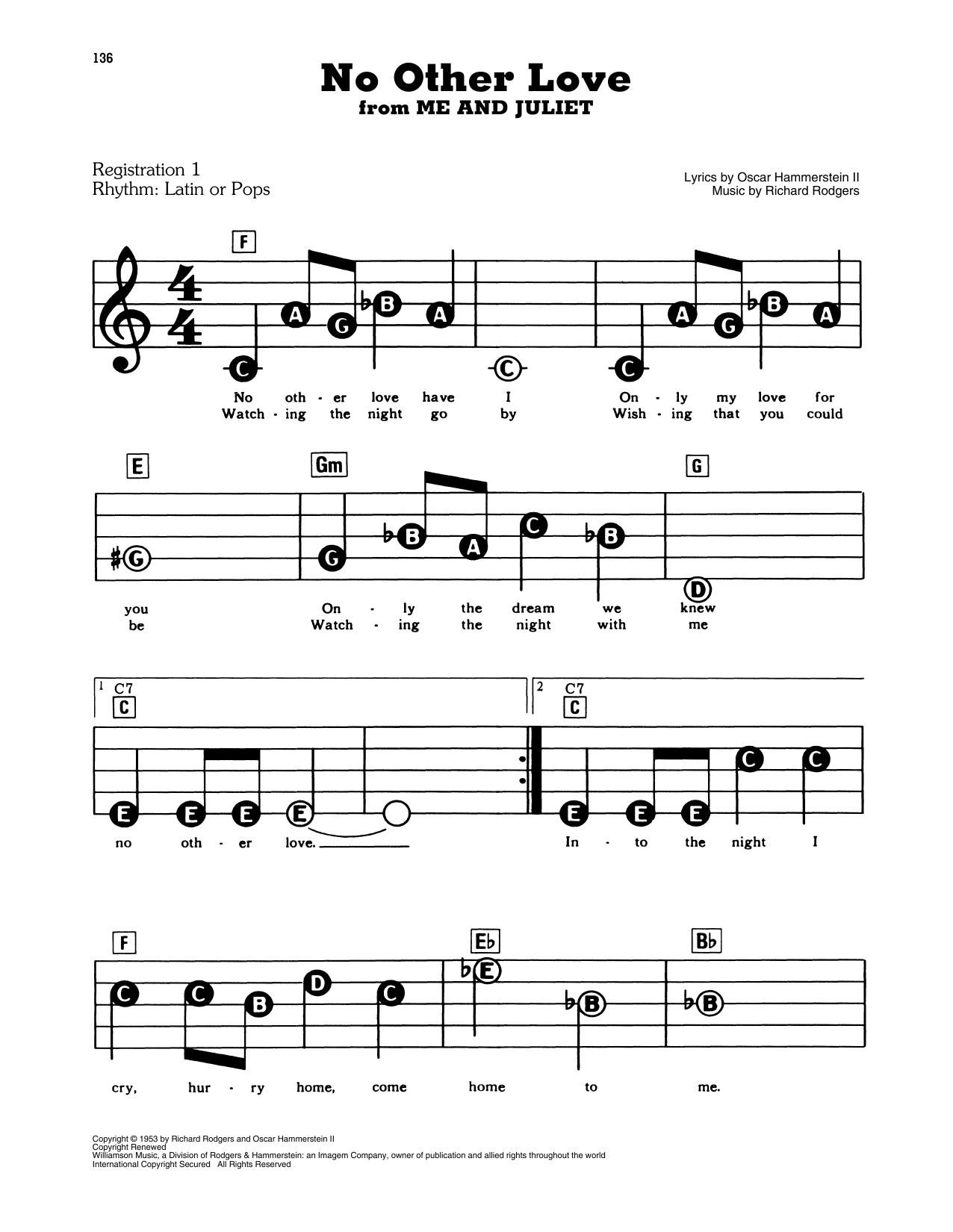
No Other Love (from Me And Juliet) Sheet Music Preview

No Other Love (from Me And Juliet): E-Z Play Today

By Rodgers & Hammerstein

Item: 35-DS00499468

Digital Download
$4.99
Description

No Other Love (from Me And Juliet): E-Z Play Today isn't in MakeMusic Cloud just yet...but it could be. Let us know you'd like to see it, and you'll help shape what comes next. In the meantime, start a free trial and dive into thousands of interactive titles your students can play along with today.

Sample Audio
No sample audio found.
Sample Video
Additional Details
Publisher: Hal Leonard
Page Count: 2
SKU: 35-DS00499468

More about this title

About the Composer: Rodgers & Hammerstein

Richard Rodgers and Oscar Hammerstein II redefined American musical theater by proving that sophisticated storytelling and complex emotions could coexist with accessible melodies. Their partnership produced some of the most performed songs in music education, from Oklahoma! to The Sound of Music, establishing a compositional language that values clarity of lyric, singability, and harmonic richness.

Their work remains central to teaching because it demonstrates how functional harmony, clear phrase structure, and memorable melody can serve dramatic purpose. Educators return to Rodgers and Hammerstein songs repeatedly because students respond to them; the writing makes sense on first hearing, yet reveals new layers with deeper study.

Why we love this

This arrangement captures the yearning simplicity of one of Broadway's most affecting love songs while remaining genuinely playable at intermediate levels. The E-Z Play format strips away unnecessary complexity without sacrificing the emotional arc of the piece, making it ideal for pianists who want to sound polished without excessive technical demands.

What to expect

Tender and direct. The song unfolds with the restraint of someone choosing words carefully, each phrase carrying quiet sincerity. There's an ache in the simplicity; the emotional weight comes not from technical display but from harmonic progression and the space between notes.

Who it's for

Intermediate pianists developing their ability to play through-composed melodies with consistent emotional direction, and accompanists preparing to support vocalists working through standard repertoire. Students transitioning from classical studies into jazz and popular styles will find this piece's harmonic language both familiar and slightly expanded.

How to get the most out of it

  • Shape the melody with slight rubato in the opening phrases to emphasize the vulnerability in the lyric, then settle into a steadier tempo once the accompaniment establishes its rhythm.
  • Keep the left hand accompaniment transparent; these figures should support rather than compete with the vocal line if this is played as an accompaniment.
  • Listen for the harmonic movement under the longer note values, allowing subtle dynamic shifts to highlight Rodgers' characteristic use of secondary dominants.

How to use it

Pair this with other mid-century Broadway selections to create a focused recital segment, or use it as a vehicle for exploring how piano accompaniment shapes vocal interpretation in musical theater. It also works well in jazz history units that trace popular song forms through the American songbook.

Skills your students will build

  • Playing sustained melodic lines over steady harmonic accompaniment
  • Interpreting jazz voicings within a tonal framework
  • Maintaining consistent tempo while allowing expressive phrasing in the melody
  • Reading and executing lead sheet style arrangements

You May Also Like